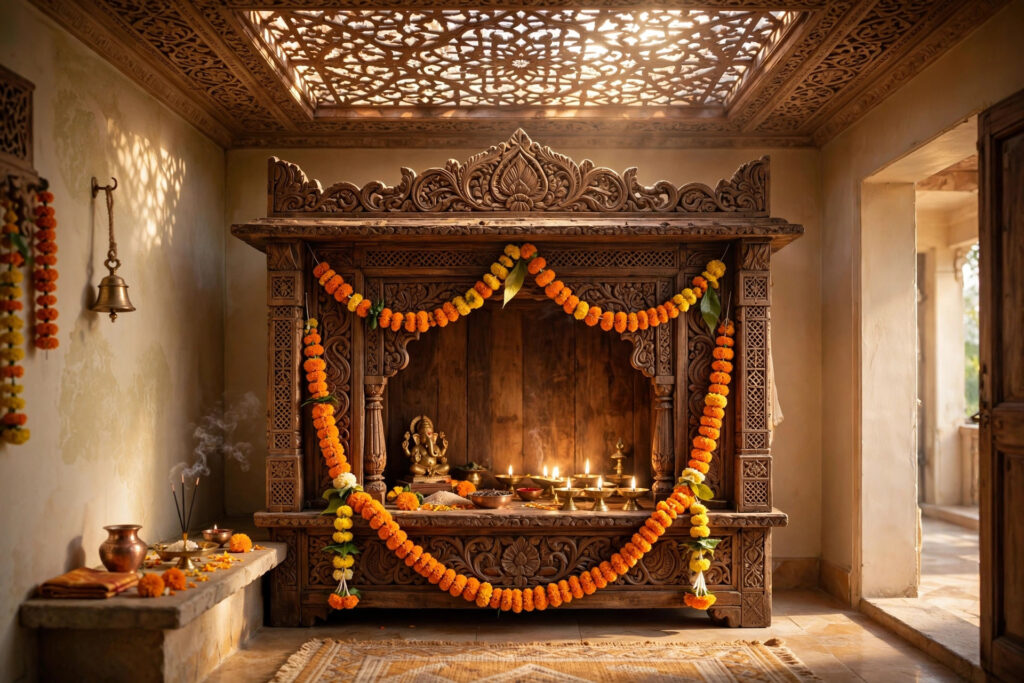

A pooja room ceiling does two jobs at once: it honours the sacred, and it survives the ritual. Diyas throw heat and soot upward, incense smoke drifts into every corner, and the room still needs to feel calm and radiant at six in the morning. That is why a pooja room false ceiling design starts from reverence and practicality together — warm light that flatters the idols, traditional motifs that feel rooted, and surfaces that can be wiped clean after a year of daily aarti. This guide covers the pooja-specific decisions — 7 traditional designs, motifs, Vastu-informed planning, diya safety, lighting, small corners and maintenance — so your mandir ceiling stays beautiful through years of daily worship.
For planning the ceilings of every room together, see our complete false ceiling design guide.
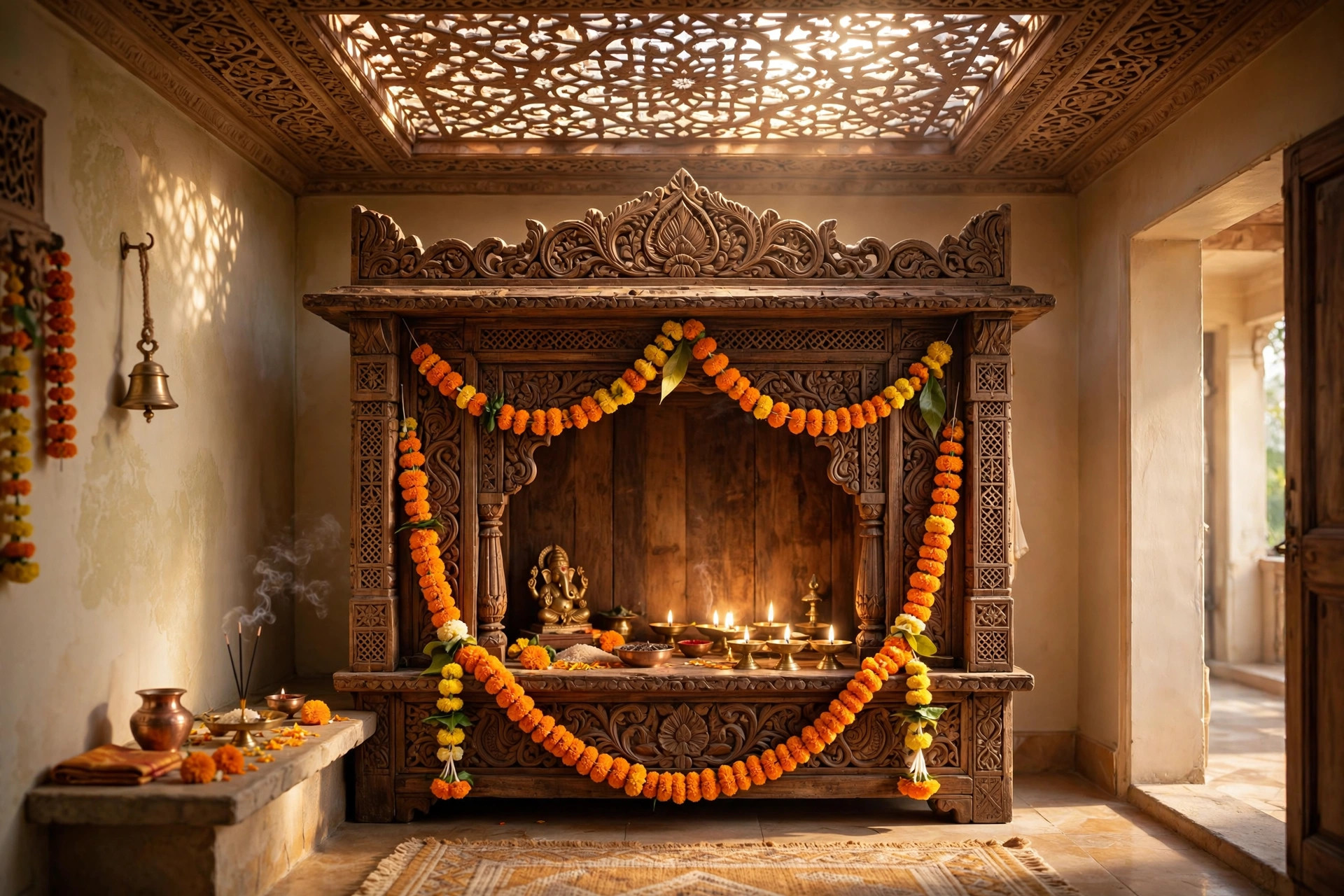
What makes a pooja room ceiling different
Every room’s ceiling answers to how the room is used. The pooja room’s demands are unique:
- Ritual heat and smoke: open diya flames and incense sticks send heat, soot and oily residue straight up, every single day. The ceiling finish must tolerate that.
- Reverence, not decoration: motifs, symmetry and warm light matter more here than in any other room — the ceiling frames the divine.
- Small rooms, big feeling: most pooja rooms are compact. The ceiling must add grandeur without stealing headroom.
- Daily, twice-daily use: this ceiling is looked at during every prayer. Details that look fine once a month become irritants when seen twice a day.
Planning with Vastu in mind
Vastu guidance for pooja rooms is widely published by Indian designers, and it does touch the ceiling. Treat it as design input from tradition, not engineering — and note that sources do not always agree.
- Direction: the northeast (Ishaan) is described as the most auspicious placement, with east and north acceptable; south and southwest placements are discouraged (Suntew Interior Designers; ZAD Interiors; Astroyogi, retrieved September 2026).
- Ceiling shape: a stepped pyramidal or gopuram-like profile is described as the traditional ideal, adapted in apartments as a stepped tray in the false ceiling (Suntew, retrieved September 2026).
- An honest conflict: one Vastu guide says the pooja room should have a low ceiling to aid meditation (ZAD Interiors), while another says to keep it slightly higher than other rooms (Astroyogi) — both retrieved September 2026. The practical middle path: in apartments, use a shallow stepped tray (40–60 mm profile) that nods to the pyramidal form without lowering headroom uncomfortably.
- Above the deity: avoid heavy beams directly above the idol; keep the zone over the murti visually light (designer guidance noted in Coohom’s pooja FAQ, retrieved September 2026).
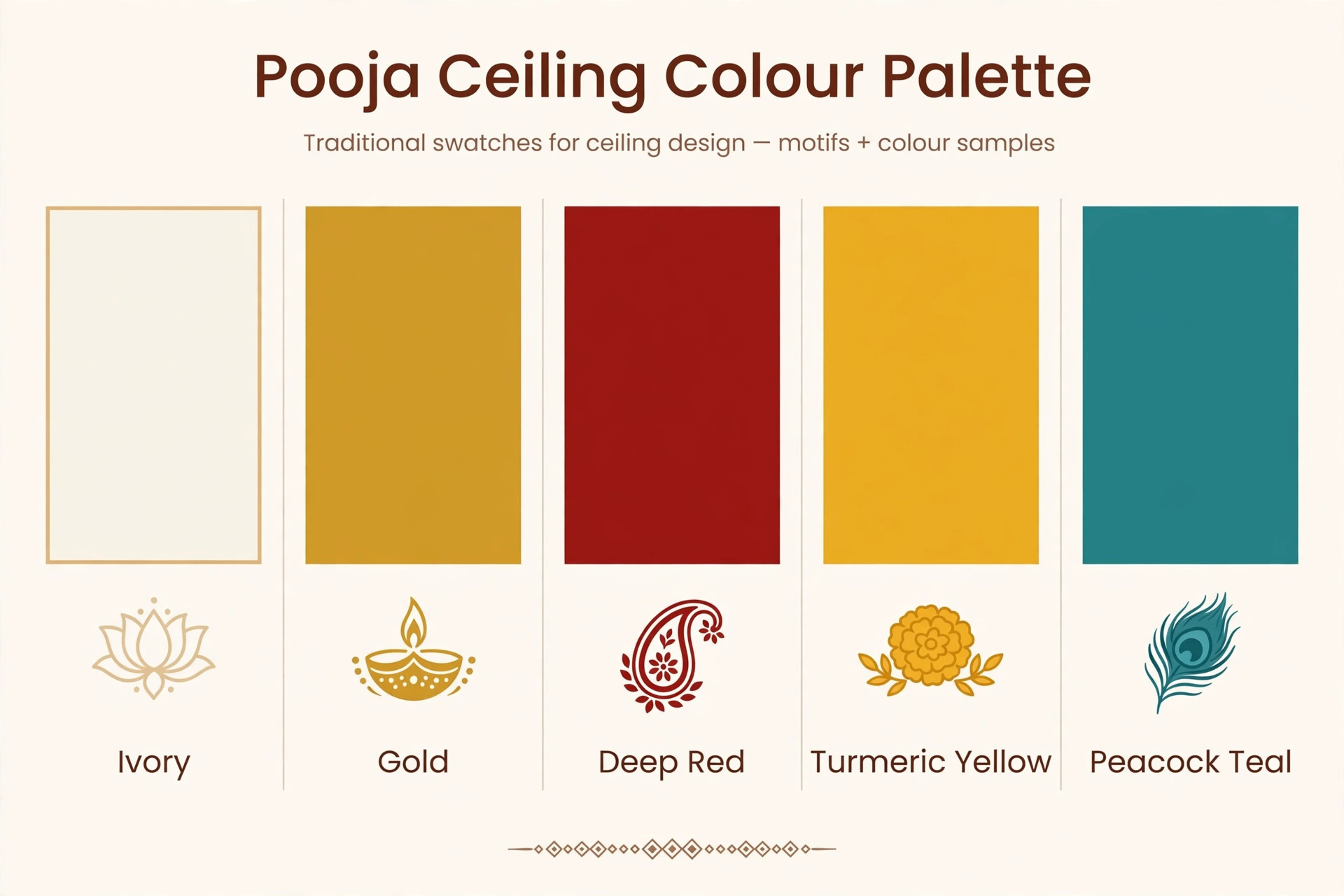
- Colours: white, cream, light yellow and light blue recur across Vastu sources; dark, heavy colours are discouraged (Suntew; ZAD Interiors; Astroyogi, retrieved September 2026).
Materials for a pooja room false ceiling
- Gypsum: the most versatile base — easy to shape into trays, domes and medallions, and described as fire-resistant in pooja-ceiling guidance (Coohom, retrieved September 2026). The default for most designs below.
- POP: best for cornices, medallions and fine ornamental detail around the tray edges.
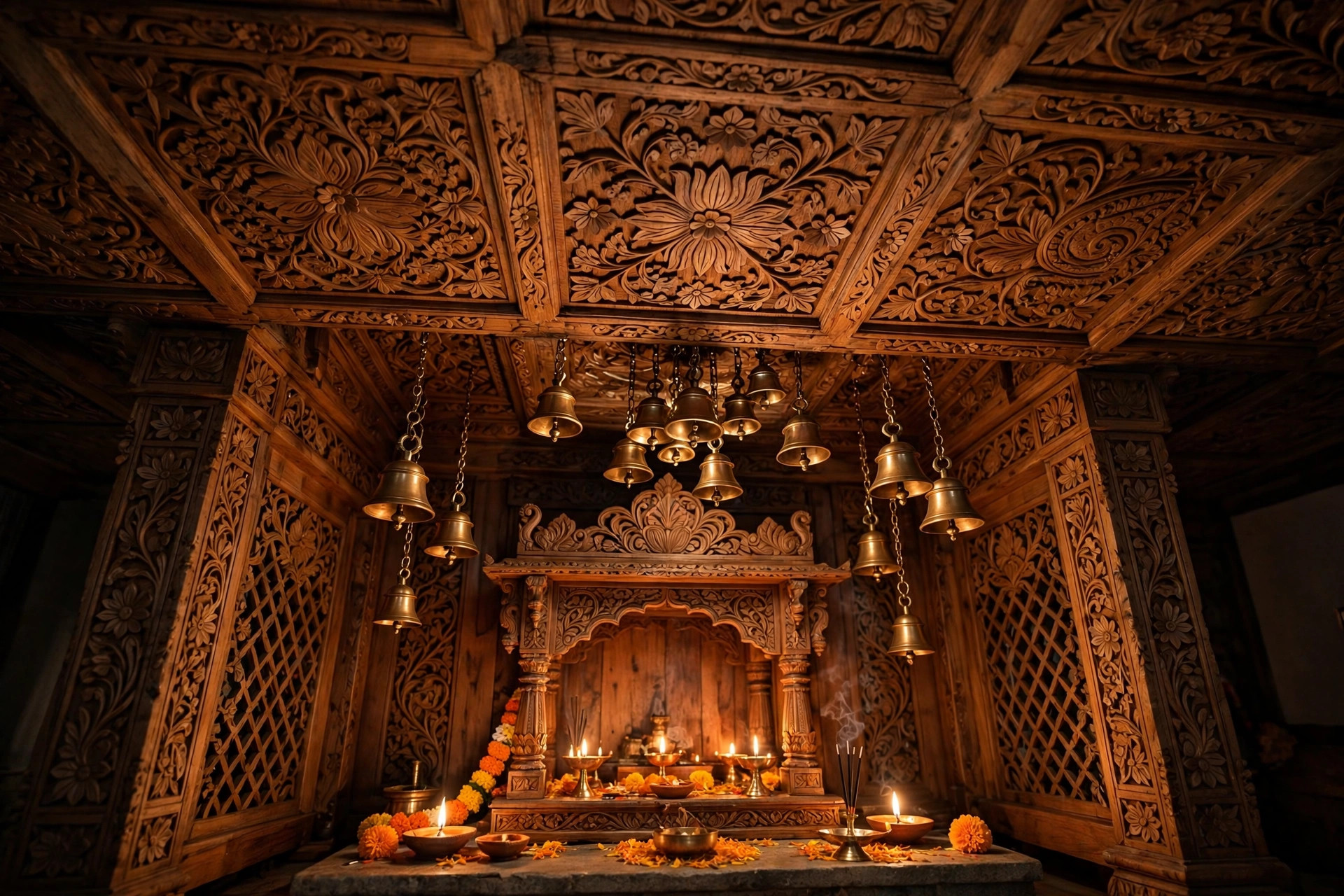
- Wood / teak: the most traditional choice, especially in South Indian homes (Suntew, retrieved September 2026). Use treated wood or veneer in high-smoke areas — it cleans far more easily than raw timber (Coohom, retrieved September 2026).
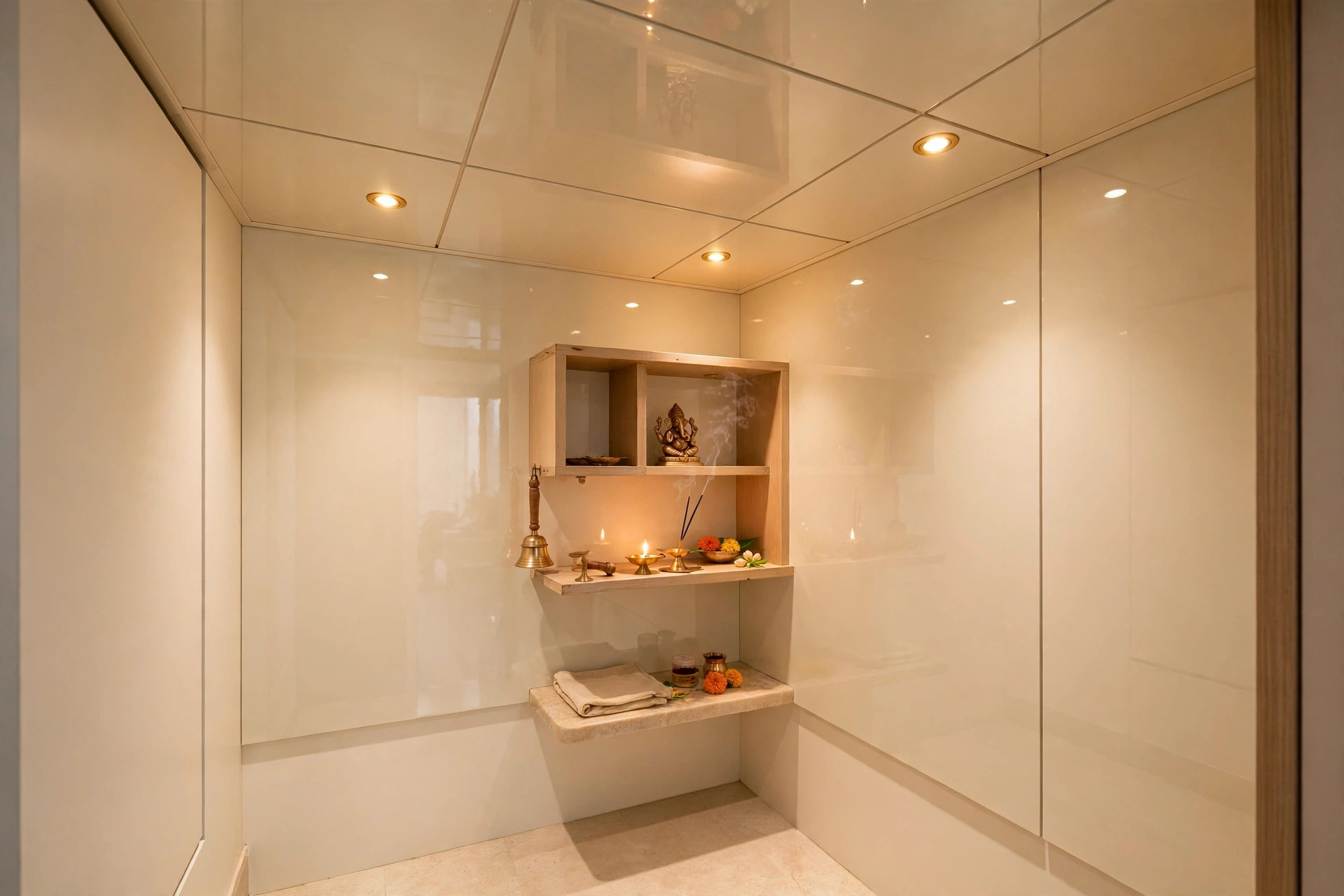
- PVC panels: a practical pick for compact pooja corners — glossy, wipeable and budget-friendly, though less traditional in feel.
- Laser-cut MDF / jaali sheets: the budget route to lattice effects with backlighting; keep away from moisture and direct flame heat (Coohom, retrieved September 2026).
7 traditional pooja room false ceiling designs
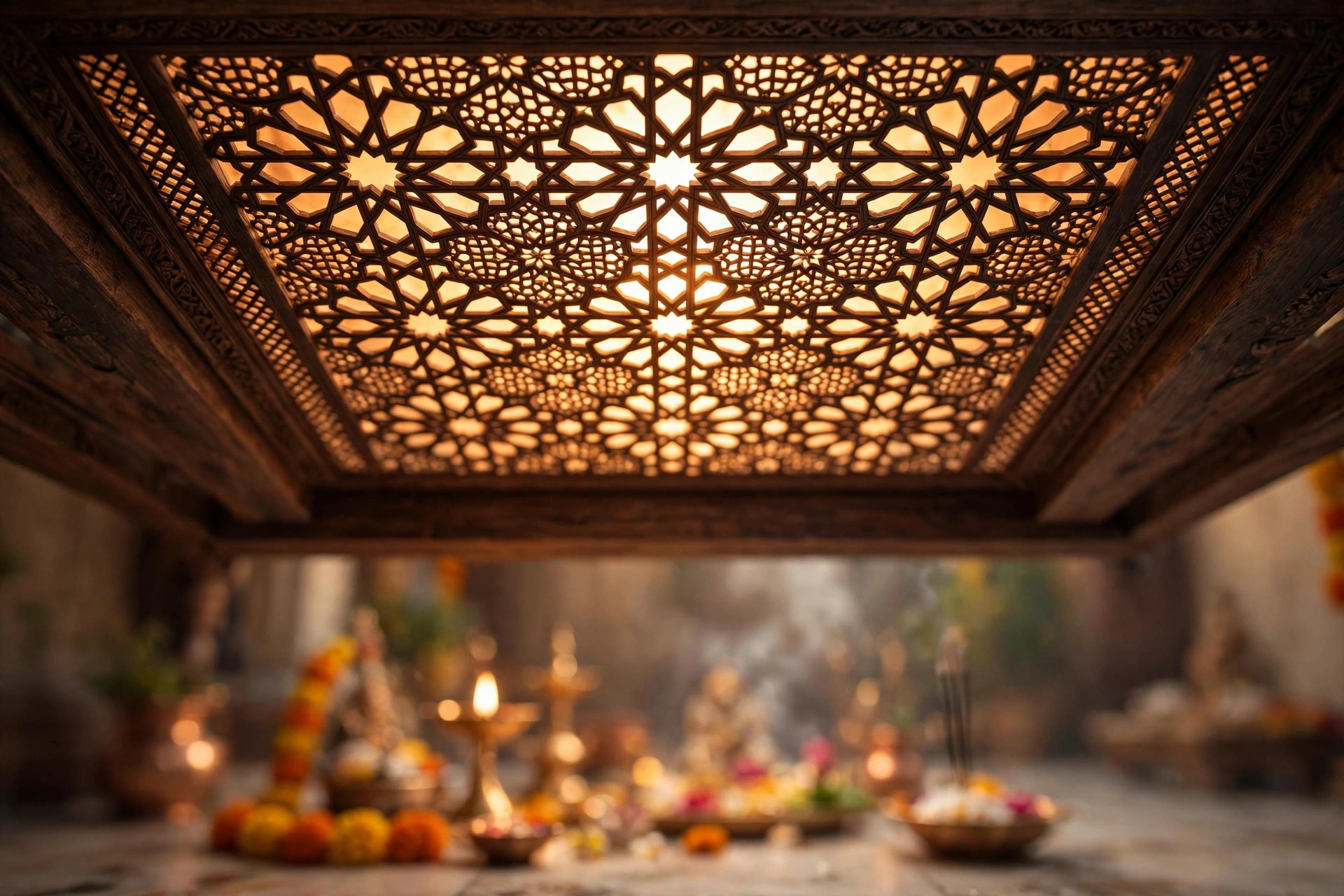
1. Backlit jali panel — the classic
A lattice (jali) panel set into the ceiling with warm light glowing through the pattern. The lattice should be dense enough to diffuse the light but open enough to ventilate heat rising from diyas (Coohom pooja guidance, retrieved September 2026). Works in teak, laser-cut wood or MDF.
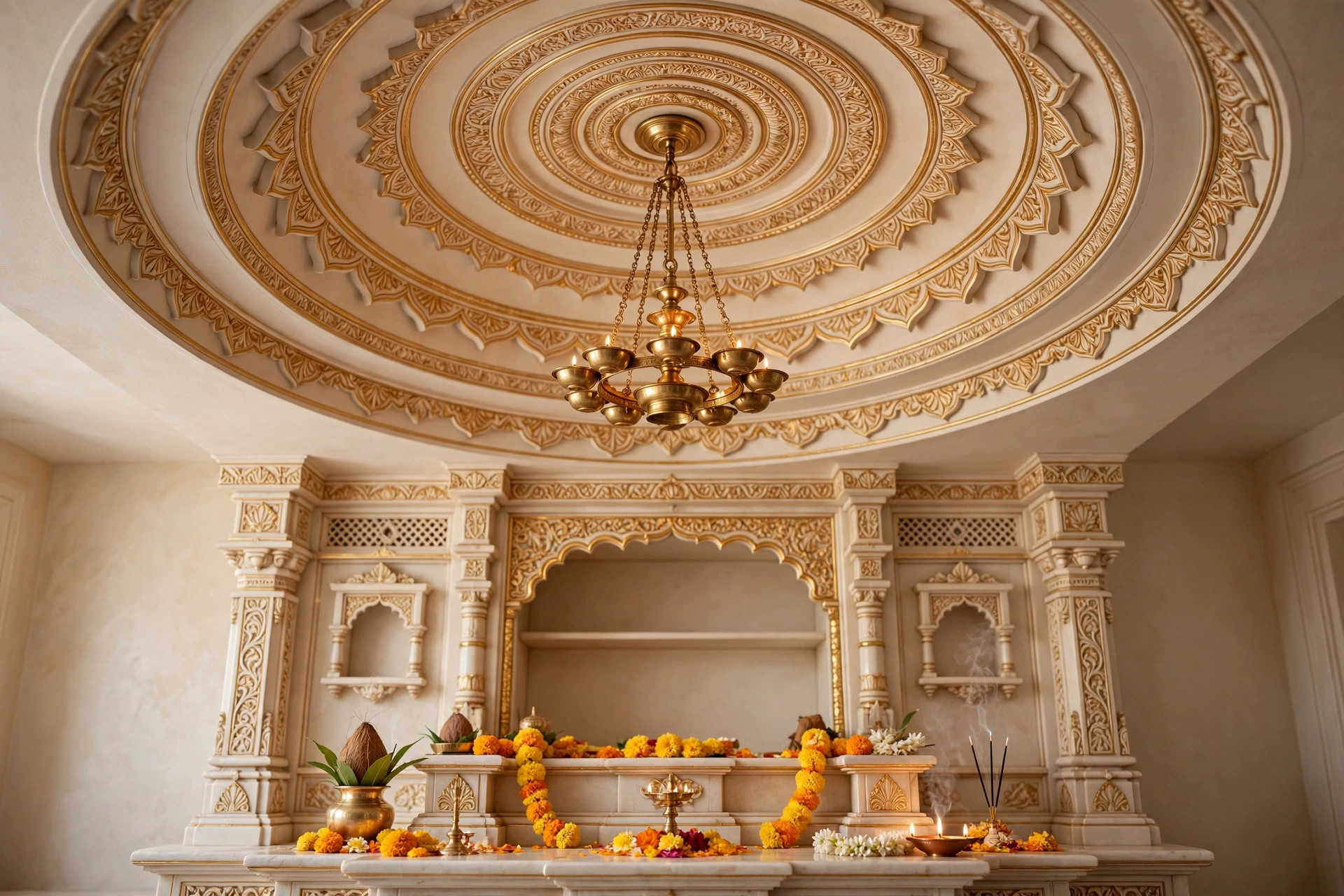
2. Shallow dome over the mandir
A gentle dome or lotus-medallion dome centred over the idol, echoing temple architecture. Keep the profile shallow (40–60 mm) in apartments so headroom survives. A central hanging brass diya-style lamp completes it.
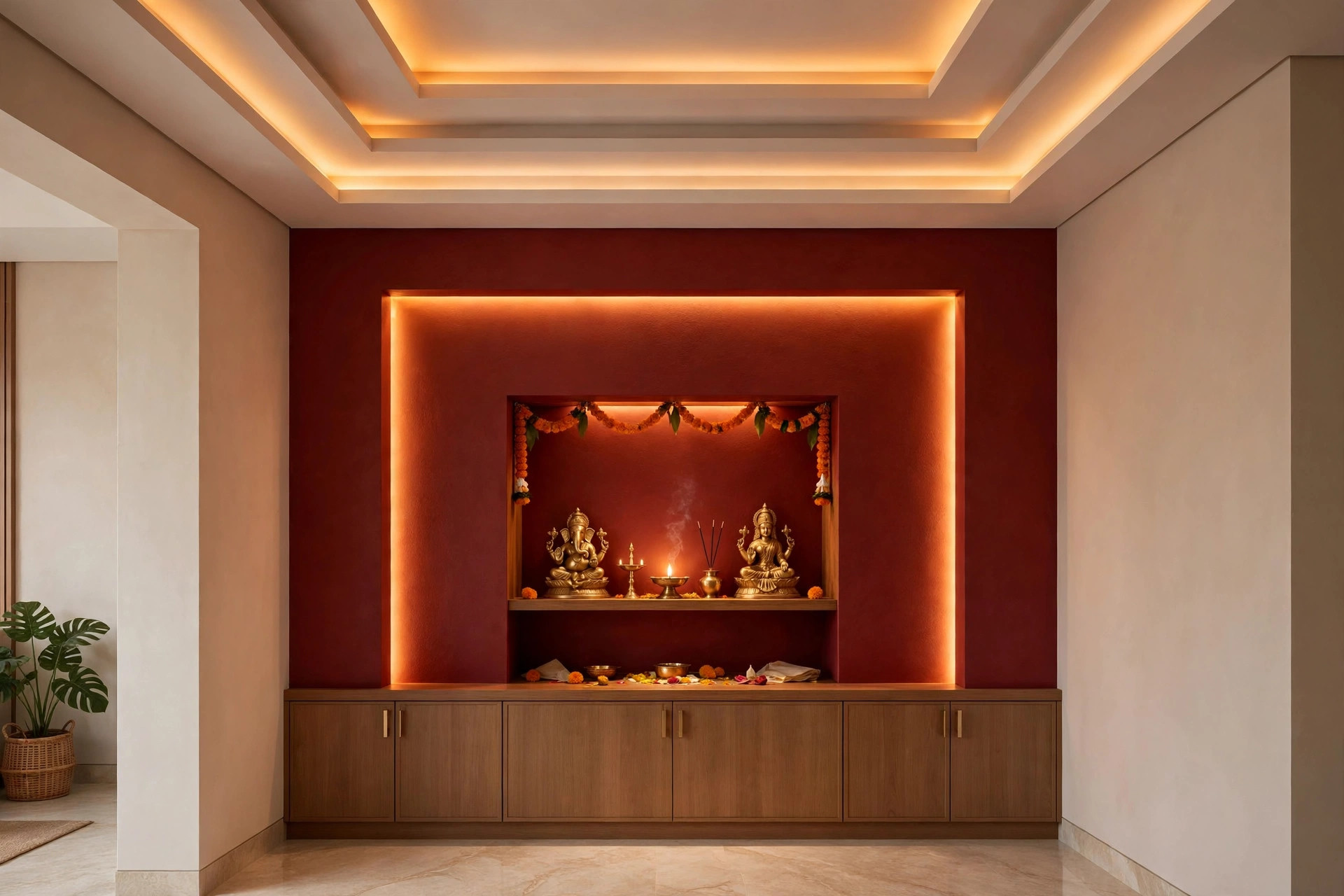
3. Stepped tray with warm cove
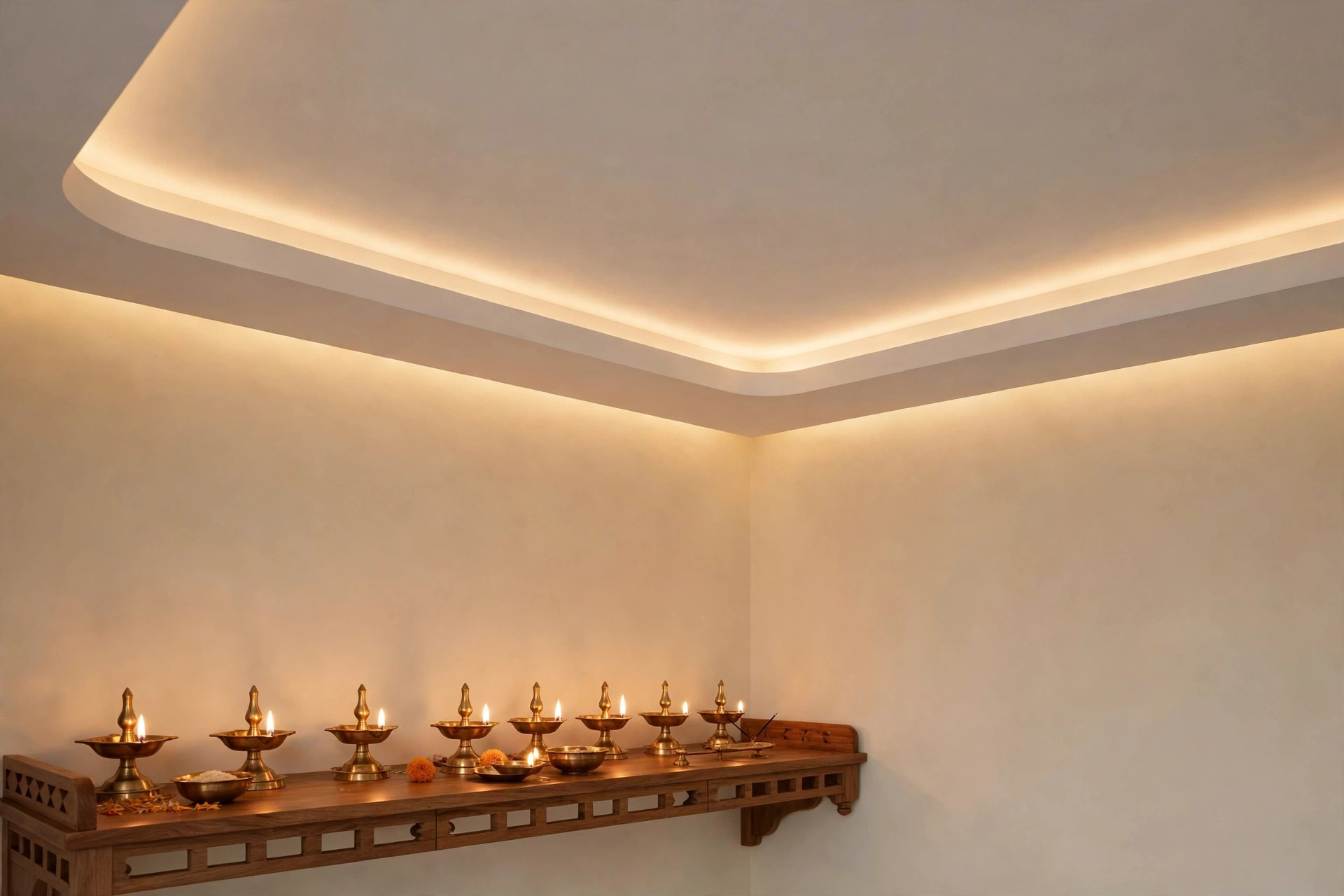
A stepped tray — the apartment-friendly nod to the pyramidal Vastu ideal — with hidden warm LED strips in the step. The cove washes the ceiling in amber while the centre stays clean and bright over the idols.
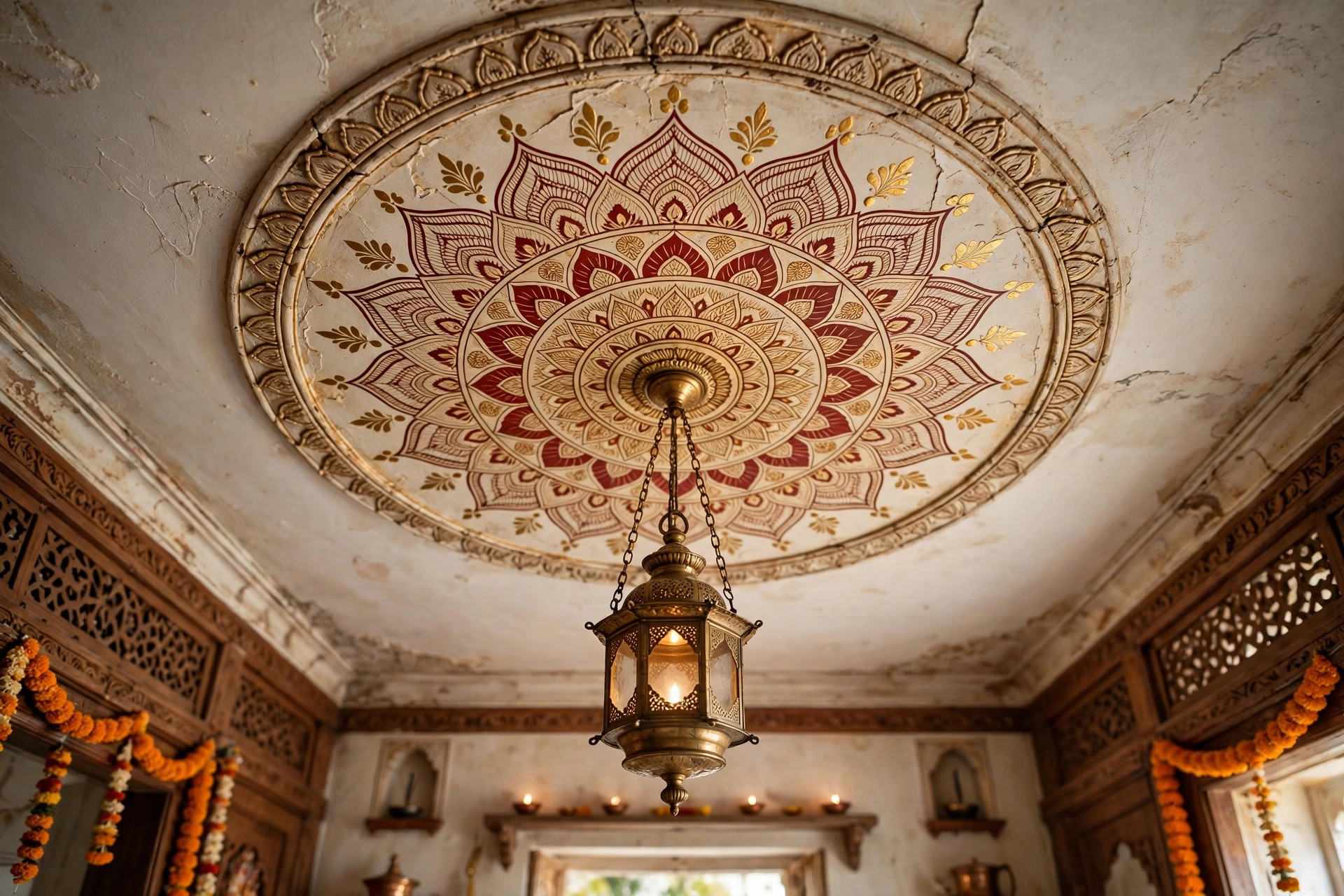
4. Mandala medallion
A hand-painted or POP-moulded mandala radiating from a central ceiling rose, in gold and deep red. The medallion anchors a hanging brass lamp and gives the room a finished, ceremonial centre.
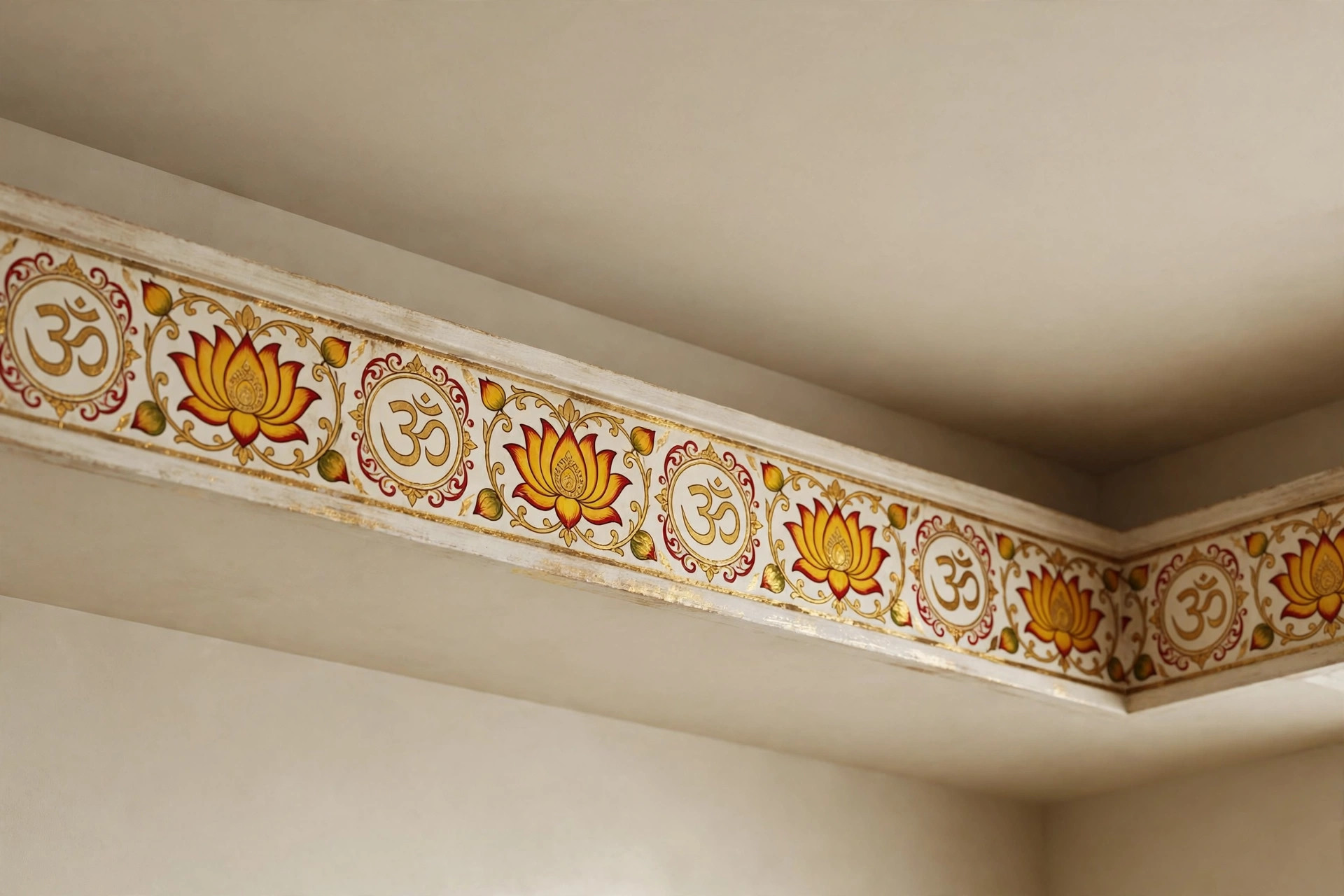
5. Auspicious motif border
Om, lotus and swastik motifs painted or inlaid along the tray edge or border band. These are traditional auspicious symbols in Hindu homes; keep the band shallow and the palette to ivory, gold and turmeric yellow so it reads as sacred, not busy.
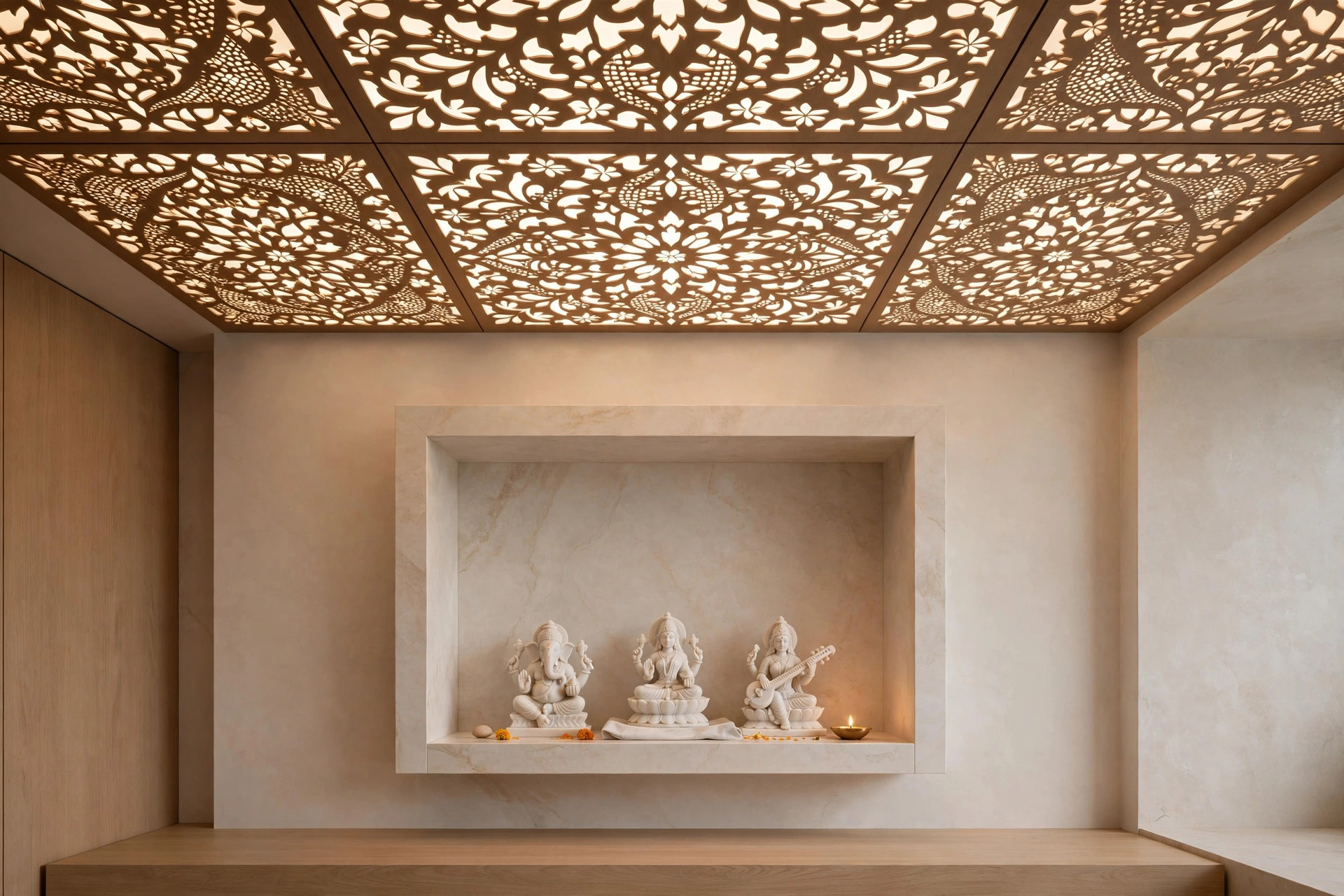
6. Modern backlit jaali
For contemporary homes: a laser-cut jaali panel backed with opal acrylic, washed by LEDs. Same traditional grammar as design 1, but crisper and more minimal — it suits marble idols and clean-lined mandirs.
7. Minimal flat with focused spots
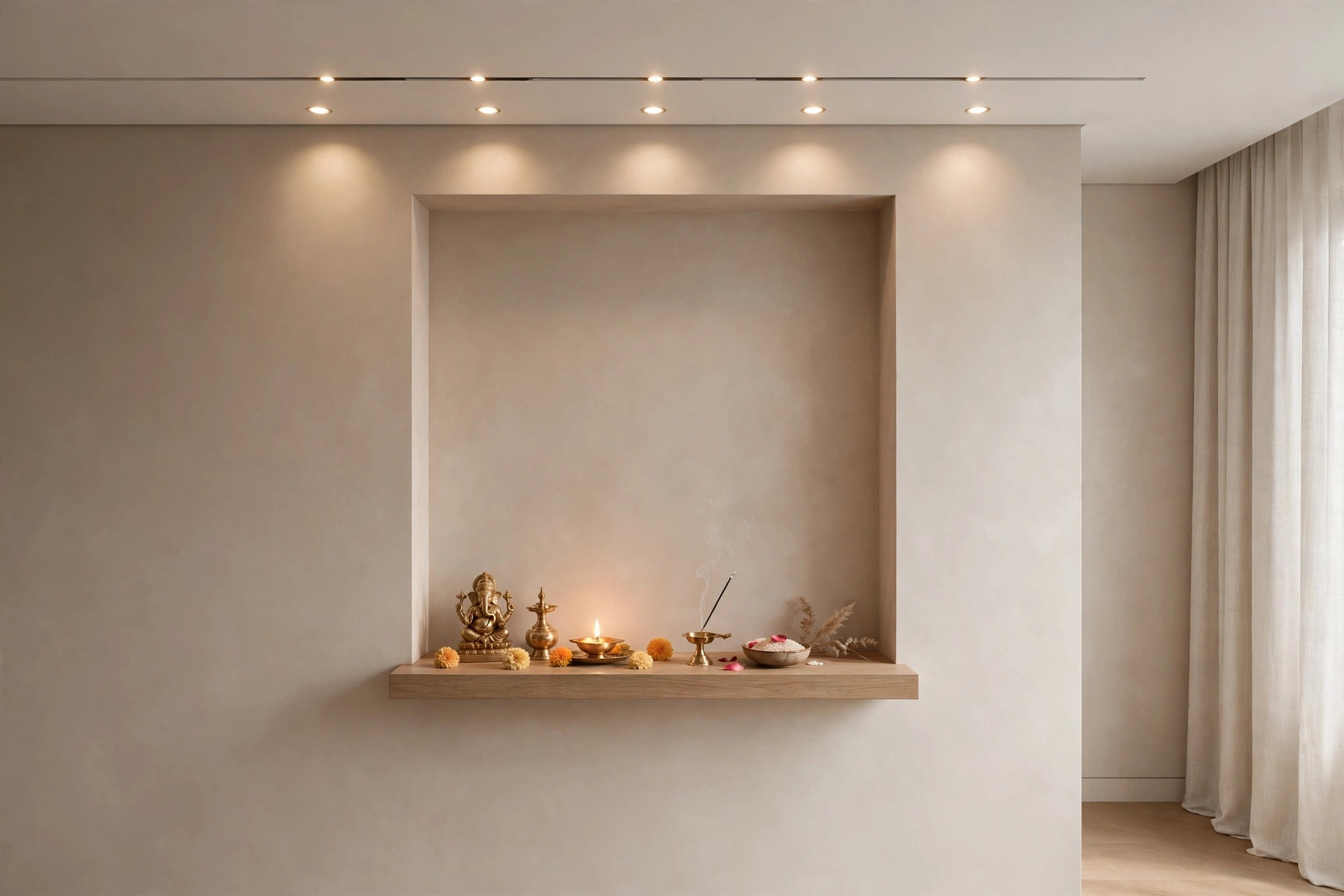
When the mandir itself is ornate, the ceiling can stay quiet: one flat layer, a single row of warm recessed spots aimed at the idols. Restraint is also traditional — it lets the murti hold the room.
Motifs: where to place them
Motifs carry meaning, so placement matters more than quantity:
- Centre: mandala or lotus medallion, centred over the idol — one focal motif, not three.
- Borders: Om, swastik and floral bands belong on tray edges and border strips, framing rather than competing.
- Jaali fields: geometric and floral lattice across backlit panels; keep the pattern open enough to ventilate diya heat (Coohom, retrieved September 2026).
- Restraint rule: one hero motif per ceiling. A mandala and a border and a dome reads as clutter in a small room.
Lighting: keep it warm and focused
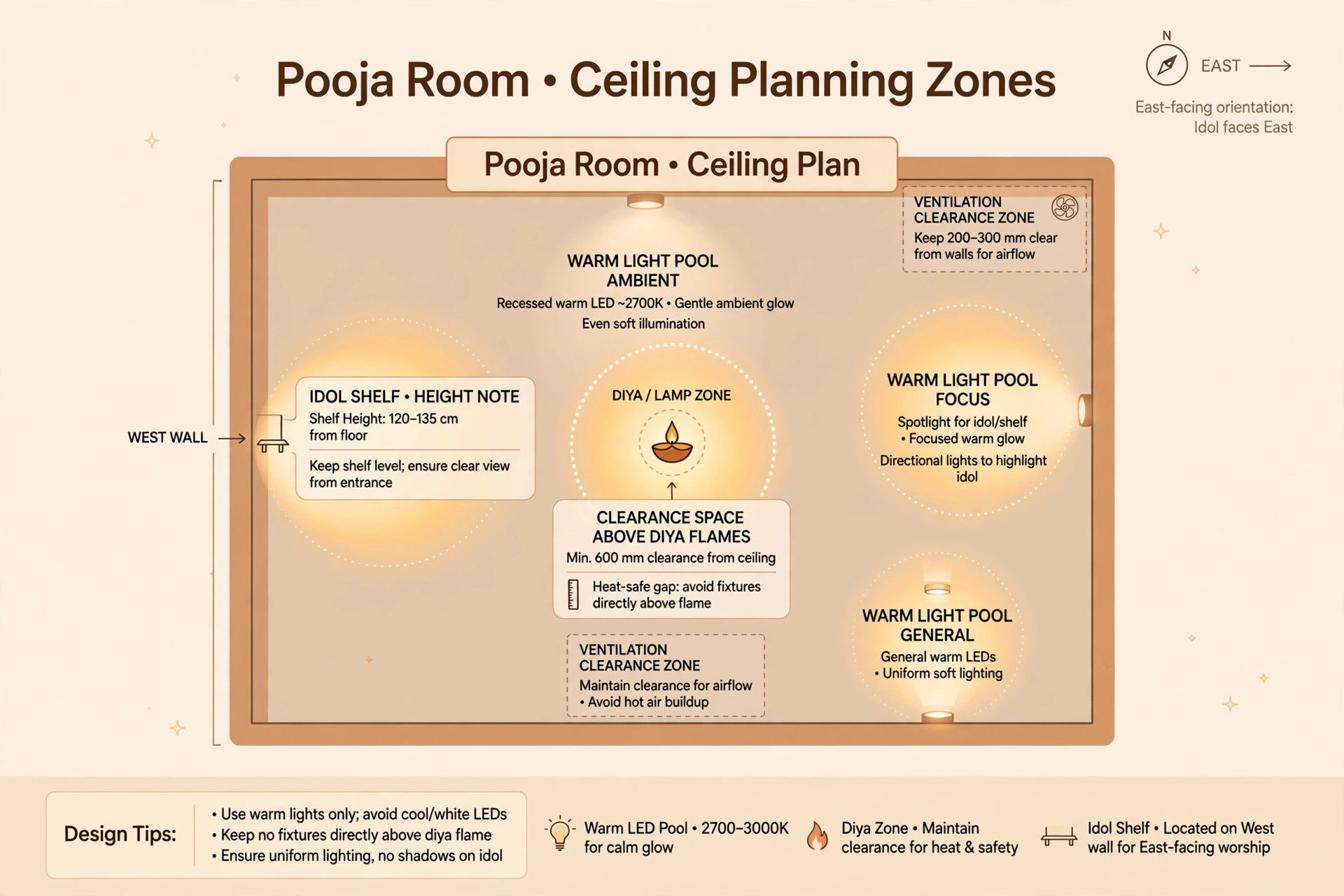
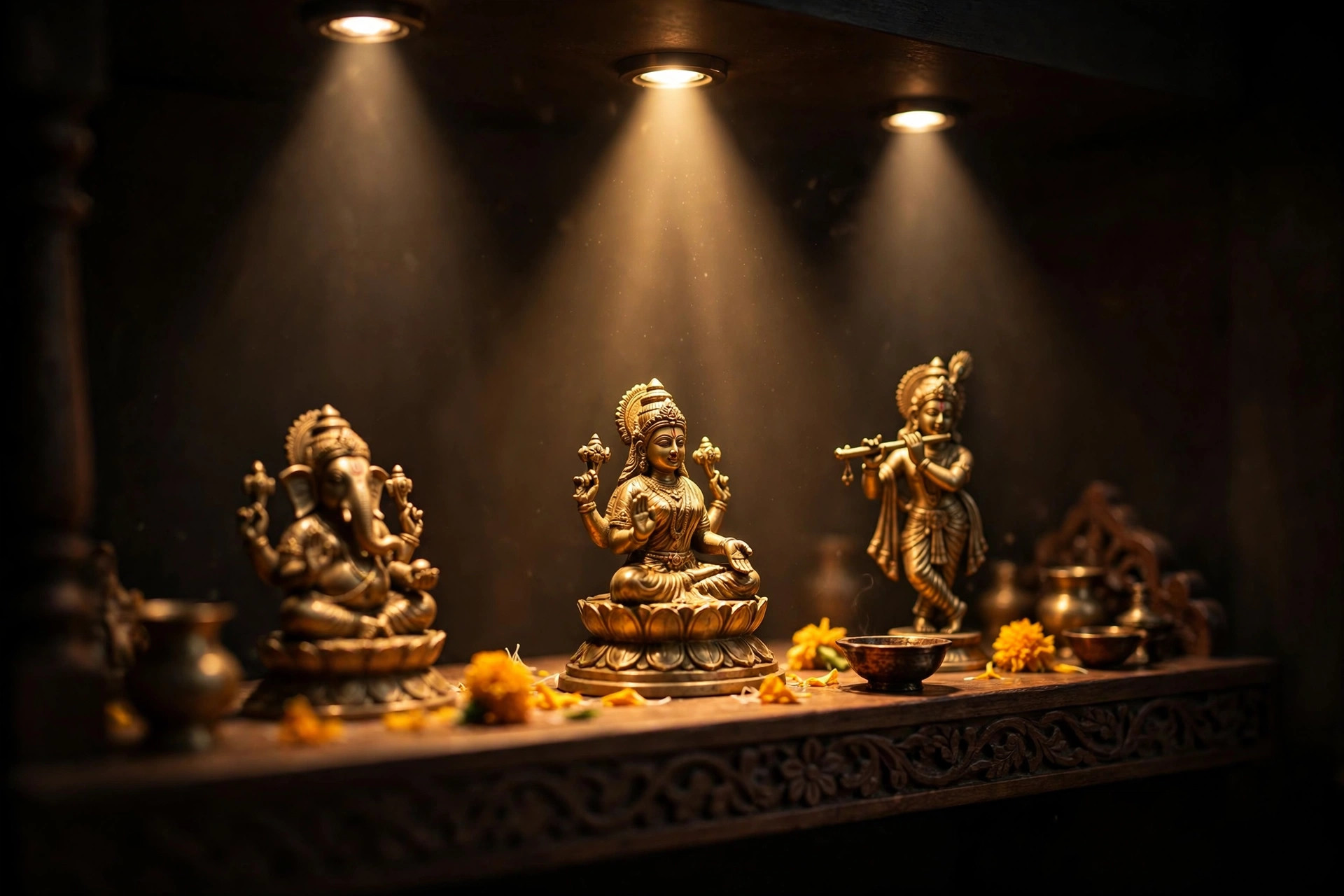
Pooja lighting guidance is unusually consistent: warm white wins. One Indian designer guide specifies 2700K warm-white focus lights — explicitly “not 4000K,” calling the warmer tone more appropriate for a sacred space (Suntew, retrieved September 2026). Pooja-ceiling FAQs suggest 2700–3000K with dimmable ambient light around 100–200 lux and a brighter highlight on the deity (Coohom, retrieved September 2026).
- Idol focus: 2–3 small warm spotlights aimed at the murti — this is the room’s visual anchor.
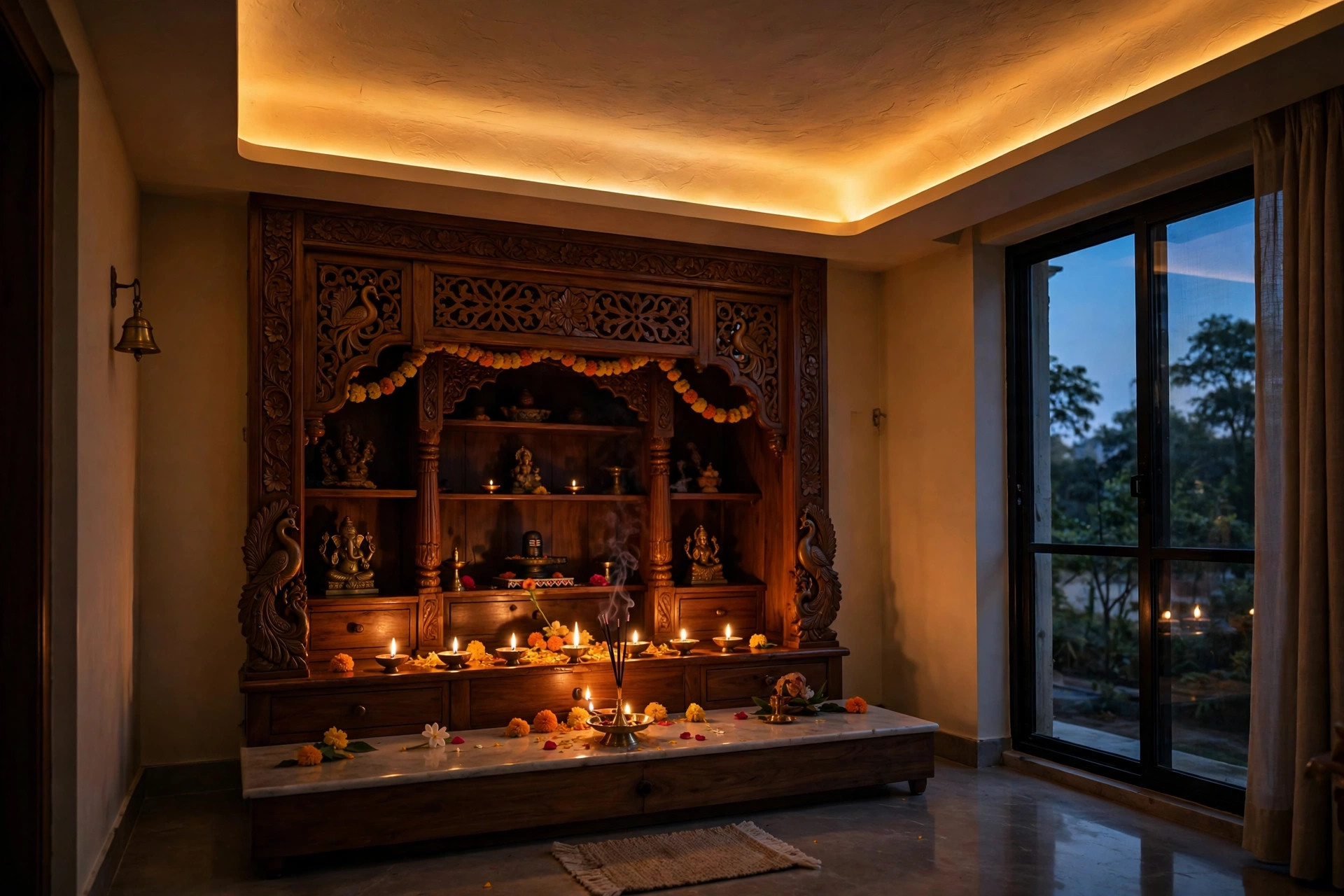
- Cove glow: hidden LED strips in trays and behind jaali panels for the halo effect over the deities (Coohom, retrieved September 2026).
- Dimmers: morning aarti wants full glow; evening prayer suits a softer level. Dimmable warm-white LEDs cover both.
- Avoid: cool white (4000K+) overheads — they flatten the warmth the room is built around.
All ceiling lighting wiring must be done by a qualified electrician.
Diya and incense safety: the non-negotiable section
No ranking page covers this in depth, so here is the honest, hedged version — what sources actually say, plus plain common sense:
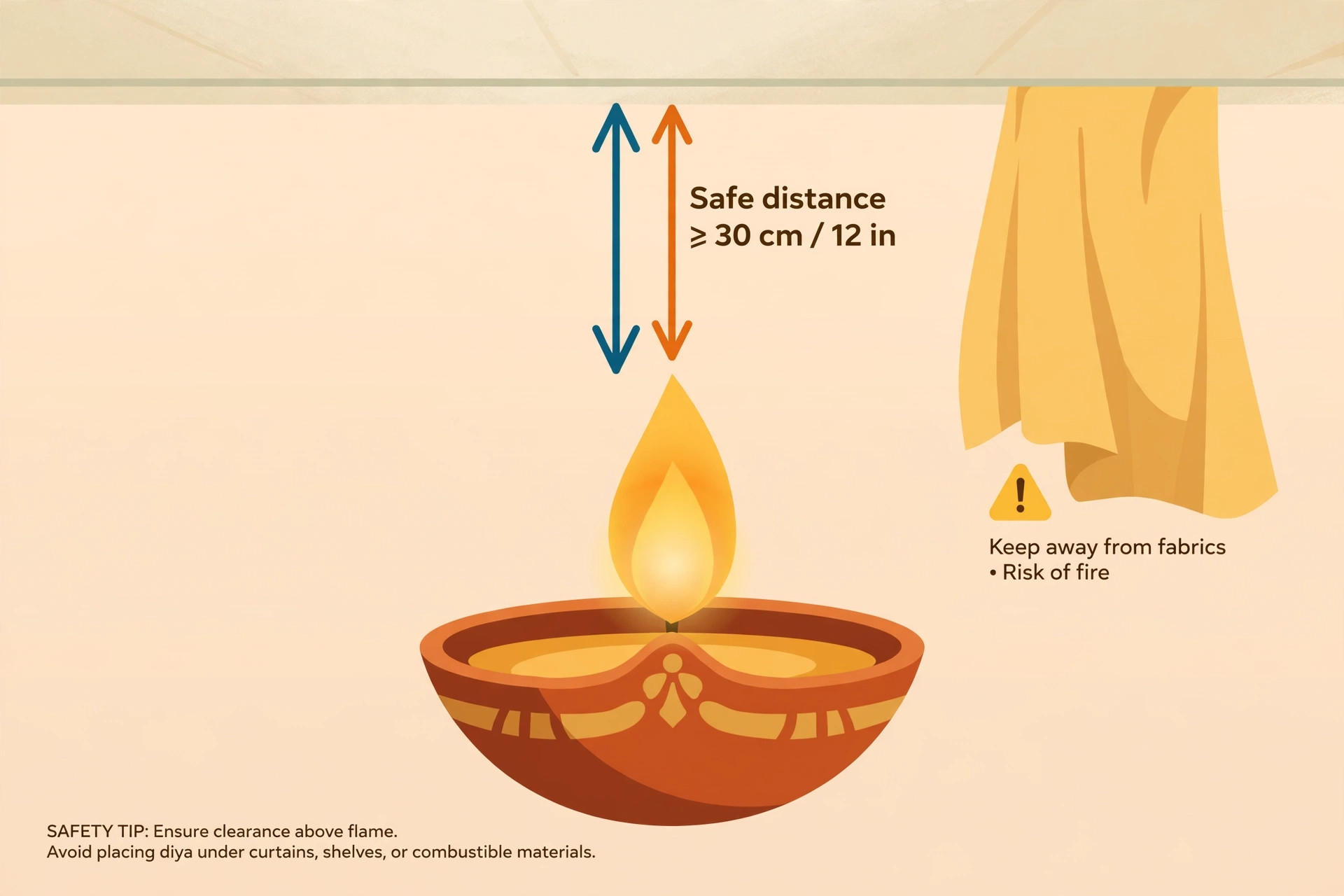
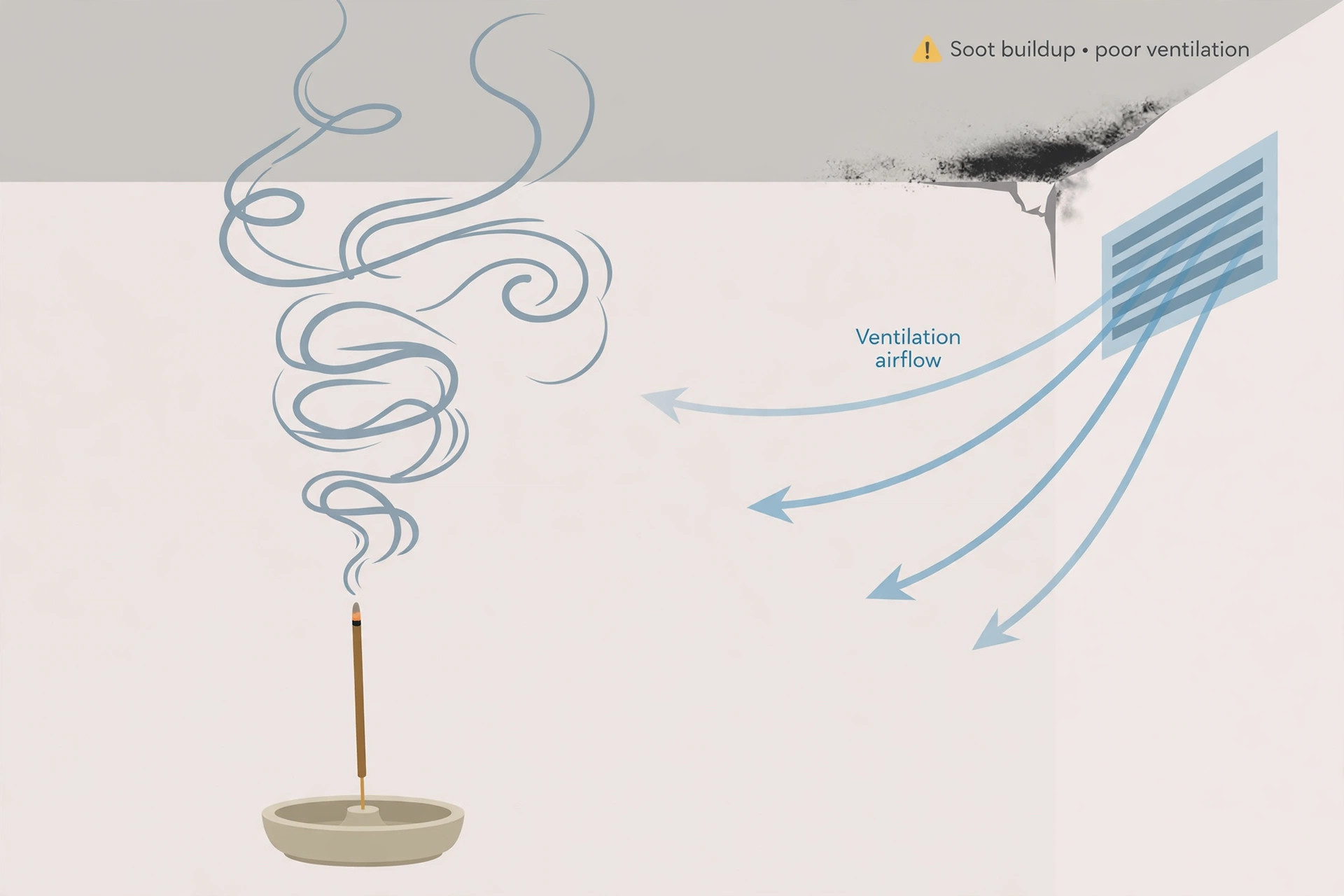
- Clearance: keep open flames well below the ceiling with generous clear air above them; never place diyas where flames can lick the ceiling, hangings or wooden panels. (No published diya-to-ceiling distance figure was found — any number you see quoted is someone’s guess, so work it out with your contractor for your ceiling height.)
- Ventilation: incense and diya smoke needs somewhere to go — a window near the pooja zone helps (ZAD Interiors suggests supporting diyas with northeast ventilation, retrieved September 2026), and full pooja rooms are designed with a dedicated exhaust or incense ventilation point (Suntew, retrieved September 2026).
- Near-heat materials: tempered or laminated glass is safer near heat sources like diyas than ordinary mirror or glass; use mirrors as trims and accents, not across the whole ceiling, to avoid glare (Coohom pooja FAQ, retrieved September 2026).
- Electrical diyas: built-in pooja niches are planned with a dedicated 16-amp circuit for electrical diyas (Suntew, retrieved September 2026) — have a qualified electrician size and certify the circuit; never overload a lighting circuit with heater-style diyas.
- Common sense: never leave open flames unattended; keep fabrics, garlands and wooden jaali away from direct flame contact.
Small pooja corners and nooks
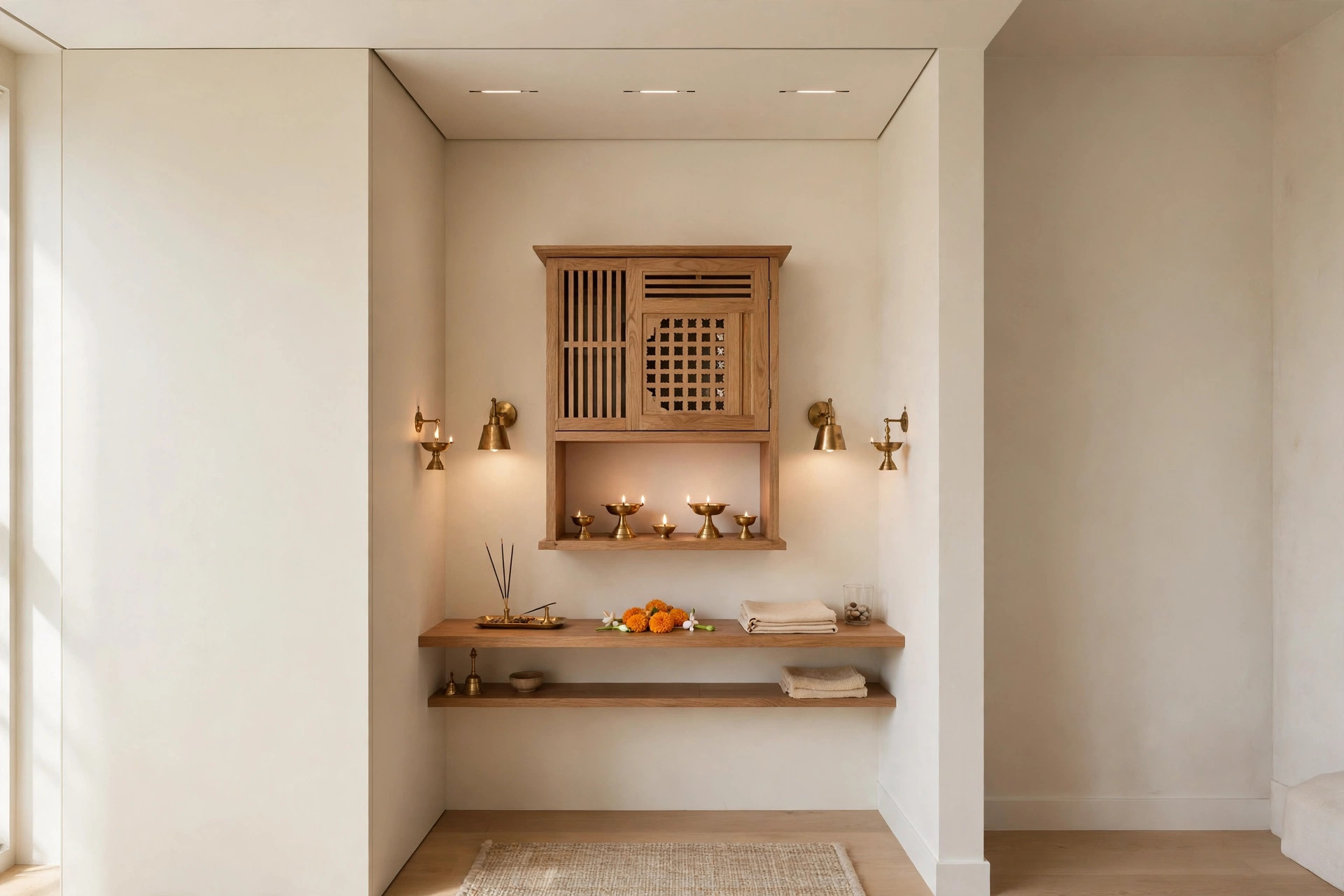
Most urban pooja spaces are corners, niches or 4–6 ft alcoves, not rooms. The rules compress well:
- Slim and flat: a single flat layer with 2–3 recessed warm spots; save the domes and deep trays for full rooms.
- Light colours: ivory and cream keep a nook feeling open; avoid dark wood overhead in tiny spaces (Coohom, retrieved September 2026).
- Mirrors as accents: a small mirror trim behind the idol multiplies the diya glow — but never a full mirrored ceiling near flames (Coohom, retrieved September 2026).
- One motif: a small medallion or border is enough; a nook cannot carry a dome and a mandala.
If your pooja corner sits inside a bedroom, the bedroom’s ceiling logic still applies around it — see our false ceiling design for bedroom guide.
Cleaning soot and smoke marks
A pooja ceiling ages in dog years — daily smoke means the maintenance routine matters as much as the design:
- Wipe, don’t scrub: soft dry cloth monthly on the zone above the diyas; a barely-damp cloth with mild soap for stubborn soot on washable paint.
- Material choice is maintenance choice: treated woods and veneer clean far more easily in high-smoke areas than raw timber (Coohom, retrieved September 2026); glossy PVC wipes cleanest of all.
- Repaint rhythm: lime-wash and matte finishes near the mandir may need refreshing every 2–3 years; washable paints stretch that.
- Jaali panels: dust the lattice with a soft brush — soot settles into every opening.

Ceiling fans and airflow
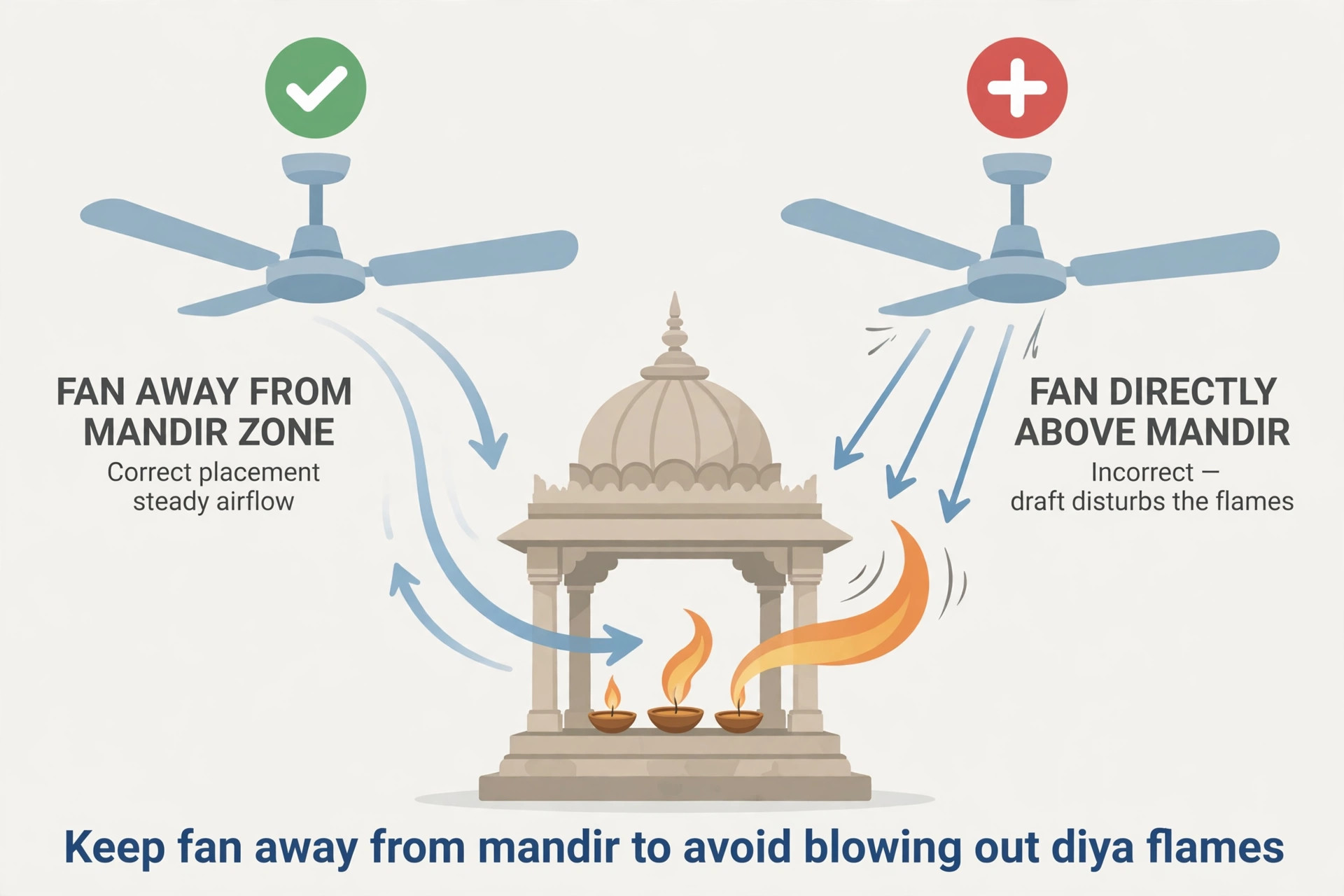
Keep ceiling fans away from the mandir zone — moving air bends diya flames, scatters incense ash and can carry soot across a wider ceiling area. If the pooja room needs a fan, place it toward the room’s far end, off during aarti. (No published fan-placement standard for pooja rooms was found; this is practical guidance, not a code.)
Budget planning: what drives the cost
No India-specific per-square-foot pooja-ceiling price was found on any ranking page — so none is quoted here. The only dated Indian pricing found covers complete pooja-room projects in Bangalore/Mangalore (2026): wall-mounted mandir units Rs.15,000–80,000, built-in niches Rs.35,000–2,00,000, and dedicated 6×6 ft rooms Rs.1.2–8 lakh across budget/mid/premium bands, varying with teak, marble and granite choices (Suntew Interior Designers, retrieved September 2026). That is full-project scope, not a ceiling-only rate — use it as budget context, not a quote.
What reliably moves the ceiling cost:
- Motif complexity: hand-painted mandalas and carved wood cost far more than a clean tray with cove light.
- Lighting count: every spotlight, strip and backlit panel adds fixture + wiring cost.
- Material: teak and carved wood at the top; gypsum + POP in the middle; PVC and MDF jaali at the budget end.
- Room size: a 4-ft nook and a full pooja room are different projects entirely — compare quotes per project, not per square foot, unless the scope matches.

Always get an itemised quote covering boards, frame, motif/carpentry work, finishing, paint, lights, wiring and taxes.
Quick decision summary
- Design from the flame upward: heat, soot and smoke tolerance first, beauty second — they are the same decision.
- One hero motif per ceiling; warm 2700–3000K light; the idol gets the focus spots.
- Stepped trays and shallow domes nod to tradition without stealing headroom; resolve Vastu conflicts practically, not anxiously.
- Ventilate the smoke, circuit the electrical diyas properly, and keep fans away from flames.
- For planning all rooms together, read our whole-home ceiling planning guide.
Before the final payment: a short handover checklist
- Every spotlight and strip works from every switch; dimmers dim smoothly without flicker.
- Jaali/backlit panels sit flush with no light leaking at the edges.
- Paint and motif work is even — check in daylight and under the night lighting.
- Electrical diya points are on their own properly rated circuit (ask what was installed, in writing).
- Ventilation/exhaust for incense runs without rattling the ceiling.
- You have the paint shades and LED specifications noted for future touch-ups.

Frequently asked questions
What is the best material for a pooja room false ceiling?
Gypsum is the most versatile all-rounder — easy to shape into trays and domes and described as fire-resistant (Coohom, retrieved September 2026). Teak wood is the most traditional (Suntew, retrieved September 2026); POP suits ornamental cornices and medallions; PVC is the practical budget pick for small corners.
Should pooja room ceiling lights be 2700K or 4000K?
2700K warm white. One Indian designer guide explicitly recommends 2700K over 4000K for sacred spaces (Suntew, retrieved September 2026), and pooja-ceiling FAQs suggest 2700–3000K dimmable ambient light with a brighter highlight on the deity (Coohom, retrieved September 2026).
What ceiling shape does Vastu suggest for a pooja room?
A stepped pyramidal or gopuram-like profile is described as the traditional ideal, adapted in apartments as a stepped tray (Suntew, retrieved September 2026). Sources conflict on height — one says low aids meditation, another says slightly higher than other rooms — so a shallow tray is the practical compromise.
Can I put a false ceiling in a small pooja corner?
Yes — keep it to a single slim flat layer with 2–3 warm recessed spots, light colours, and one small motif. Save domes and deep trays for full rooms.
Is a mirrored ceiling safe near diyas?
Not as a full ceiling. Use mirrors as trims or accents to multiply the diya glow, and choose tempered or laminated glass near heat sources rather than ordinary mirror (Coohom pooja FAQ, retrieved September 2026).
What does a pooja room ceiling cost in India?
No ceiling-only per-square-foot Indian price was published on any ranking page I checked. The only dated Indian figures cover complete pooja-room projects in Bangalore/Mangalore (2026) — Rs.15,000 to Rs.8 lakh depending on scope and materials (Suntew, retrieved September 2026). Get itemised per-project quotes for your actual scope.
Where should diyas go relative to the ceiling?
Well below it, with generous clear air above every flame — and incense needs ventilation, not just a pretty ceiling. Built-in niches are planned with a dedicated 16-amp circuit for electrical diyas (Suntew, retrieved September 2026); have a qualified electrician certify the work.
If your pooja space flows into the dining area, festive lighting continuity matters on both sides — see our dining room false ceiling designs.
All images in this guide are original concept renders and illustrations created for falseceiling.in — they show design ideas, not completed projects.