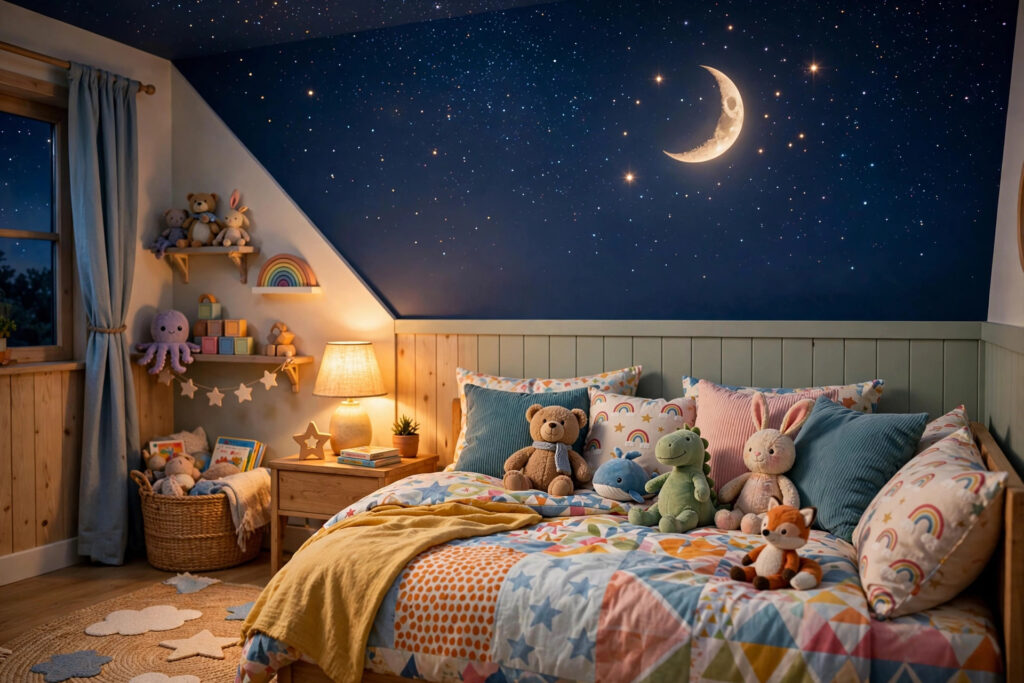

A kids’ room ceiling has the toughest audience in the house: a five-year-old who wants stars, a ten-year-old who wants cool, and parents who want safe, washable and not-a-fortune. The good news is that a kids room false ceiling design can give everyone what they want — playful shapes and night-sky magic for the child, rounded edges and wipeable surfaces for the parents, and lighting that shifts from homework-bright to bedtime-calm. This guide covers 8 fun designs, materials, lighting moods, safety essentials, grow-with-me ideas and real Indian pricing context.
For planning the ceilings of every room together, see our complete false ceiling design guide.
What makes a kids’ ceiling different
A bedroom ceiling wants calm; a kids’ room ceiling has four jobs:
- Safety first: rounded edges, secure fixtures, non-toxic finishes — children touch, throw and stare at ceilings more than adults do.
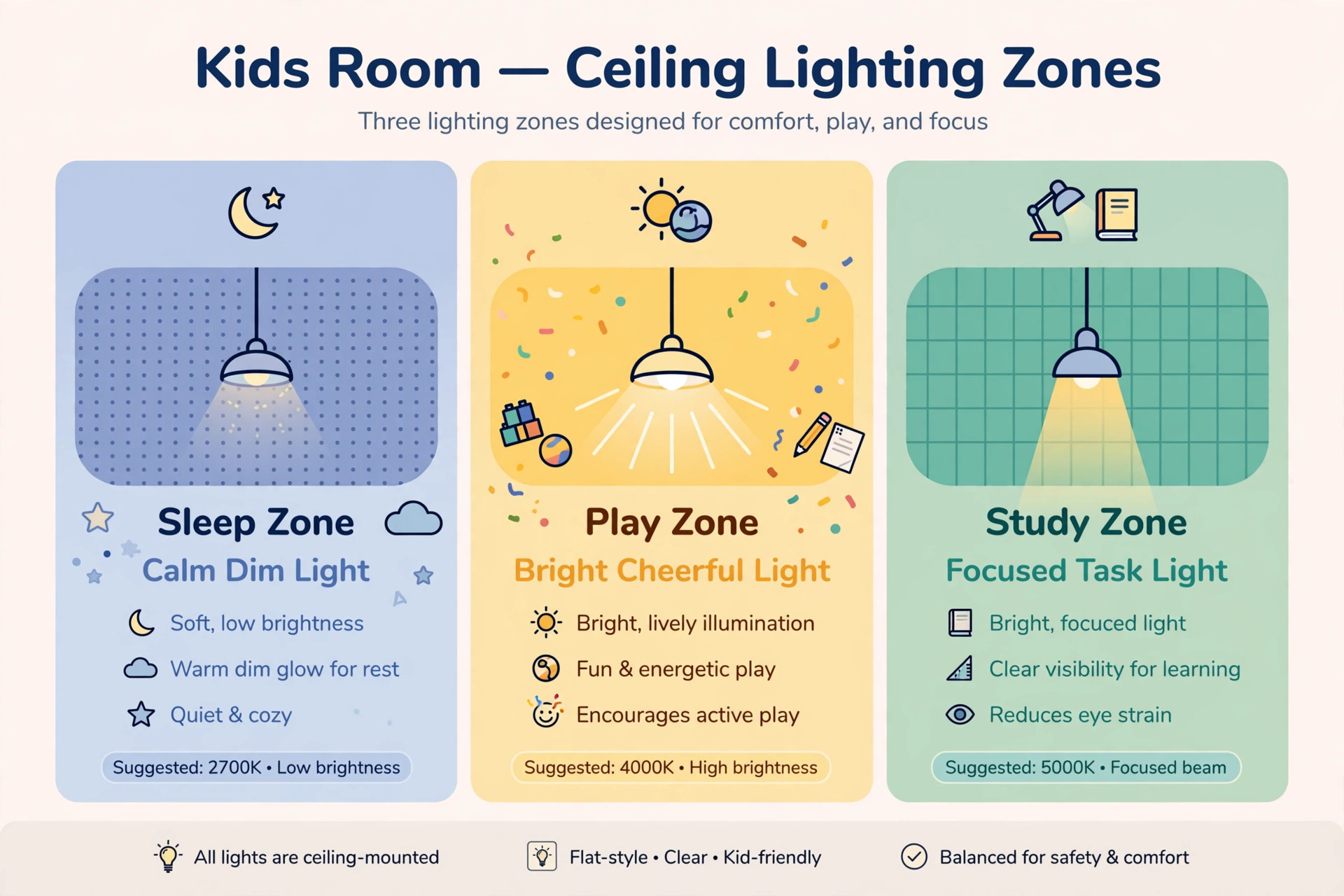
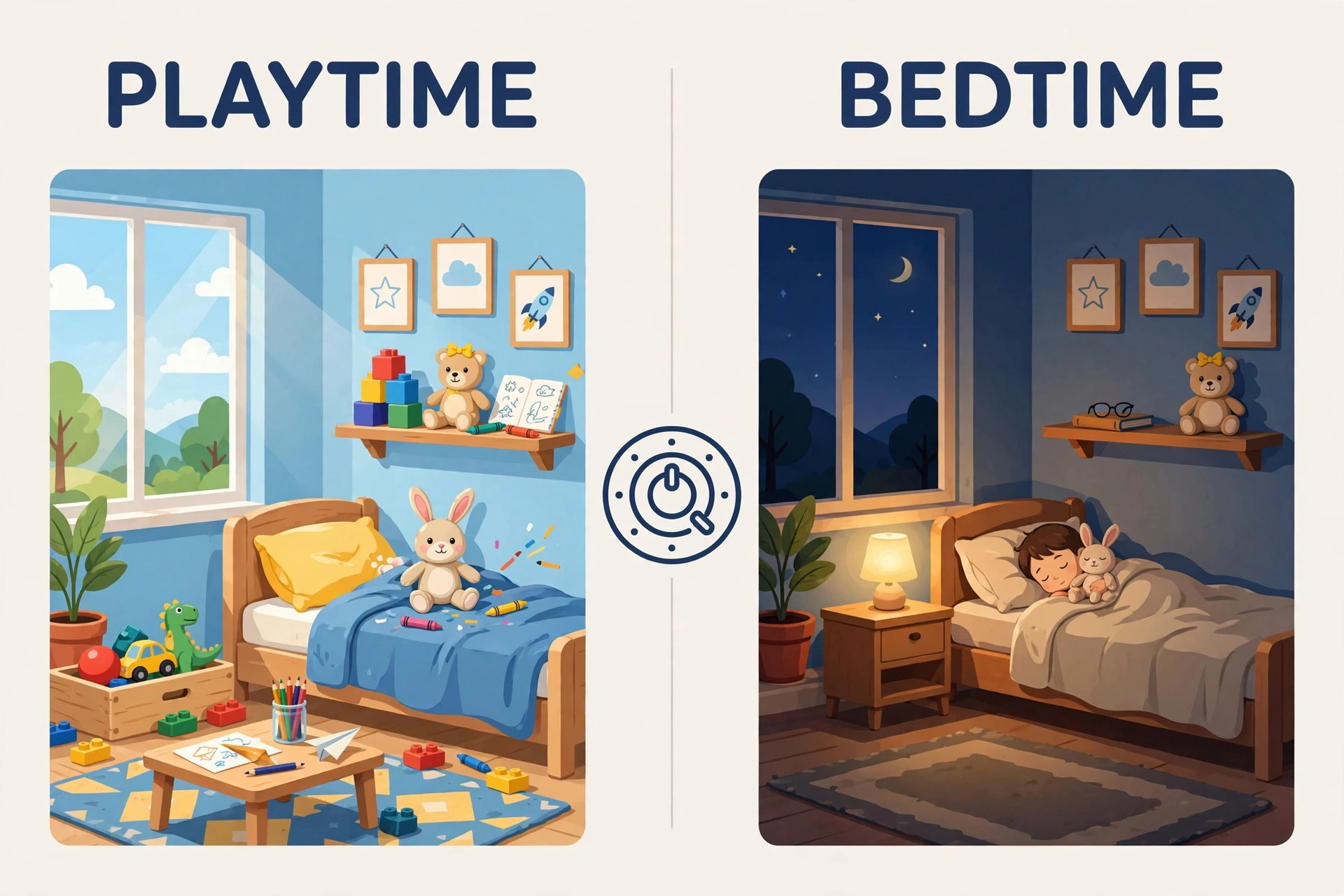
- Three moods, one room: bright for play, focused for homework, dim and calm for sleep. The lighting plan matters as much as the design.
- Adaptability: today’s dinosaur fan is tomorrow’s teenager. The best kids’ ceilings can evolve without being ripped out.
- Wipeability: crayons, stickers and little handprints happen. Glossy, washable surfaces forgive a lot.
Materials for a kids’ room false ceiling
- Gypsum: the default — lightweight boards that shape easily into curves, clouds and stars. One practical advantage for kids’ rooms: gypsum is light enough that sections “may be changed after a few years as your child grows older” (MagicBricks, retrieved September 2026).
- POP: best for custom moulded shapes — peach-toned POP with LED “stars in the midnight sky” is a classic kids’ treatment (MagicBricks, retrieved September 2026). Keep it dry; POP and gypsum both dislike excess moisture.
- PVC panels: the wipeable workhorse — glossy, moisture-resistant and budget-friendly. Crayon marks wipe off instead of becoming permanent art.
- Finishes: choose child-safe, non-toxic, low-VOC paints — rounded corners, child-safe paints and non-toxic materials are standard asks in kids’ room design (Livspace, retrieved September 2026).
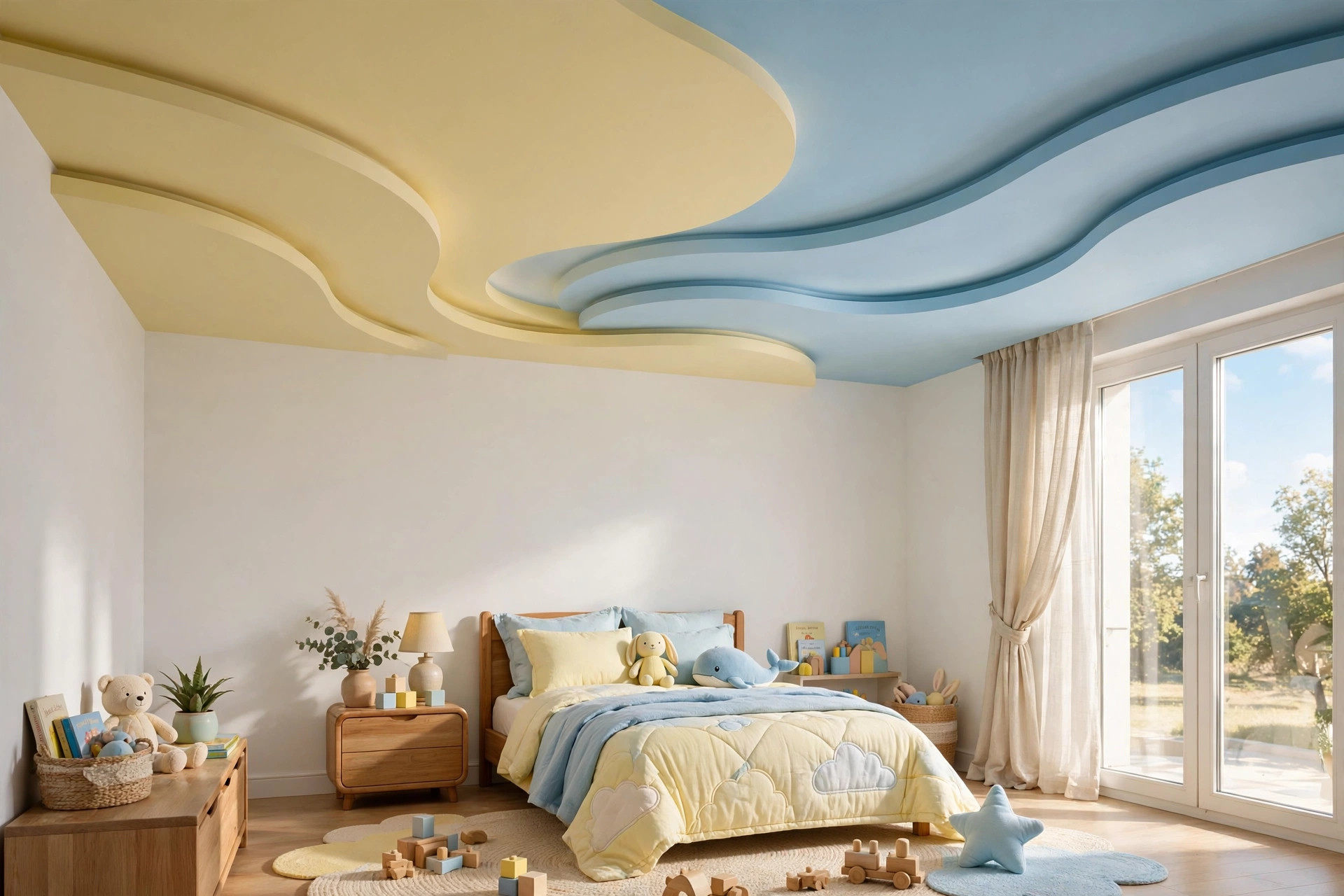
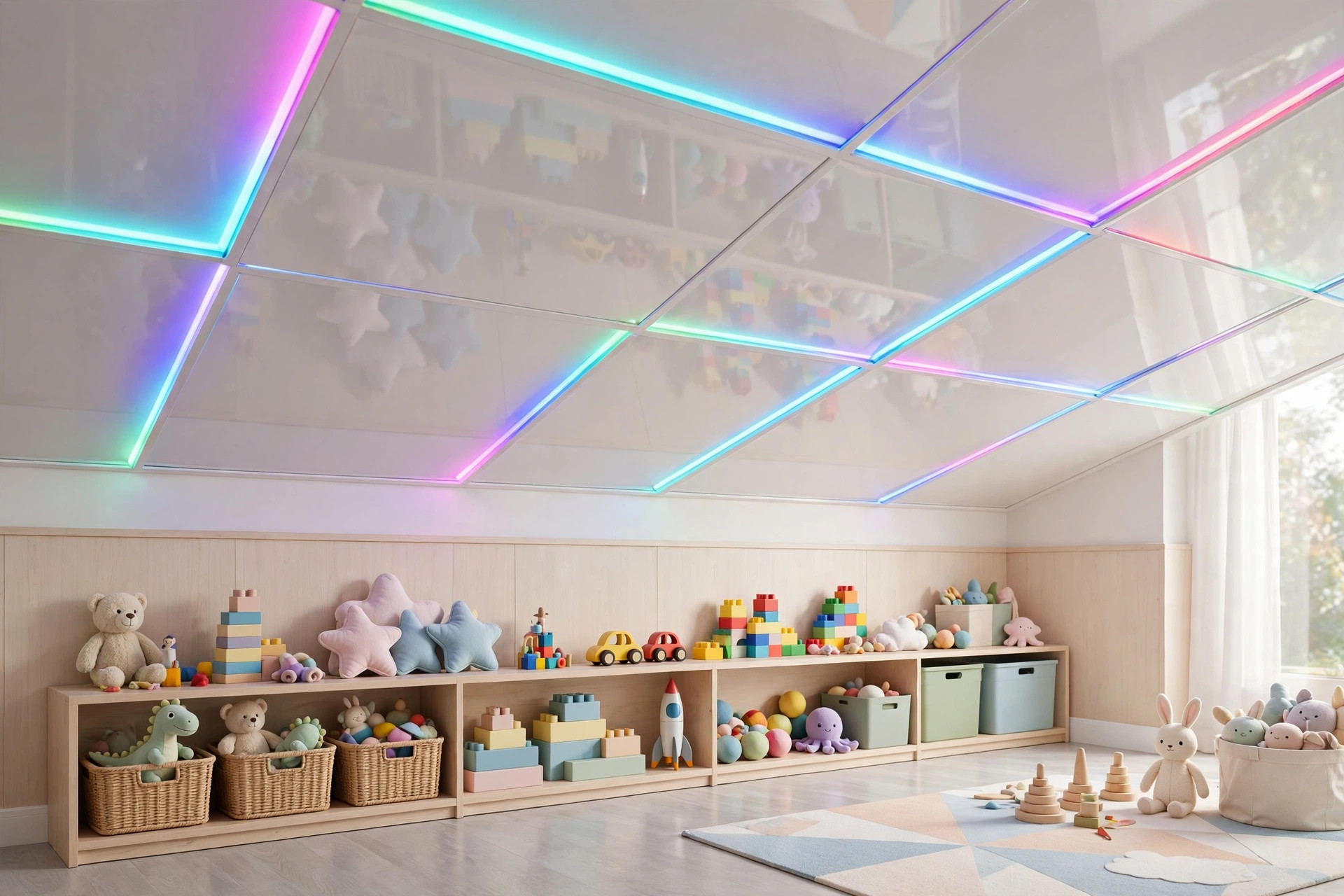
8 fun kids’ room false ceiling designs
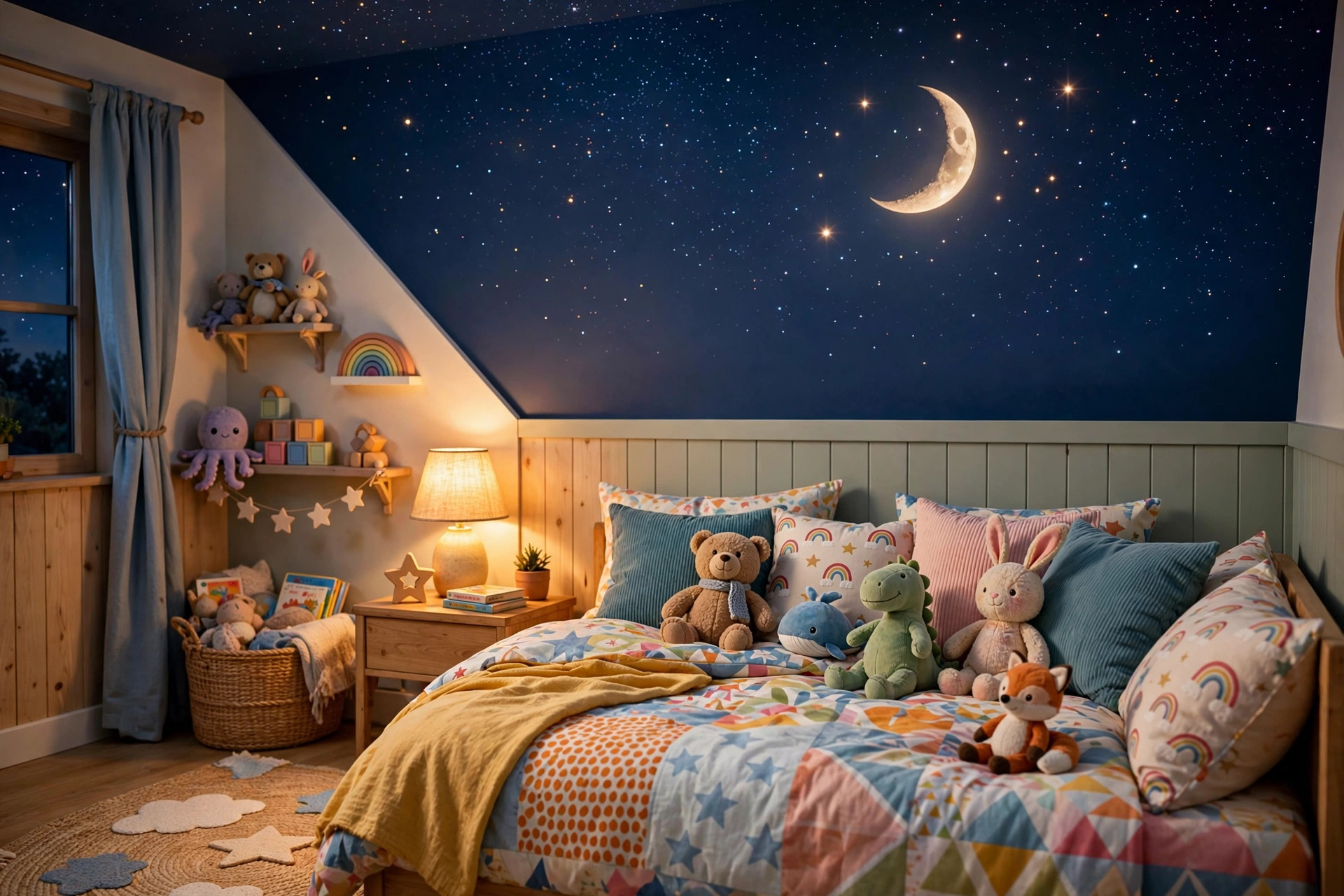
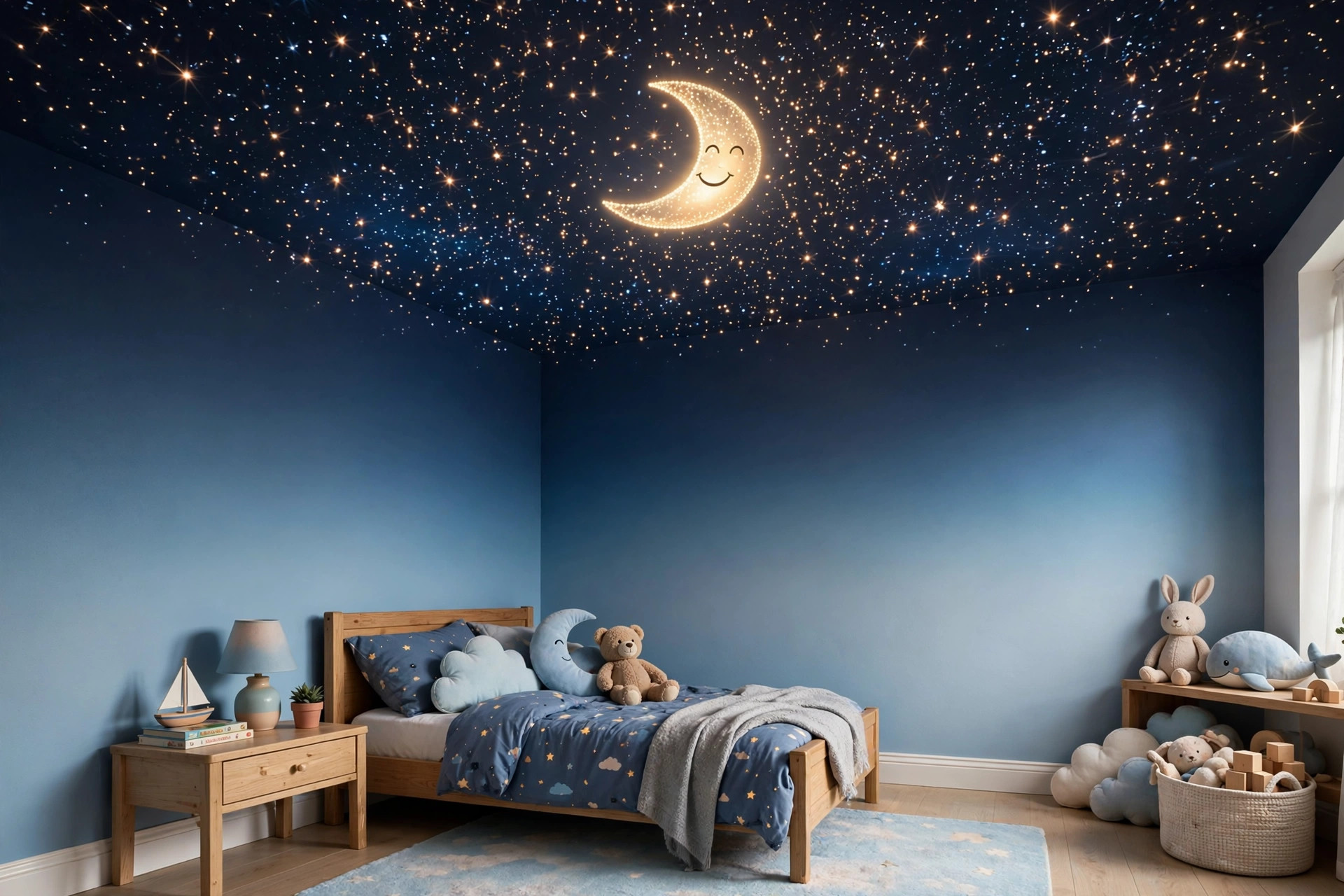
1. Night sky with glowing stars
The most requested kids’ ceiling: deep blue with fibre-optic star points or glow-in-the-dark stars and a crescent moon. Fibre-optic stars need above-ceiling access with ventilated drivers — plan that before the boards go up (Coohom kids’ FAQ, retrieved September 2026).
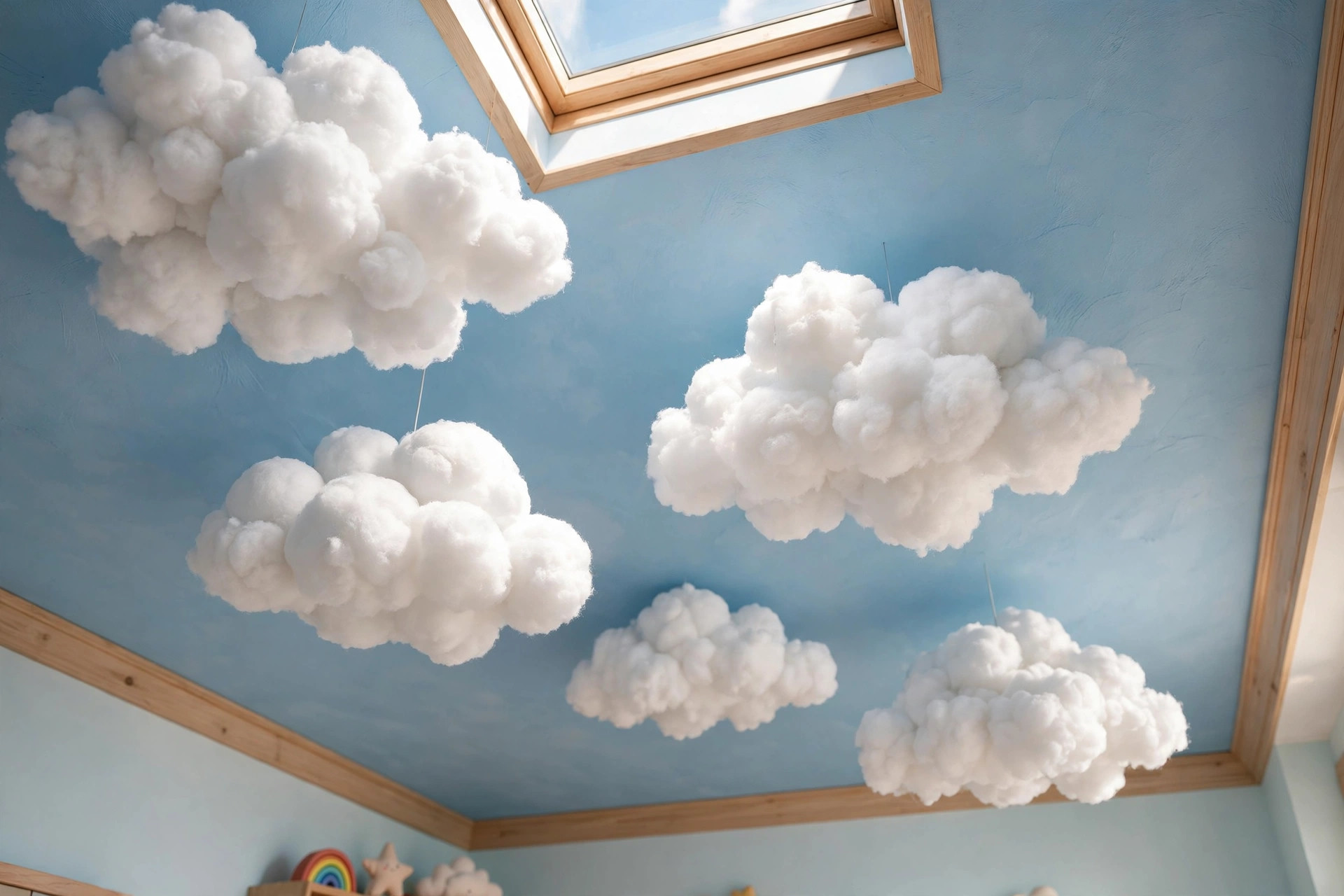
2. Storybook clouds
Soft layered cloud shapes in white on sky blue, with hidden LED strips behind the layers for a floating effect. Calming by day, magical at dusk — and it makes small rooms feel open (Livspace cloud-ceiling design, retrieved September 2026).
3. Rainbow arch
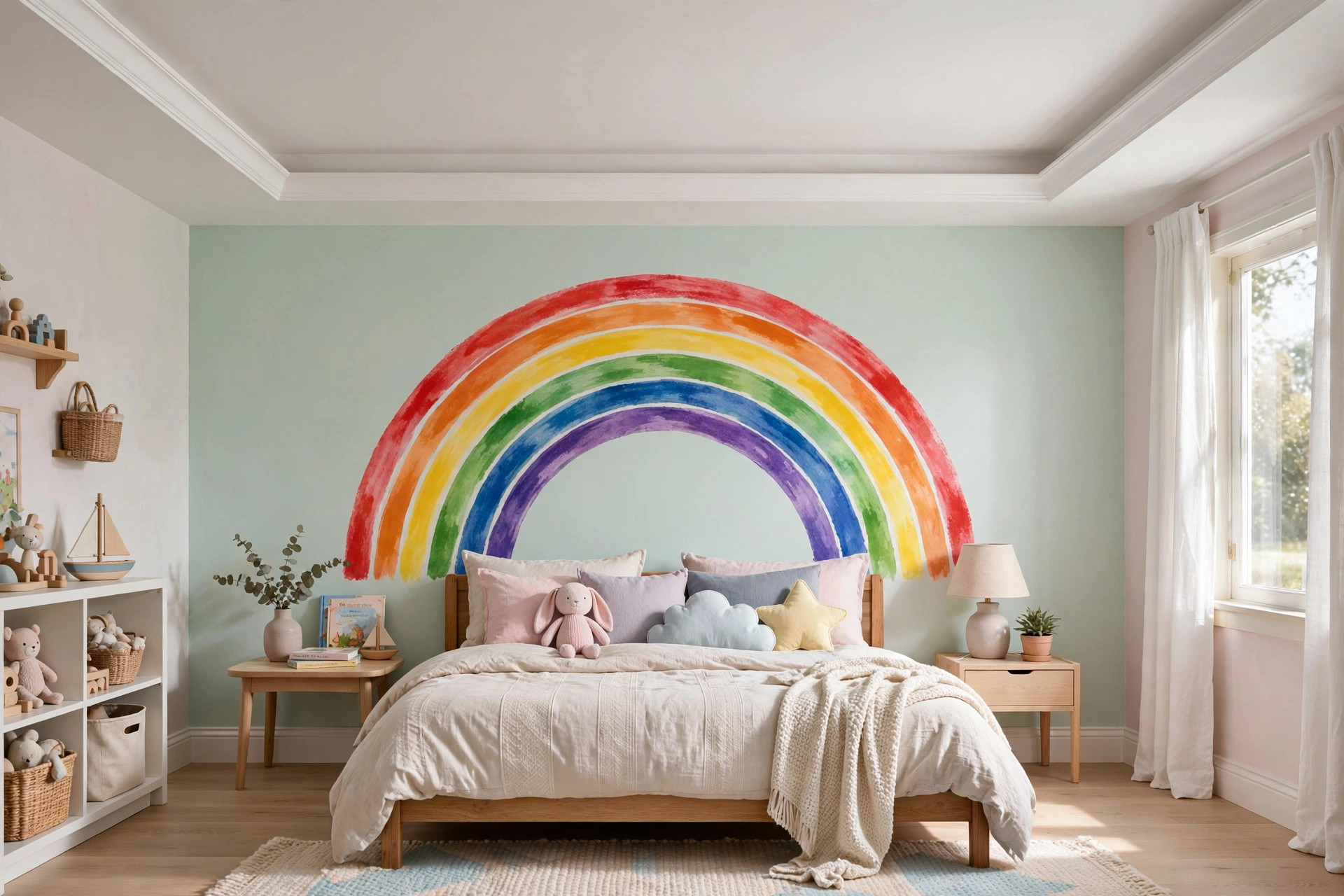
A hand-painted rainbow spanning a white tray ceiling over the bed. Simple, cheap to refresh, and easy to paint over when the rainbow phase ends.
4. Ocean waves
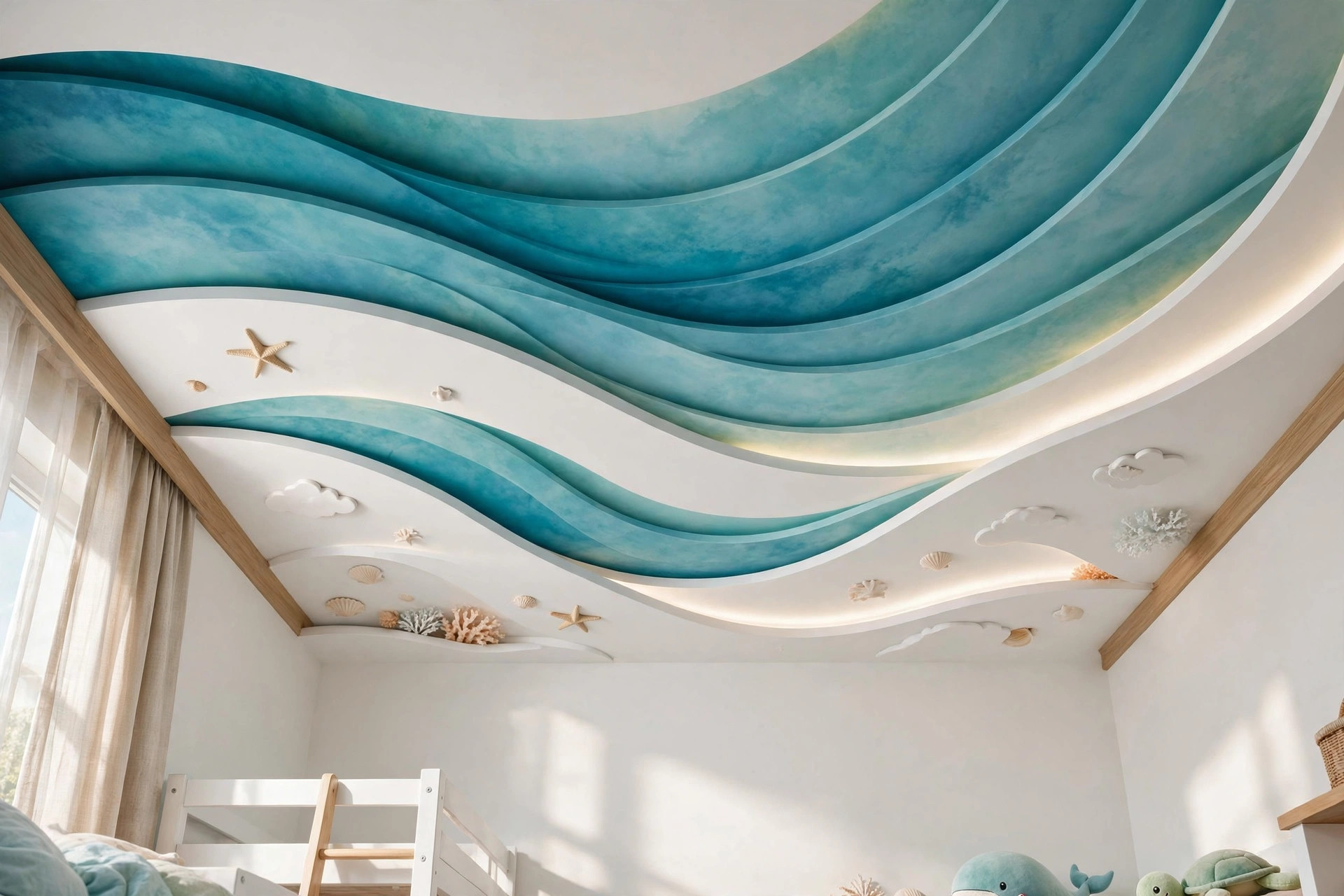
Flowing wave curves in teal and aqua sweeping across white — pairs beautifully with a marine or nautical room theme, where lights set between the original and false ceiling give a seamless glow (MagicBricks, retrieved September 2026).
5. Geometric colour blocks
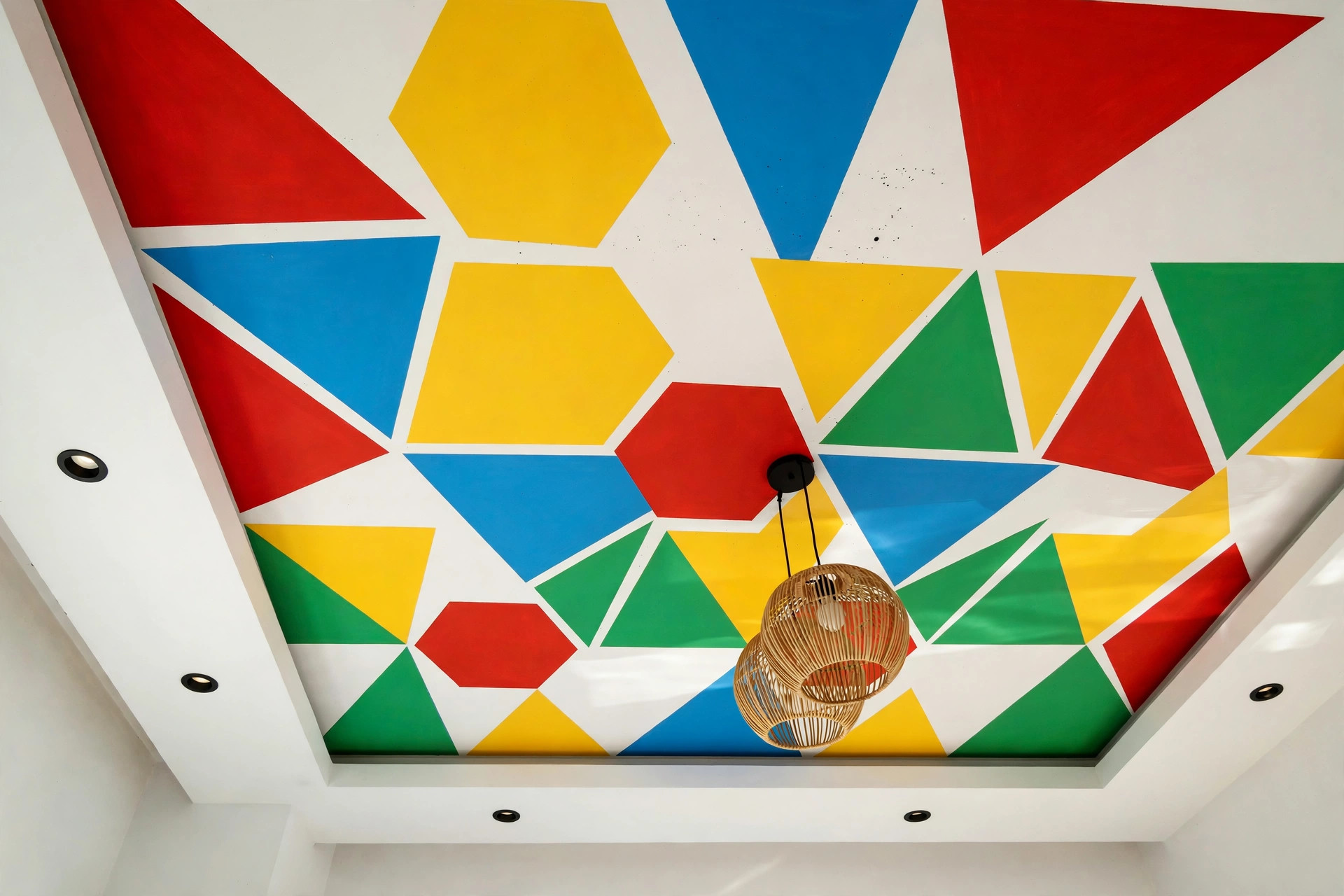
Bold triangles and hexagons in primary colours on white. Modern, graphic, and gender-neutral — it ages better than character themes when the child hits double digits.
6. Space mission
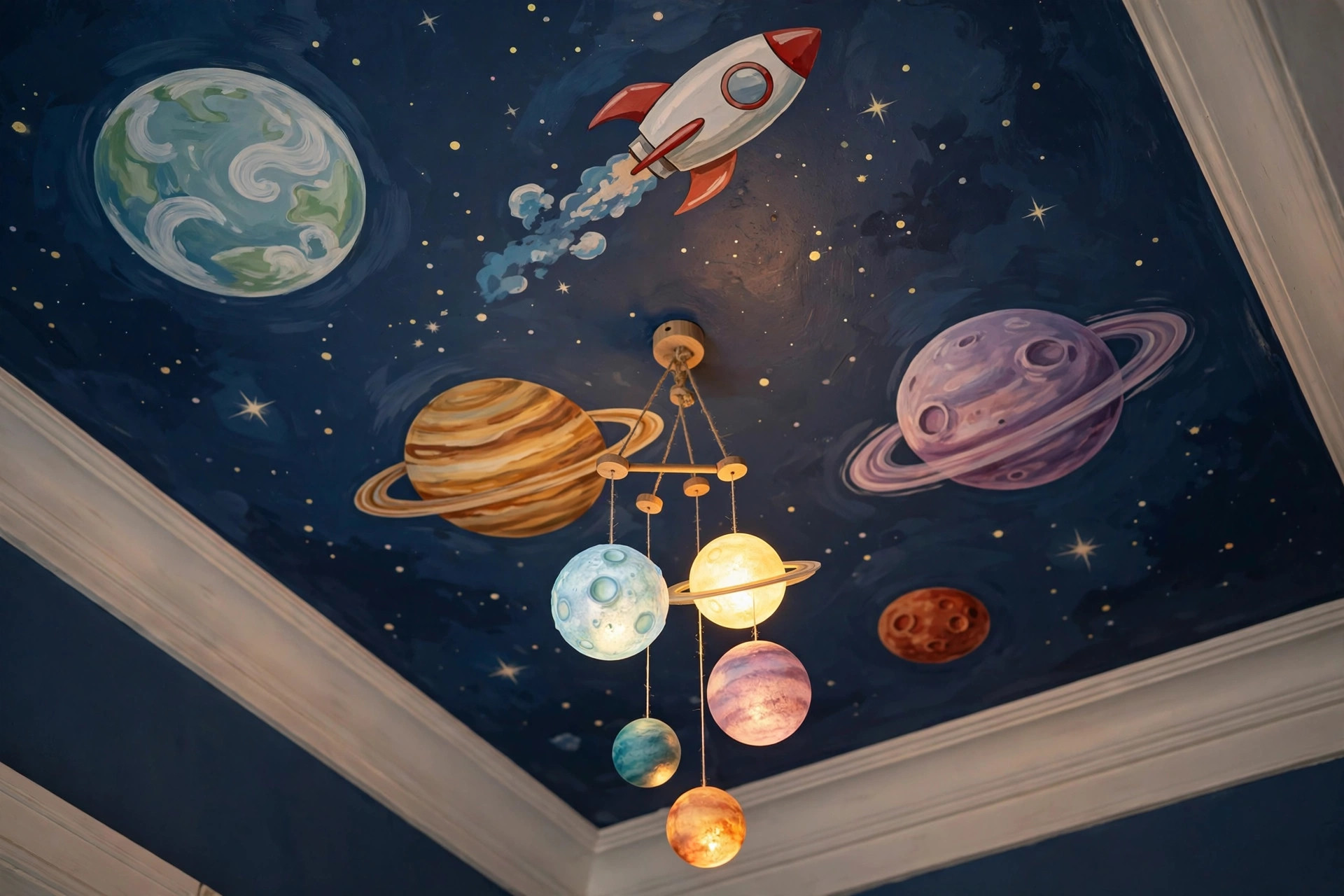
Planets, rockets and stars on deep blue, with a hanging planet mobile. The step up from the night sky for the space-obsessed — combine with dimmable spots so it doubles as a calm sleep ceiling.
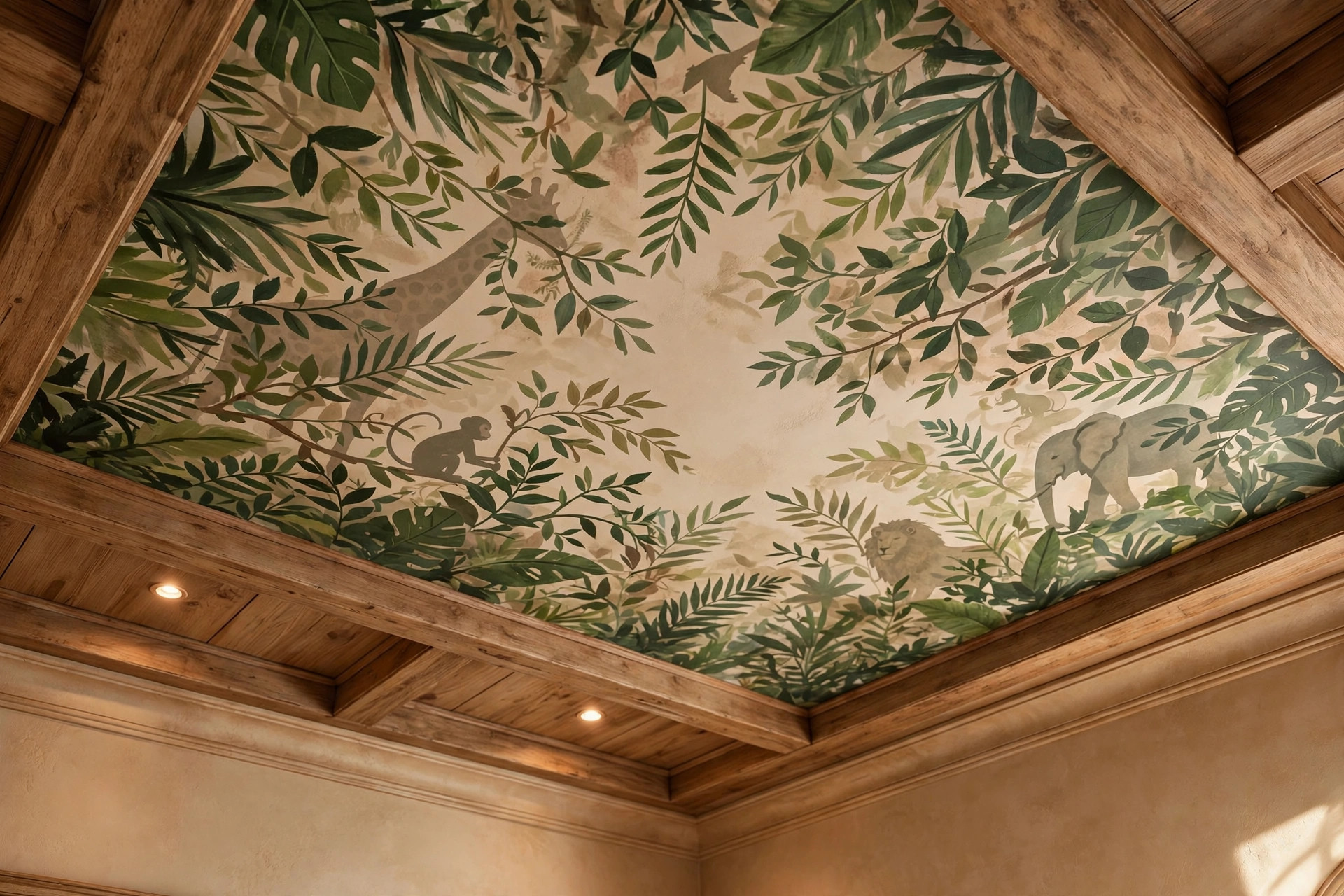
7. Jungle canopy
Leaf-canopy patterns in greens with subtle animal silhouettes. Warm, adventurous, and it hides minor marks better than plain white ever will.
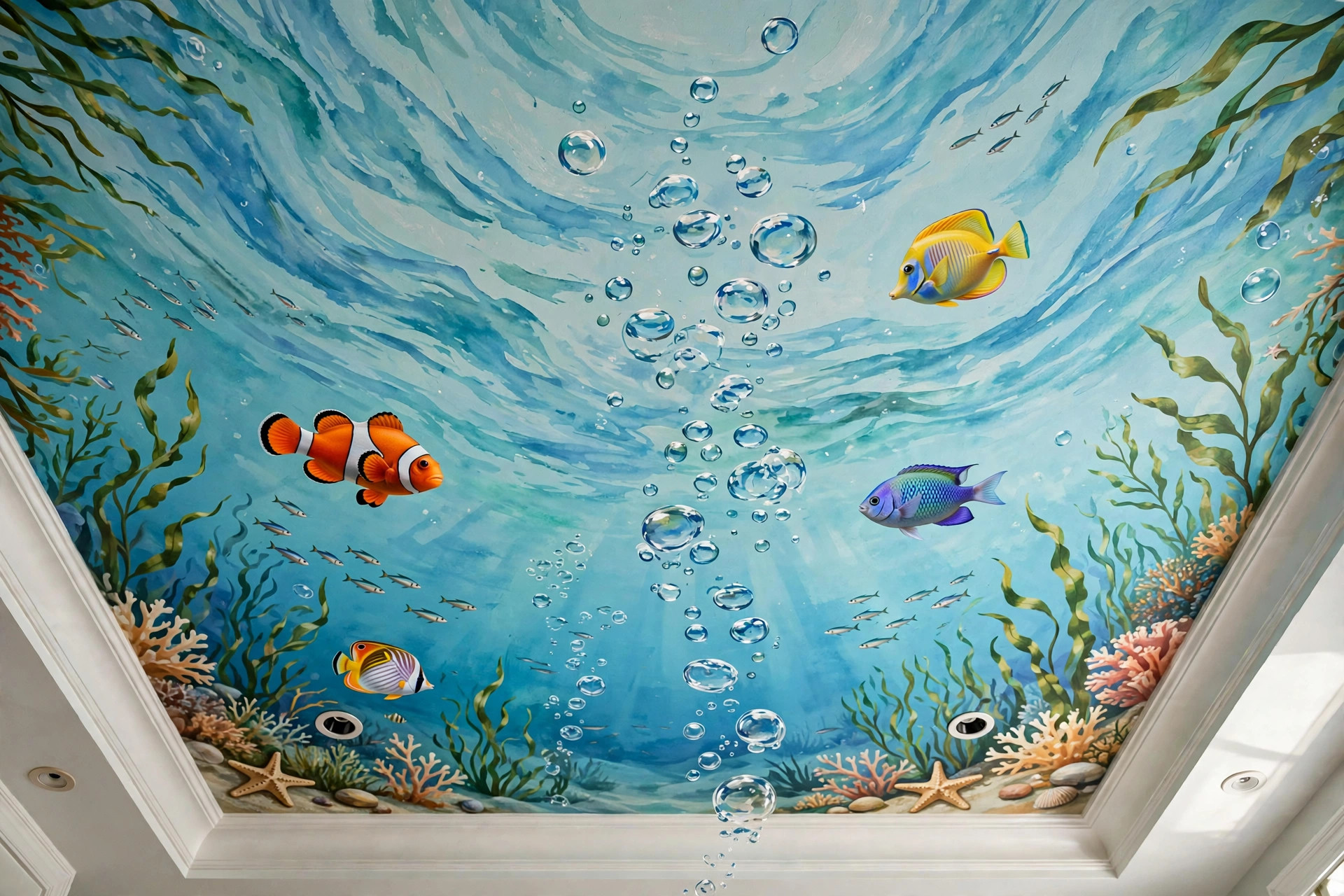
8. Underwater world
Waves, fish and rising bubbles in aqua — the happiest ceiling on this list. Works especially well with cove lighting, which reads as watery glow.
Lighting for play, study and sleep
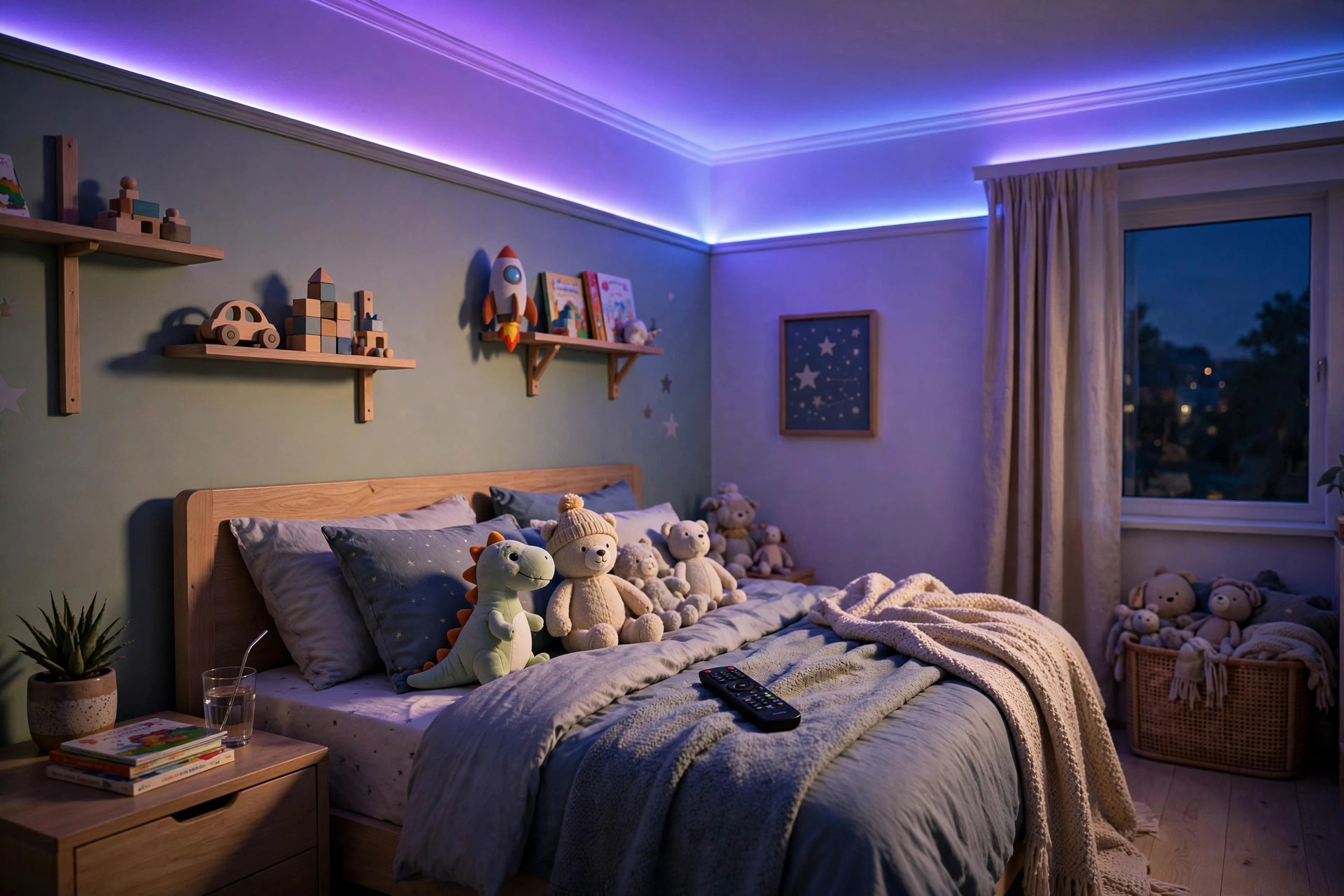
Kids’ room lighting is layered like the designs: cove lights for soft glow, recessed spotlights for task zones, and a pendant or two as a focal point, with dimmers to adjust brightness through the day (Livspace, retrieved September 2026).
- Play: bright, even, cheerful — cove plus spots at full.
- Study: focused downlights over the desk; minimal visual distraction on the ceiling itself above the study zone.
- Sleep: dim warm cove or a low nightlight; colour-changing RGB strips are popular for the “not quite lights-out” negotiation (Coohom, retrieved September 2026).
- Flicker: use quality constant-current LED drivers with compatible dimmers — cheap drivers plus dimmers is the classic flicker combination (Coohom kids’ FAQ, retrieved September 2026).
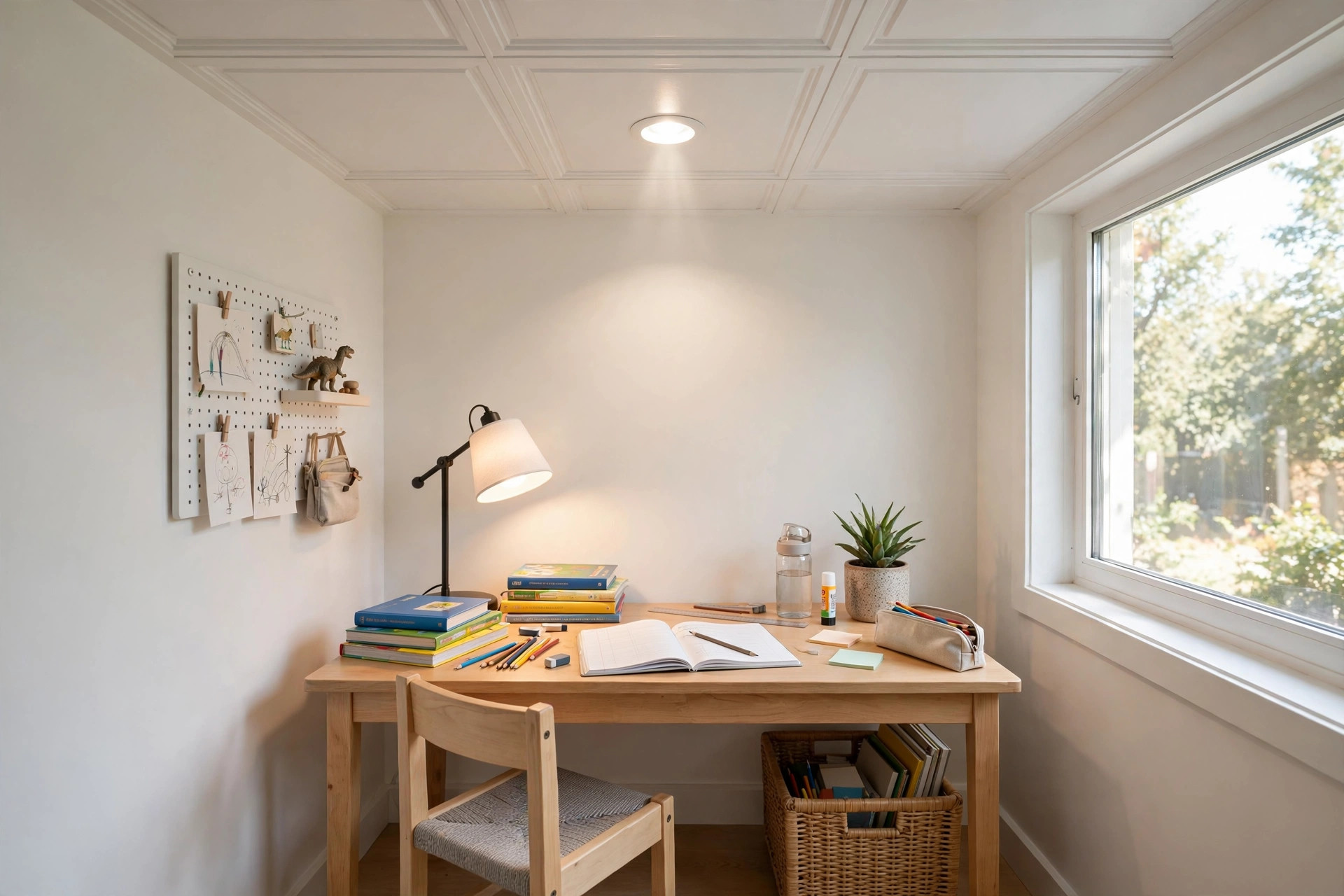
The study corner deserves its own light
Above the desk, restraint wins: a bright, even downlight on the work surface and a visually quiet ceiling — no busy patterns pulling young eyes upward. As homework years approach, the study zone’s lighting matters more than its theme.
Kids’ rooms are bedrooms first — for the grown-up side of the planning, see our false ceiling design for bedroom guide.
Safety essentials (non-negotiable)
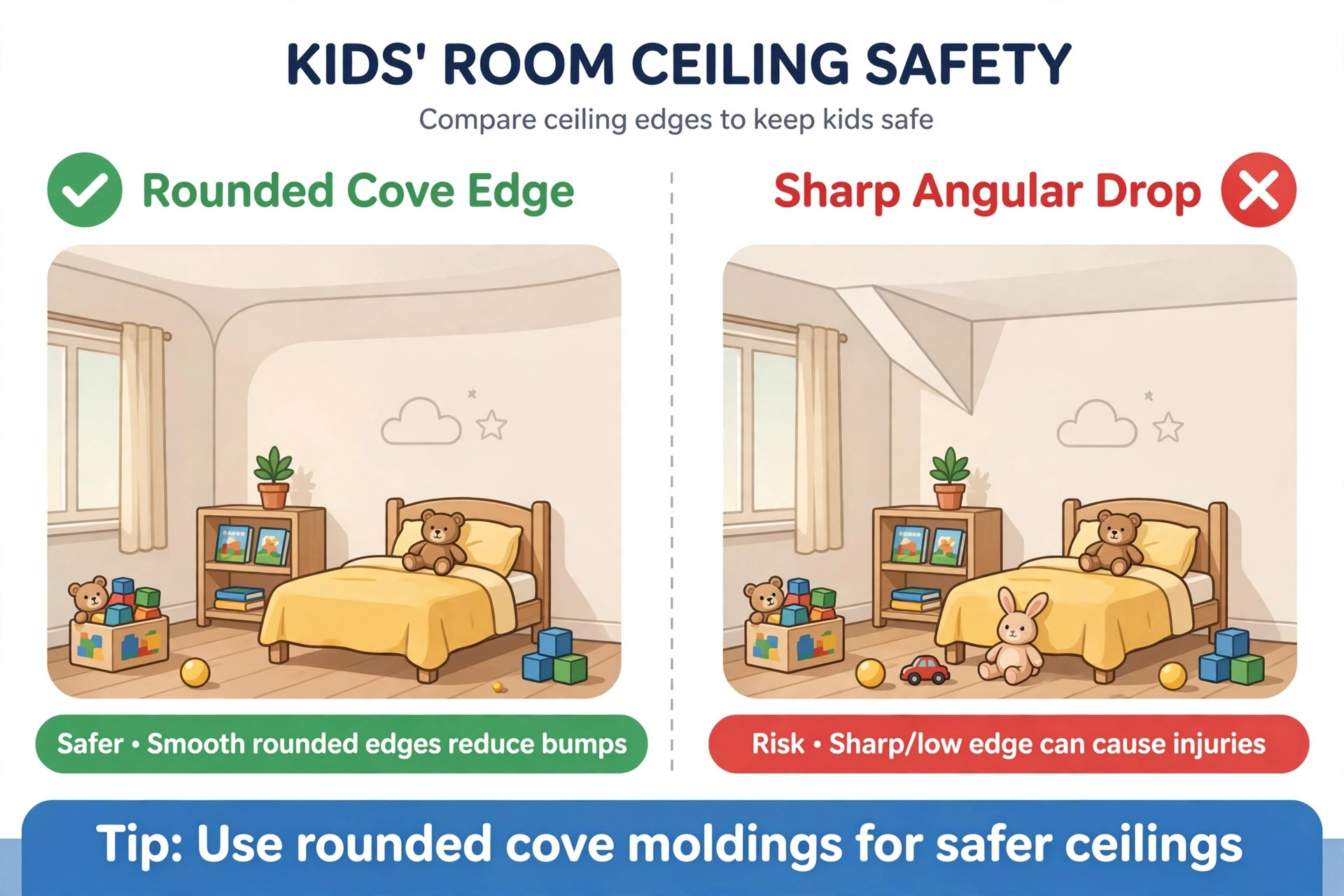
- Edges: rounded corners and soft coves over sharp angular drops — rounded detailing is a standard child-safe ask (Livspace, retrieved September 2026).
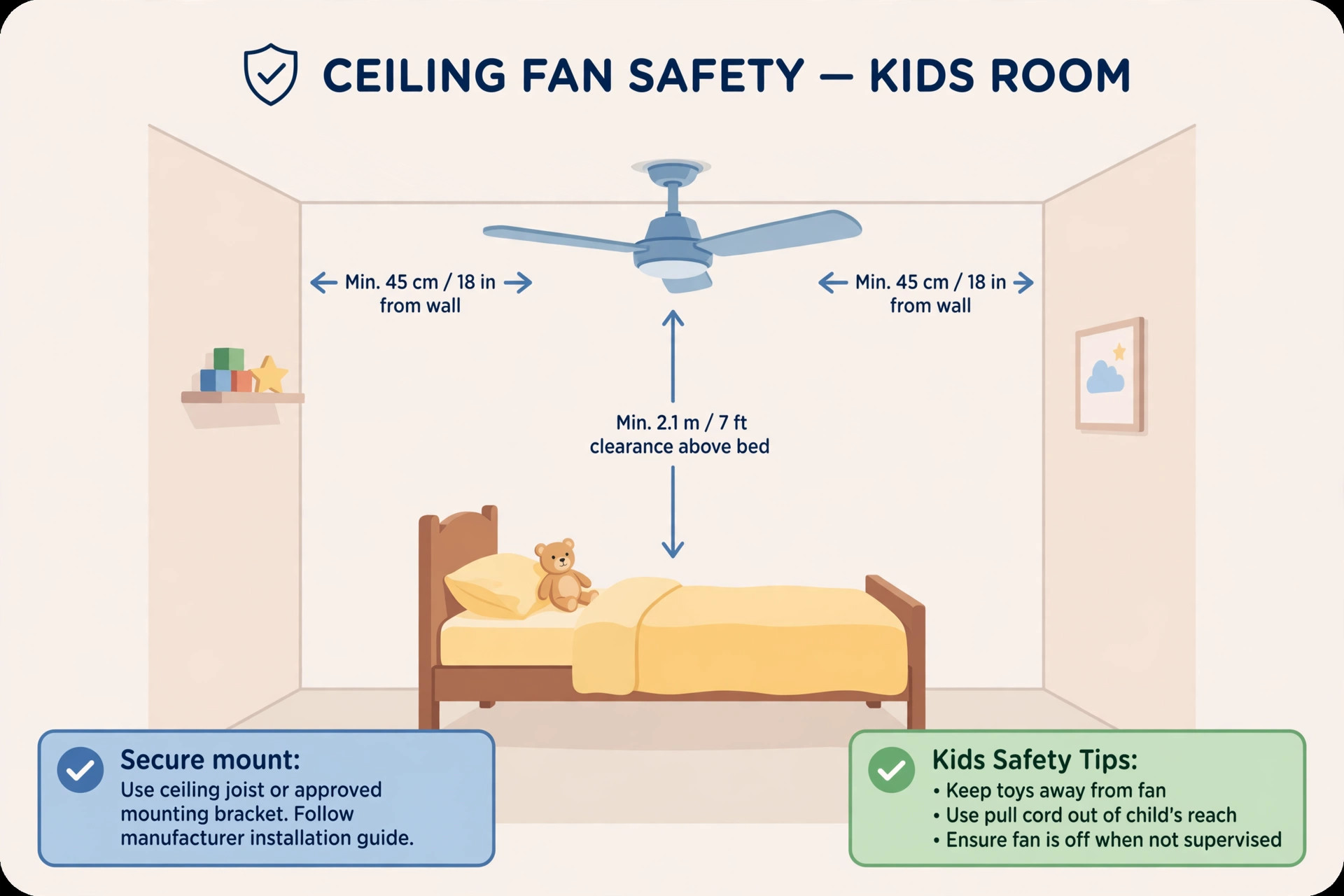
- Nothing heavy over beds: avoid heavy decorative elements directly above where children sleep, and keep all hardware ceiling-rated (Coohom kids’ FAQ, retrieved September 2026).
- Fans and fixtures: fans, chandeliers and AC vents need proper reinforcements, concealed wiring and load-bearing mounts — aesthetics and safety engineered together (Livspace, retrieved September 2026). Heavy loads anchor to the structural slab, never to the ceiling board; a qualified installer decides the mounting.
- Clear height: in small rooms a 10–15 cm drop is often enough, keeping clear height where children move and play (Coohom kids’ FAQ, retrieved September 2026) — confirm against your actual ceiling height with your contractor.
- Finishes: non-toxic, low-VOC paints and adhesives (Livspace; Coohom, retrieved September 2026).
- Servicing: have electrical fixtures and concealed wiring inspected yearly (Livspace, retrieved September 2026).
Designs that grow with your child
The smartest kids’ ceiling investment is adaptability:
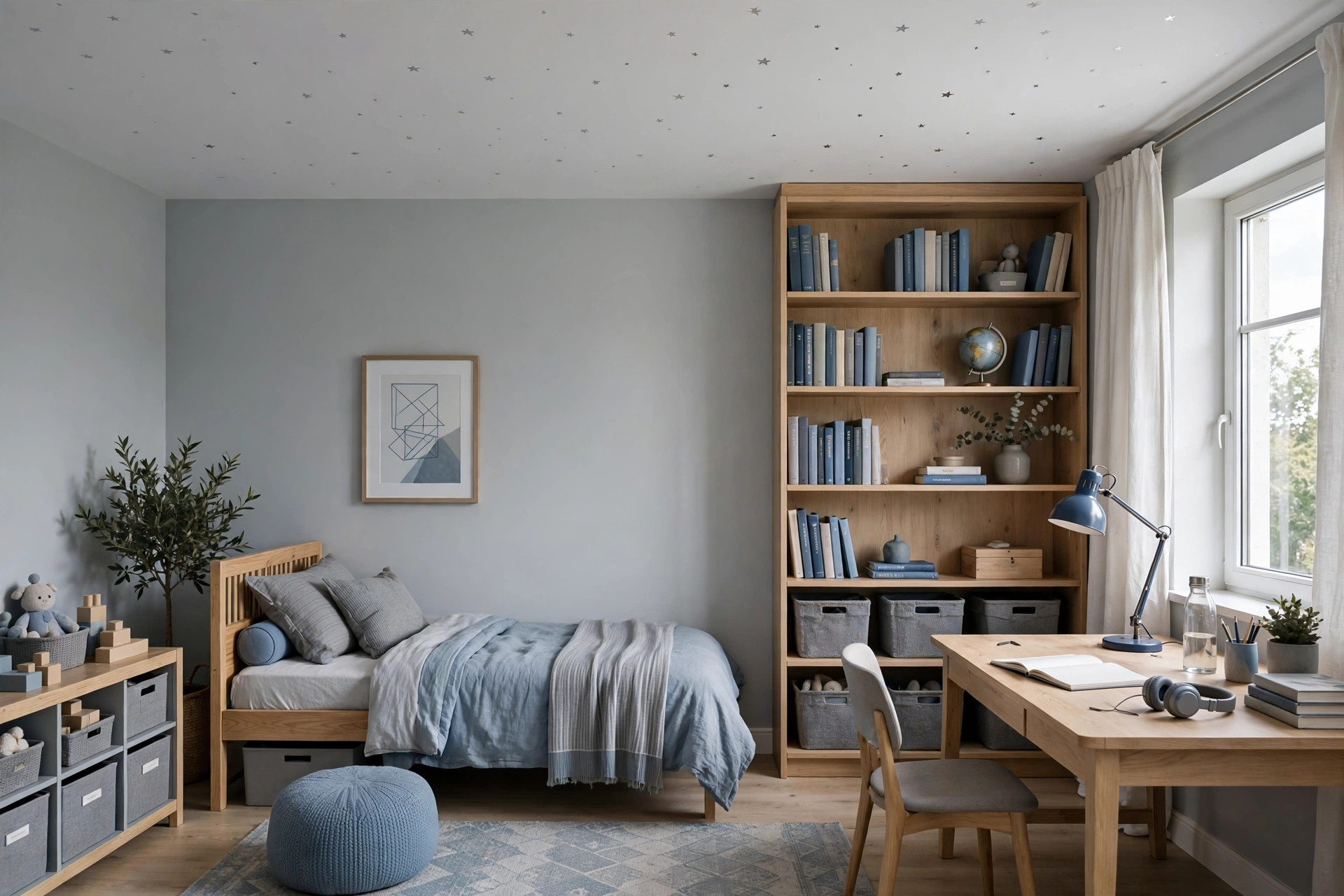
- Neutral base, changeable art: a calm base ceiling with magnetic stars, decals or glow stickers that peel off when tastes change — the sky evolves without repainting.
- Repaintable gypsum: lightweight gypsum sections can be refreshed or replaced after a few years as the child grows (MagicBricks, retrieved September 2026).
- Modular thinking: rooms designed with convertible, height-adjustable elements evolve “from a toddler’s play space into a teen’s study zone” (Livspace, retrieved September 2026) — apply the same logic overhead.
- Geometric over character: colour blocks and waves age gracefully; cartoon characters have an expiry date.
Small kids’ rooms
Compact rooms need slim thinking: a 9 ft ceiling is described as ideal, and in smaller spaces designers recommend slimmer gypsum layers or edge lighting to preserve headroom (Livspace, retrieved September 2026). Light colours, vertical visual lines and a single focal design keep a small room feeling bigger — one rainbow beats five themes.
Cleaning and maintenance
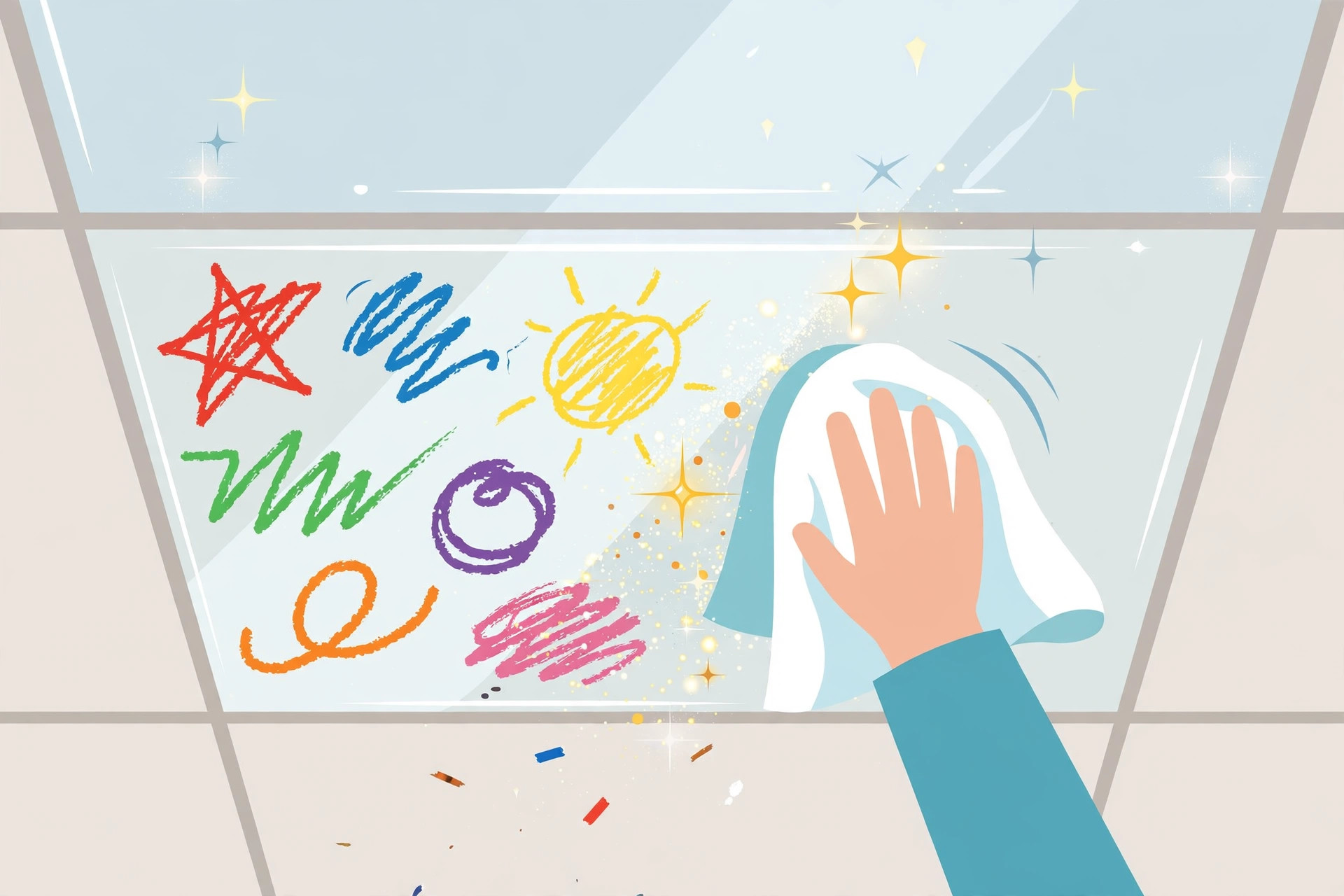
- Dust regularly with a dry microfibre mop — textured and shaped ceilings collect more dust than flat ones.
- Wipe marks early: crayon and handprints come off glossy PVC and washable paint easily if caught early; matte paint absorbs them.
- Avoid excess moisture on POP and gypsum during cleaning (Livspace, retrieved September 2026) — damp cloth, never wet.
- Yearly check: inspect electrical fixtures and concealed wiring once a year (Livspace, retrieved September 2026).
Budget planning: what drives the cost
Dated Indian pricing context exists here: Livspace quotes a typical false-ceiling price of ₹120–₹250 per sq. ft. (September 2026, India), with premium finishes, layered designs and integrated LED profiles pushing costs up, and final quotes customised to the space (Livspace, retrieved September 2026). That is a generic installed range — no per-material (gypsum vs POP vs PVC) Indian split was published on any page checked, so treat material comparisons as directional:
- Theme art: hand-painted murals, fibre-optic star fields and sculpted shapes cost far more than painted patterns and decals.
- Lighting: RGB strips, fibre optics and multiple dimmable zones add fixture + wiring + driver cost.
- Layers: double-layer and multi-level ceilings cost more than flat-plus-accent designs.

Always get an itemised quote covering boards, frame, theme/paint work, lights, wiring, drivers and taxes.
Quick decision summary
- Safety and wipeability first, theme second — the theme can change, the ceiling board cannot (easily).
- Light in three moods: bright for play, focused for study, dim for sleep — dimmers are mandatory, not optional.
- Gypsum for shapes, PVC for wipeability, low-VOC paints throughout.
- Design for the teenager too: neutral bases and changeable accents outlast character phases.
- For planning all rooms together, read our whole-home ceiling planning guide.
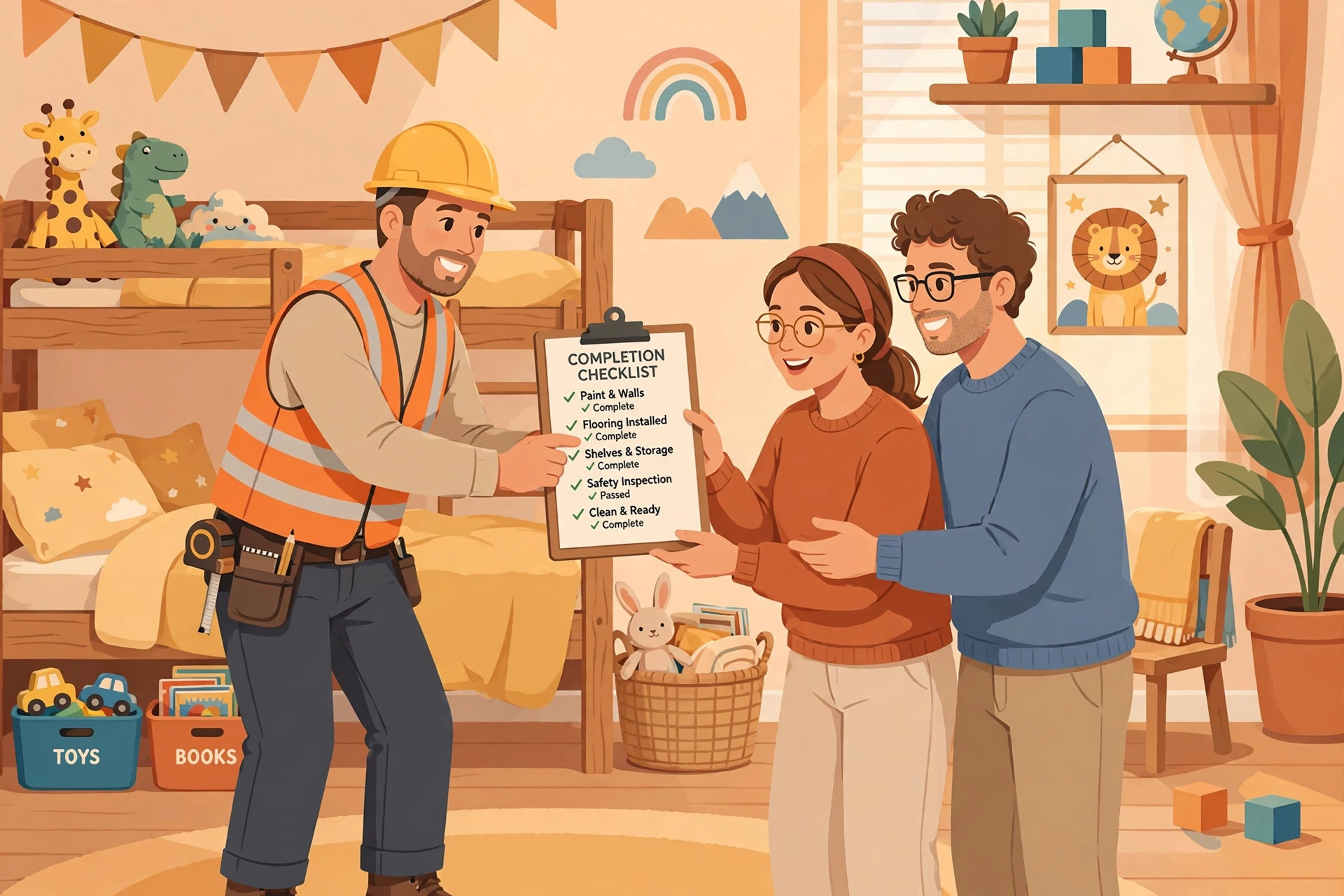
Before the final payment: a short handover checklist
- Every light and dimmer works smoothly from every switch — no flicker at any dim level.
- All edges are smooth and rounded where children can reach; no sharp exposed corners.
- Fan and any hanging fixture is firmly mounted with no wobble (ask how it is anchored, in writing).
- Paint is even and fully cured — check in daylight and at night.
- Fibre-optic or strip drivers are accessible and ventilated, not sealed inside the void.
- You have the paint shades and LED/driver specifications noted for future touch-ups.
Frequently asked questions
What is the safest material for a kids’ room false ceiling?
Lightweight gypsum with non-toxic, low-VOC paints is the standard recommendation — gypsum is light, shapes easily, and sections can be replaced as the child grows (MagicBricks; Livspace, retrieved September 2026). Keep all hardware ceiling-rated and avoid heavy elements over beds (Coohom kids’ FAQ, retrieved September 2026).
How much ceiling height does a kids’ room need?
A 9 ft ceiling is described as ideal; in smaller spaces use slimmer gypsum layers or edge lighting to preserve headroom (Livspace, retrieved September 2026). In small rooms a 10–15 cm drop is often enough (Coohom kids’ FAQ, retrieved September 2026) — confirm against your actual height with your contractor.
Can the ceiling support a fan or chandelier?
Yes, when engineered for it — proper reinforcements, concealed wiring and load-bearing mounts (Livspace, retrieved September 2026). Heavy loads must anchor to the structural slab as determined by a qualified installer, never to the ceiling board alone.
How do I stop LED lights from flickering?
Use quality constant-current LED drivers with compatible dimmers — cheap drivers paired with dimmers are the classic flicker combination (Coohom kids’ FAQ, retrieved September 2026). Test every dim level before final payment.
What does a kids’ room false ceiling cost in India?
Livspace quotes a typical ₹120–₹250 per sq. ft. (September 2026, India), rising with premium finishes, layered designs and integrated LED profiles (Livspace, retrieved September 2026). No per-material Indian split was published anywhere checked — get itemised quotes for your exact scope.
Will my child outgrow the design?
Probably — so plan for it. Neutral base ceilings with changeable decals, magnetic stars and repaintable gypsum evolve from toddler to teen without a rebuild (MagicBricks; Livspace, retrieved September 2026).
All images in this guide are original concept renders and illustrations created for falseceiling.in — they show design ideas, not completed projects.