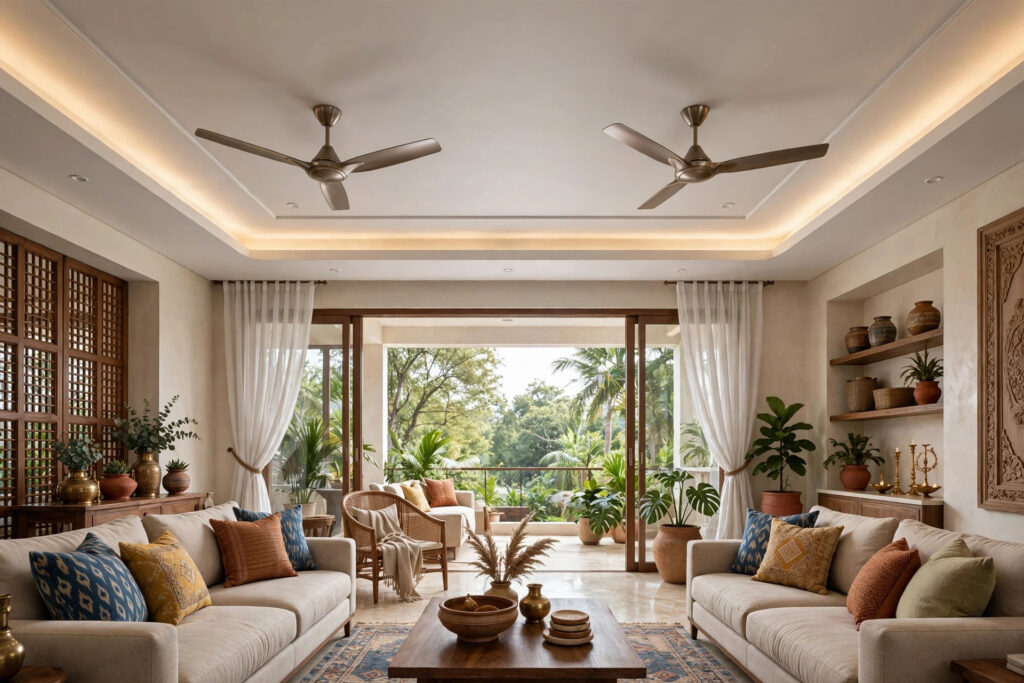

In a long Indian hall, one ceiling fan always leaves a dead corner. Two fans fix the airflow — and immediately create a design problem: two fans on a decorated ceiling can look like an afterthought. This guide covers both halves: layout ideas that make two fans look intentional, and the safety basics of hanging any fan from a false ceiling.
It is written for halls, which is where the two-fan question comes up most. The principles apply to large bedrooms and living-dining spaces too.
When two fans make sense — and when they don’t
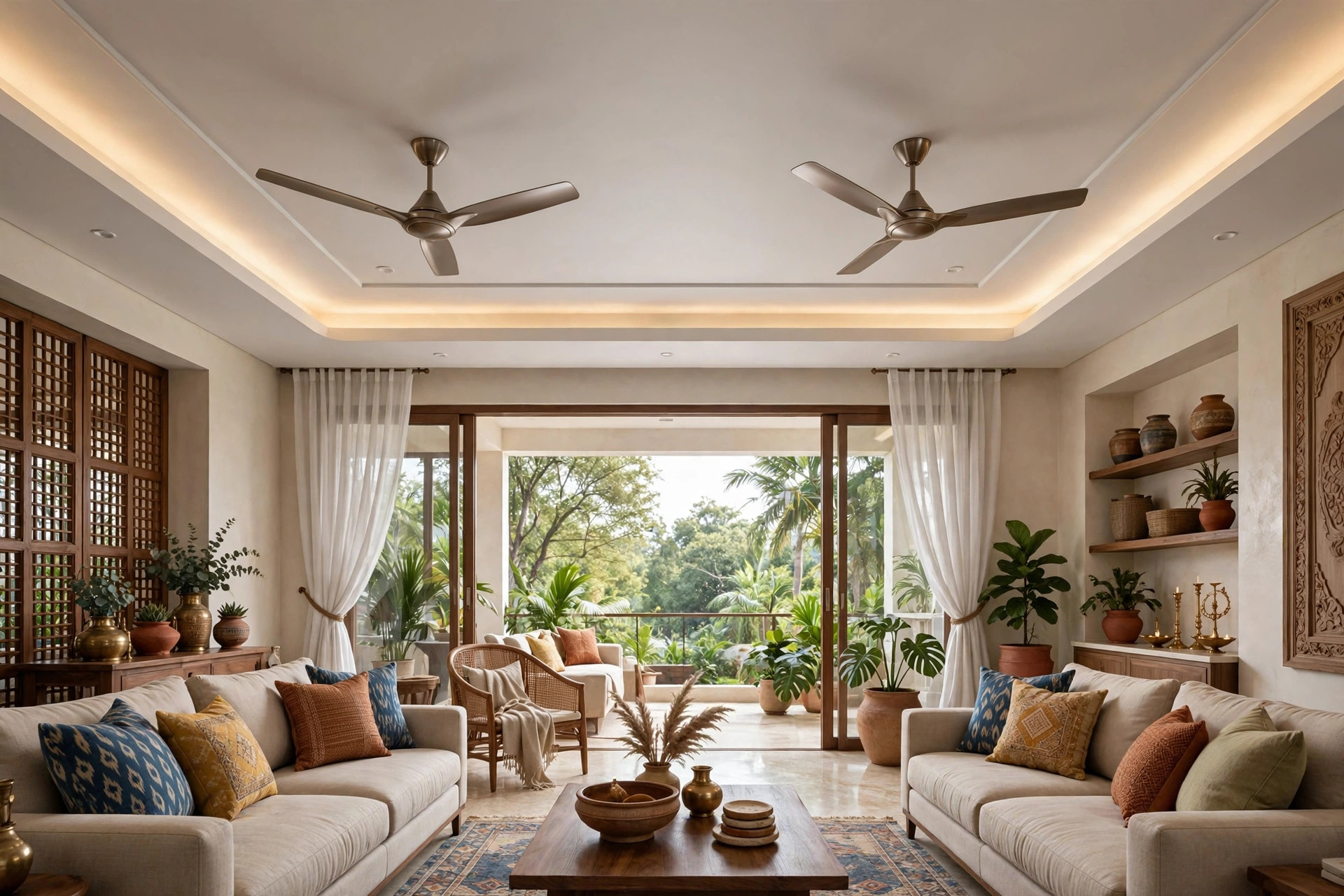
Two fans make sense in halls roughly 200 sq ft and above, especially long rectangular halls where a single central fan leaves the ends still. They also make sense in combined living-dining spaces, where each fan serves one zone. Below that size, two fans crowd the ceiling visually and acoustically — one well-placed fan with good sweep is the better answer.
Ceiling height matters as much as floor area. A false ceiling already drops the slab by several inches; in a room under 9.5 ft, two fans plus a multi-level ceiling can feel oppressive. In low rooms, keep the ceiling flat and the fans slim.
The placement rules that actually matter
Placement decides both airflow and looks. The widely repeated guidance in Indian interior guides (including NoBroker’s 2026 two-fan guide) comes down to five rules:
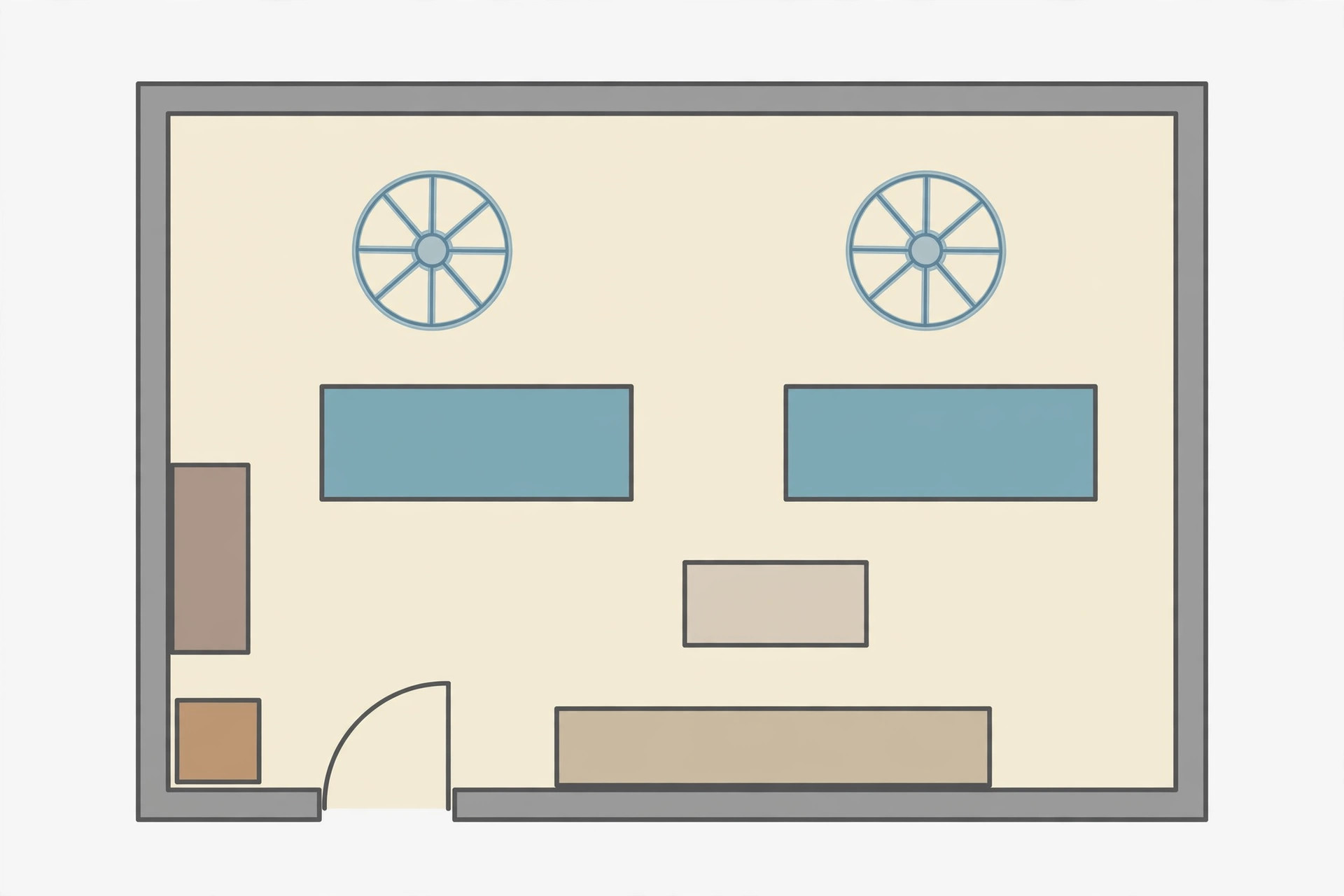
- The thirds rule: divide the hall’s length into three equal parts and place the fans at the one-third and two-thirds marks along the central axis. This is the single most useful layout rule for two fans.
- Spacing: keep the fans at least 6–8 feet apart, and 2–3 feet away from the nearest wall.
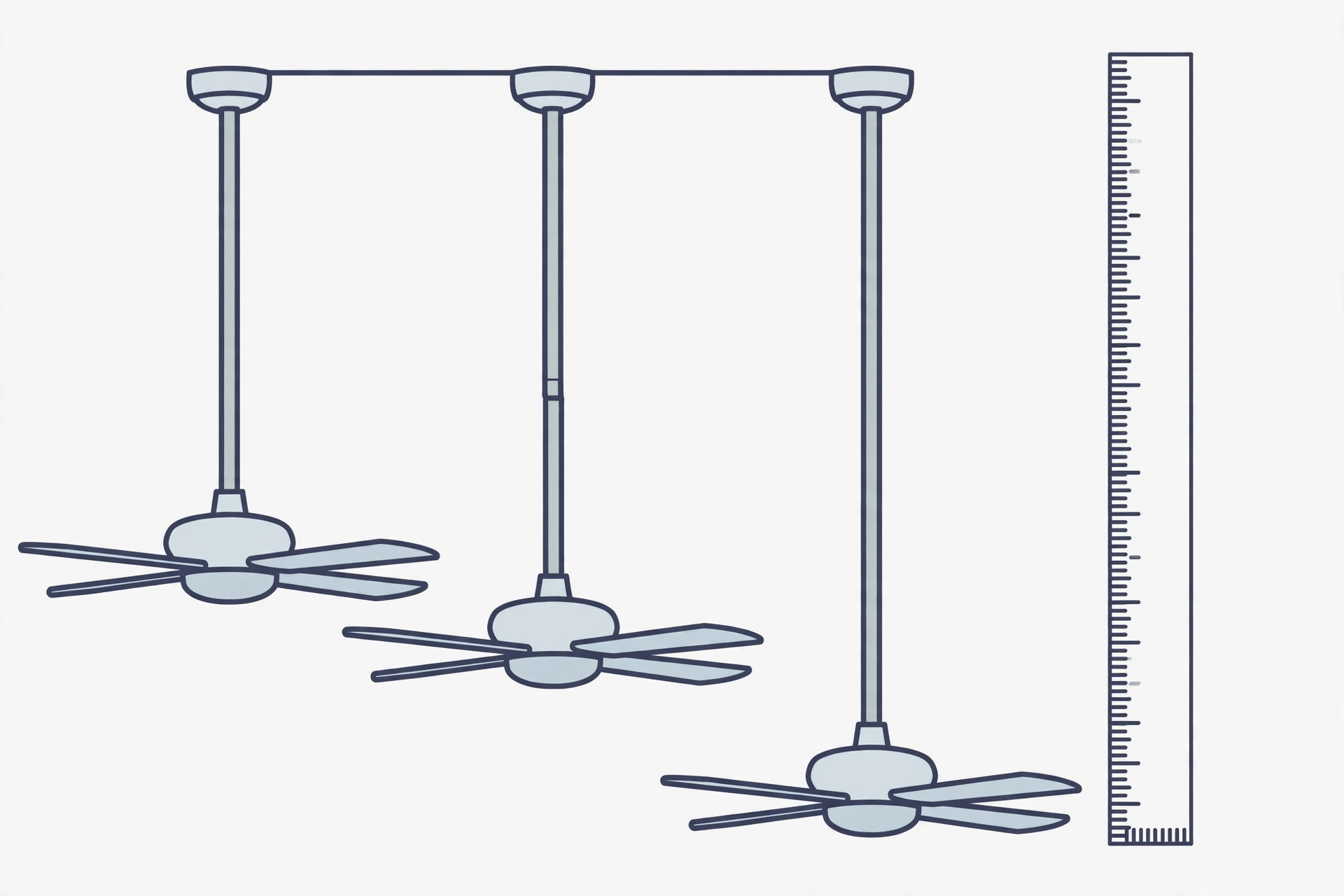
- Height: fan blades should hang at least 7 feet above the floor. In halls with 10 ft+ ceilings, use a longer downrod so the fan sits in the air it needs to move.
- Sweep: for halls of 200–400 sq ft, a 1,200 mm (48-inch) sweep per fan is the standard recommendation; above 400 sq ft, consider 1,400 mm fans.
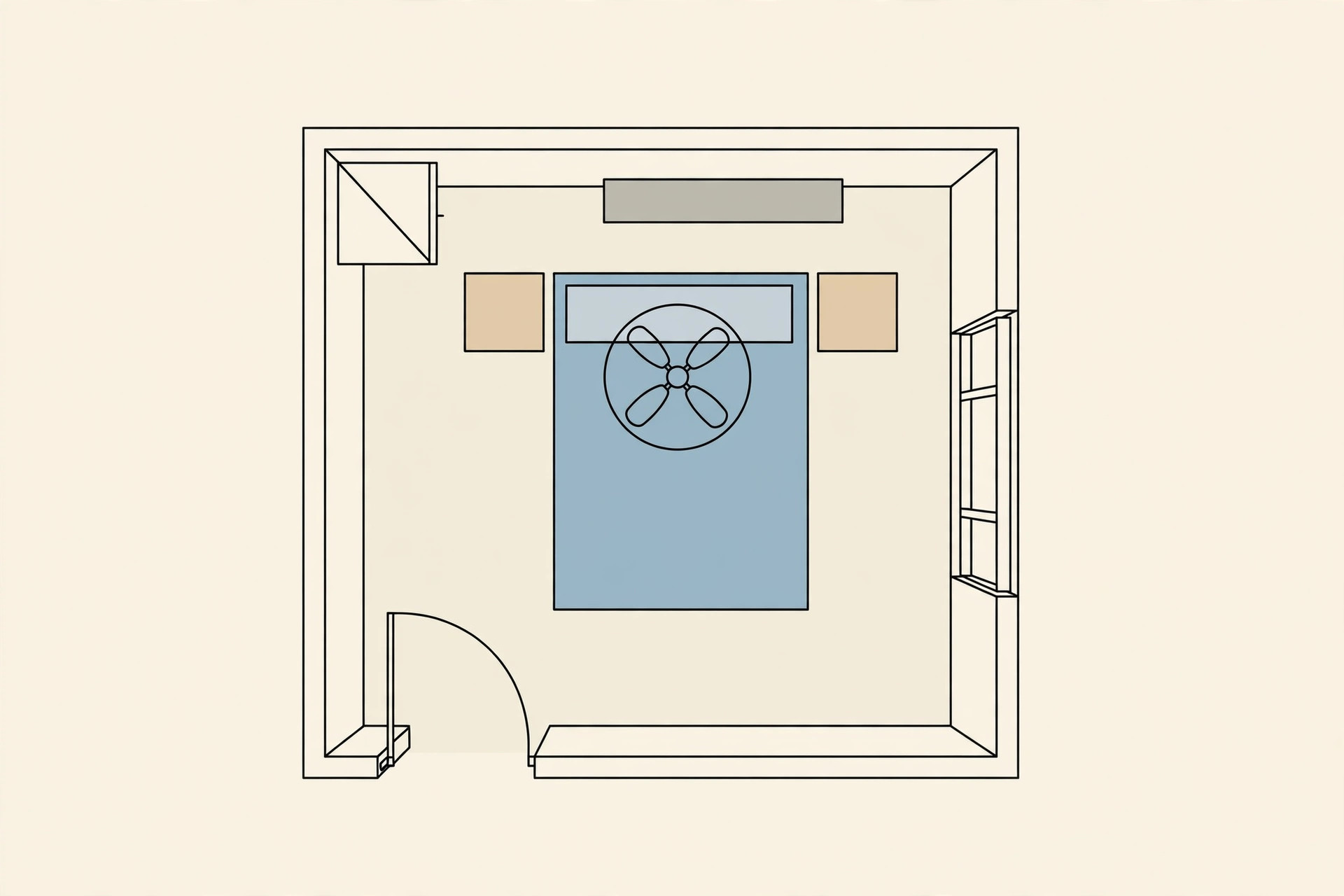
- Not over heads: position fans to circulate air over the seating zone, not directly above where people sit for hours.
In a 12-foot-wide hall, one designer’s rule of thumb puts each fan centre about 4 feet from its side wall — equidistant spacing that reads as intentional symmetry.
Layout ideas that make two fans look deliberate
The trick behind every good two-fan ceiling is the same: give each fan a frame — a medallion, a panel, a tray zone — so the pair reads as a designed composition rather than two holes in a slab. The ideas below are adapted from the layouts Indian interior guides return most often for this exact search.
Flat ceiling, symmetrical fans
The simplest and cheapest: a single-level flat POP or gypsum ceiling, two fans on the thirds, recessed LED downlights distributed evenly. It suits compact halls under 250 sq ft and standard apartments. Per NoBroker’s 2025–26 cost bands, simple flat POP runs about ₹75–₹95 per sq ft (POP only, before fans).
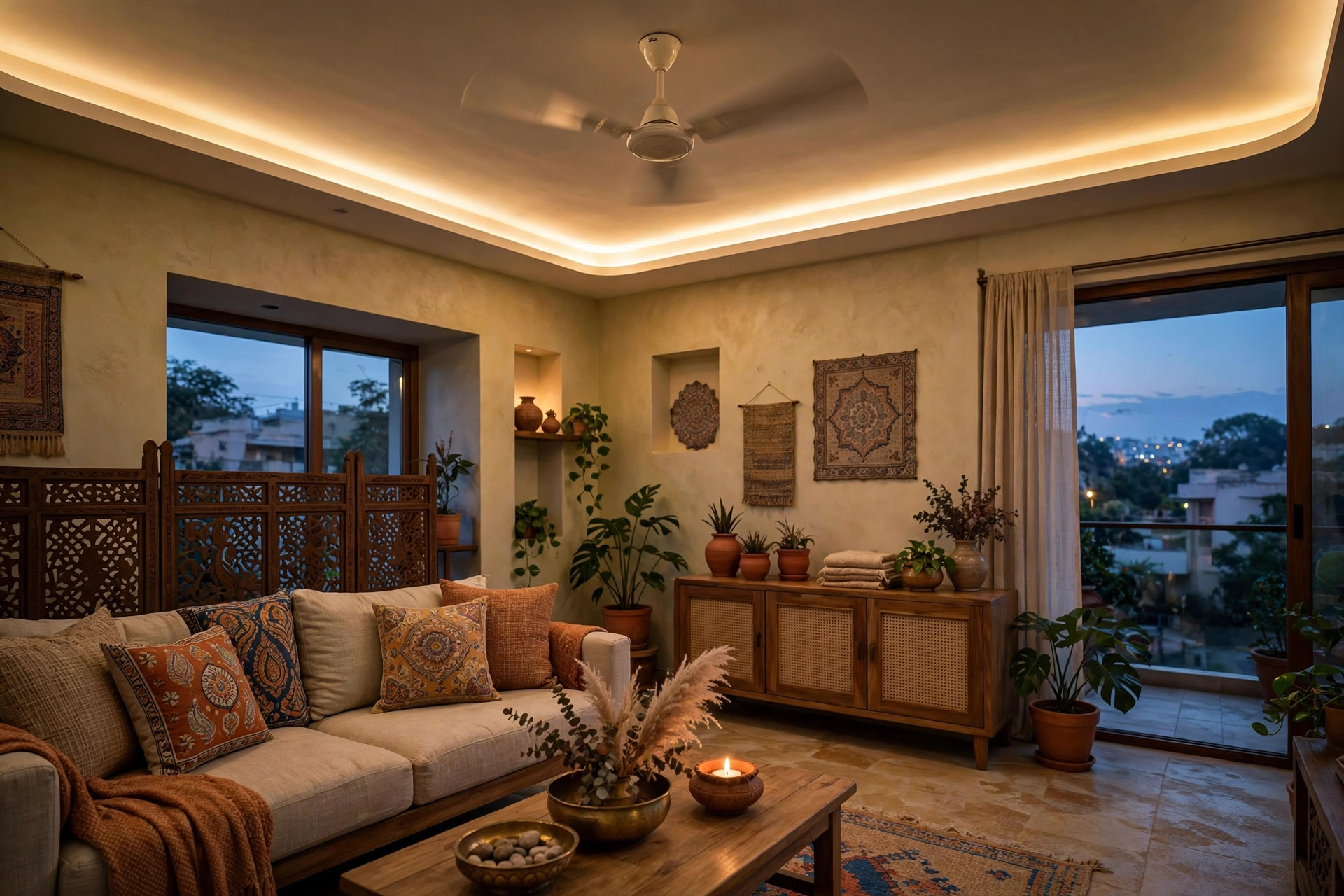
Double cove with a central fan band
A two-level ceiling with a perimeter cove, the fans sitting in the flat central band between the cove borders. Warm indirect light washes up from the cove; the fans stay clear of it. The most popular two-fan look in Indian living rooms, at roughly ₹95–₹115 per sq ft for the POP work.
Circular medallions around each fan
A decorative circular POP frame or medallion centred on each fan. Traditional and Indian-contemporary homes use this most; it turns each fan into a deliberate focal point. Roughly ₹95–₹120 per sq ft.
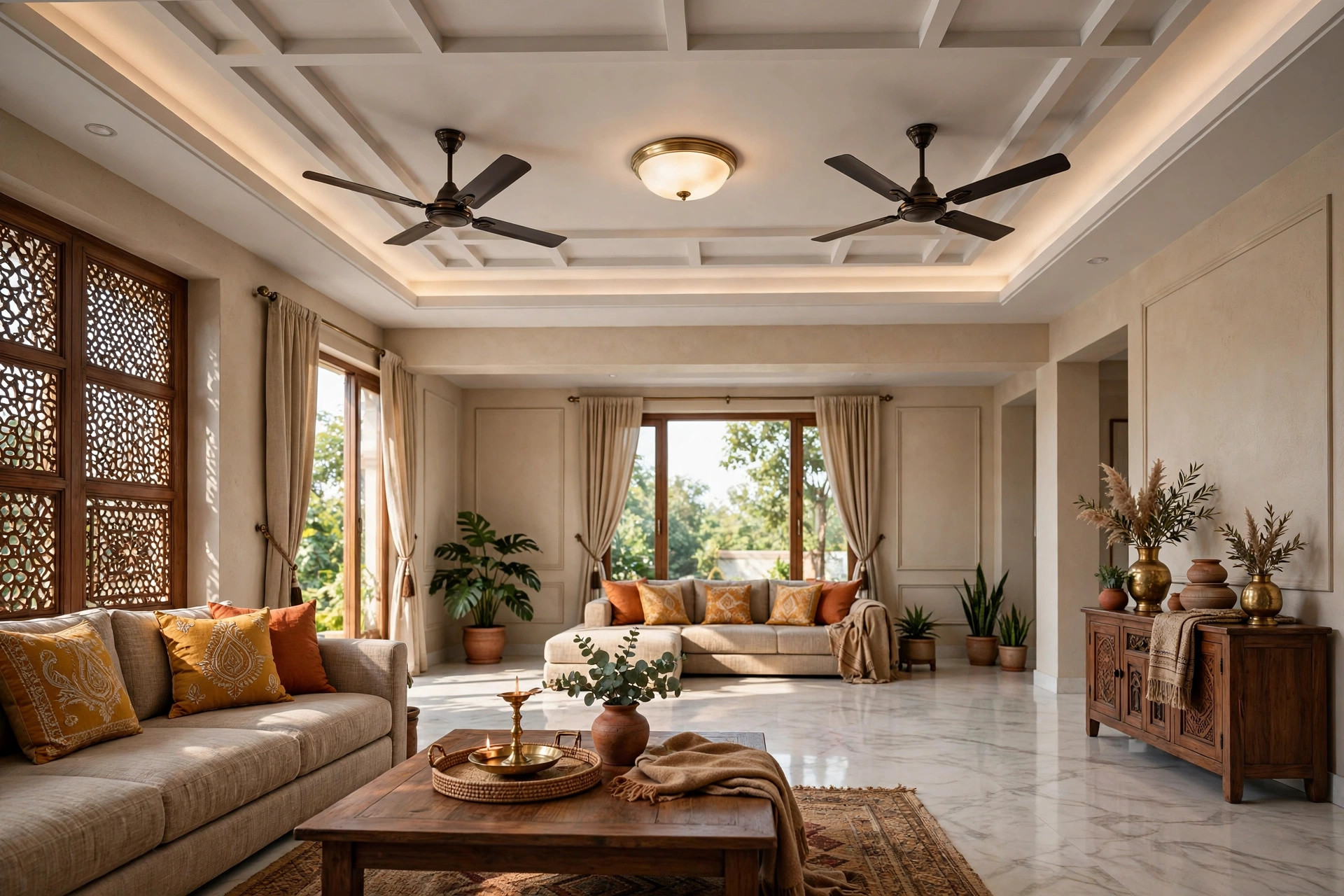
Tray and coffered layouts
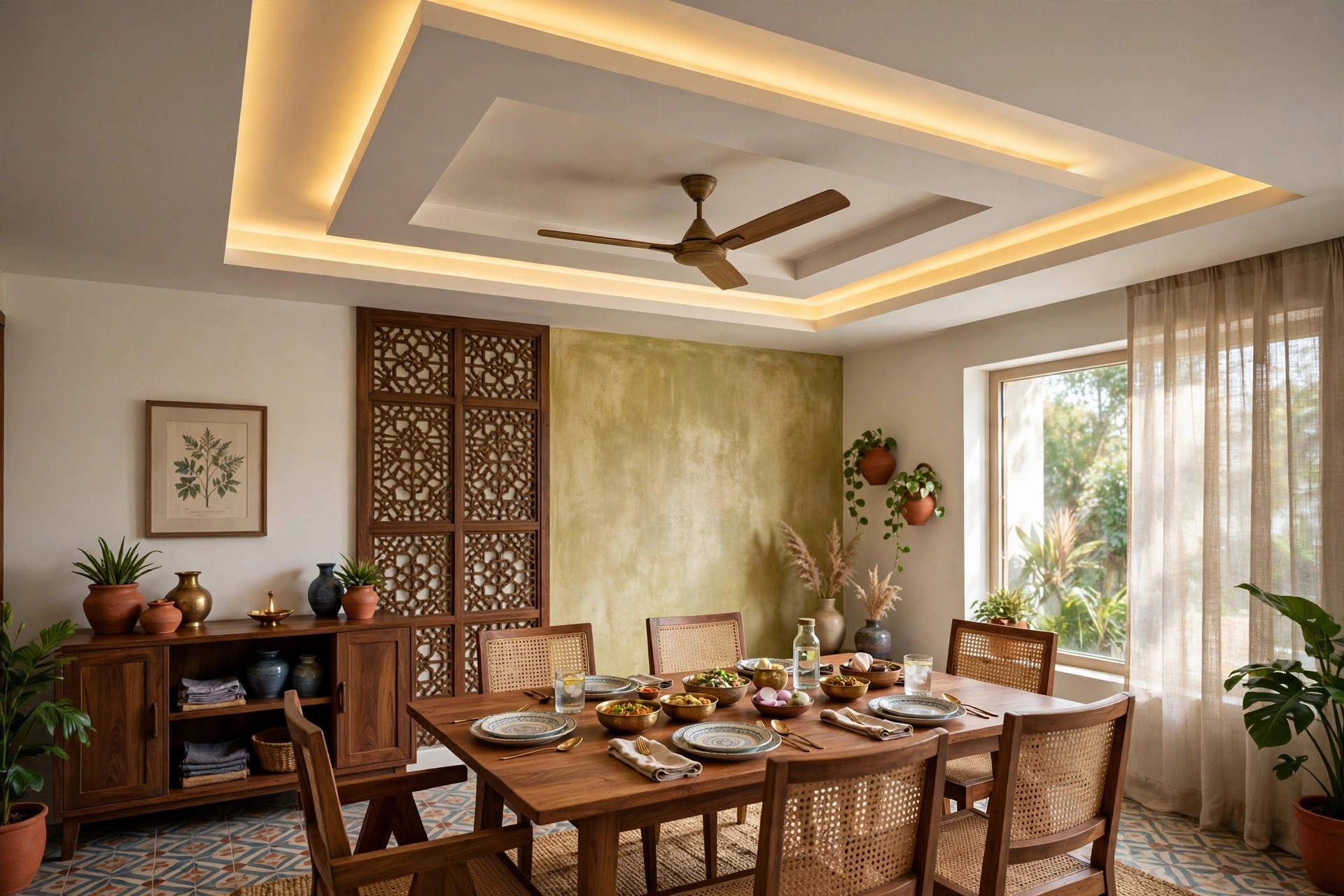
In a tray ceiling, both fans sit in the raised central tray while the step-down border carries the cove — best for halls with 10 ft+ ceilings (about ₹100–₹120 per sq ft). In a coffered ceiling, the two fans occupy adjacent central coffers of the recessed grid (about ₹110–₹130 per sq ft, the premium end). Both belong to the shaped-ceiling family described in the overview of false ceiling designs.
Geometric and plus-minus panels
Angular shapes — squares, rectangles, hexagons, or the alternating raised/lowered “plus-minus” step pattern — with each fan centred in its own frame. Contemporary and bold; roughly ₹100–₹125 per sq ft. Alignment is everything: a fan canopy sitting off-centre in its geometric frame ruins the effect.
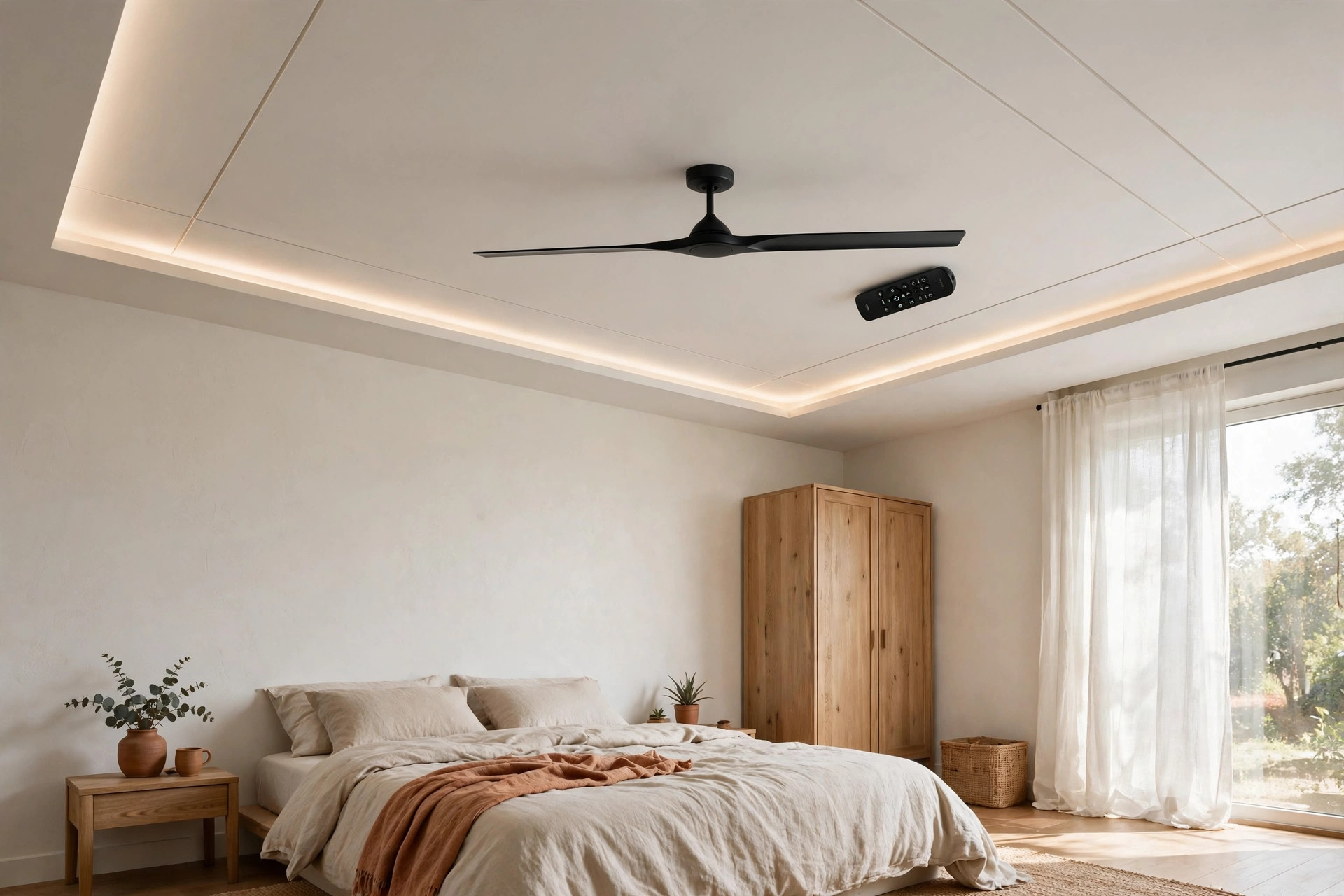
Minimalist: slim fans, clean ceiling
A single-level ceiling with flush edges, minimal spotlights, and two slim-profile or BLDC designer fans. The fans become the design statement. Suits urban apartments; about ₹80–₹100 per sq ft for the POP.
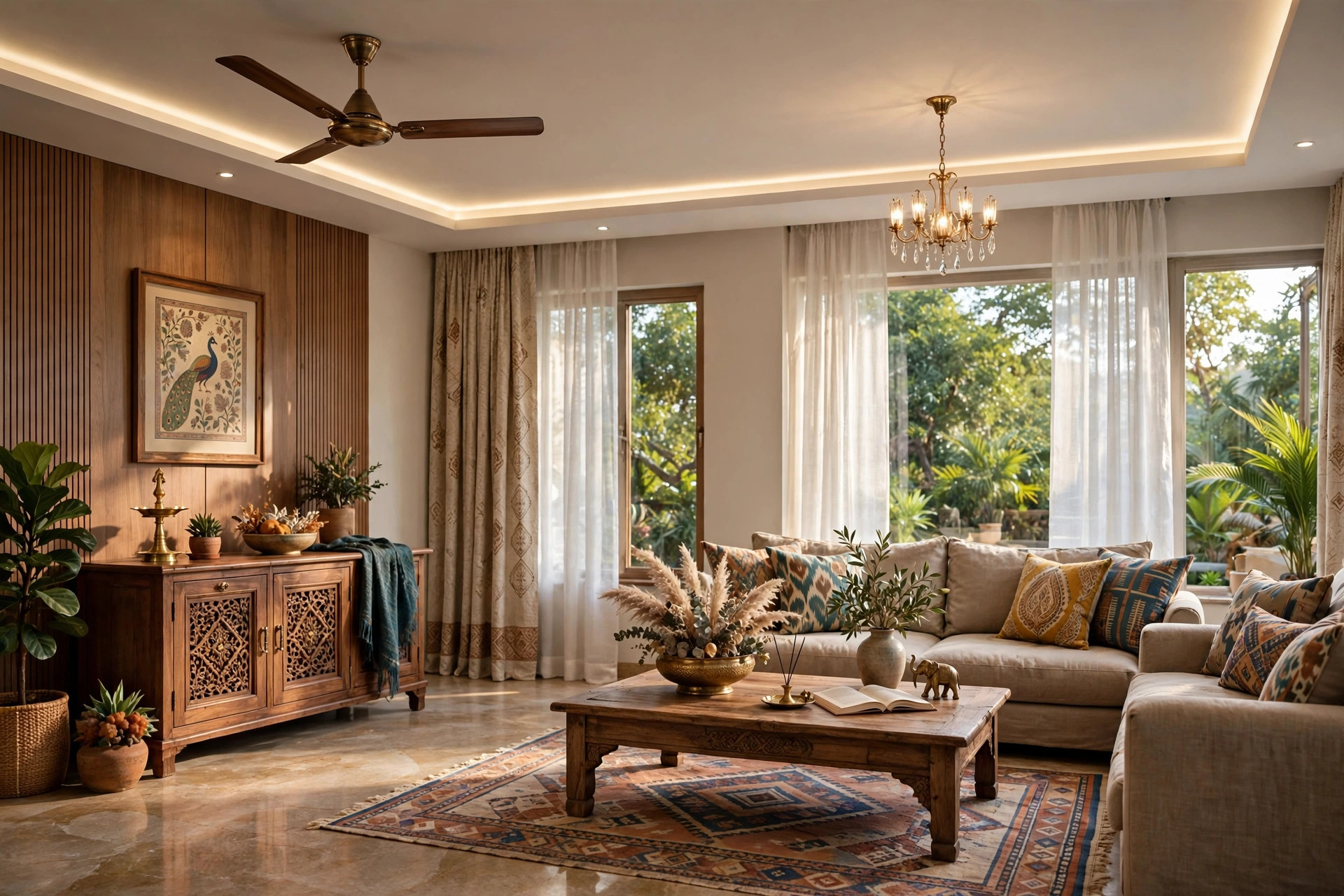
Fans plus lights: plan them together
Two fans plus a chandelier plus cove plus spotlights is how ceilings become cluttered. Decide the hierarchy: fans for air, one statement light (a central flush-mount or a chandelier between the fans) for focus, and cove or spots for ambience. Never let a spinning fan blade cross a hanging pendant’s drop zone. The full fixture logic is in the false ceiling lighting guide.

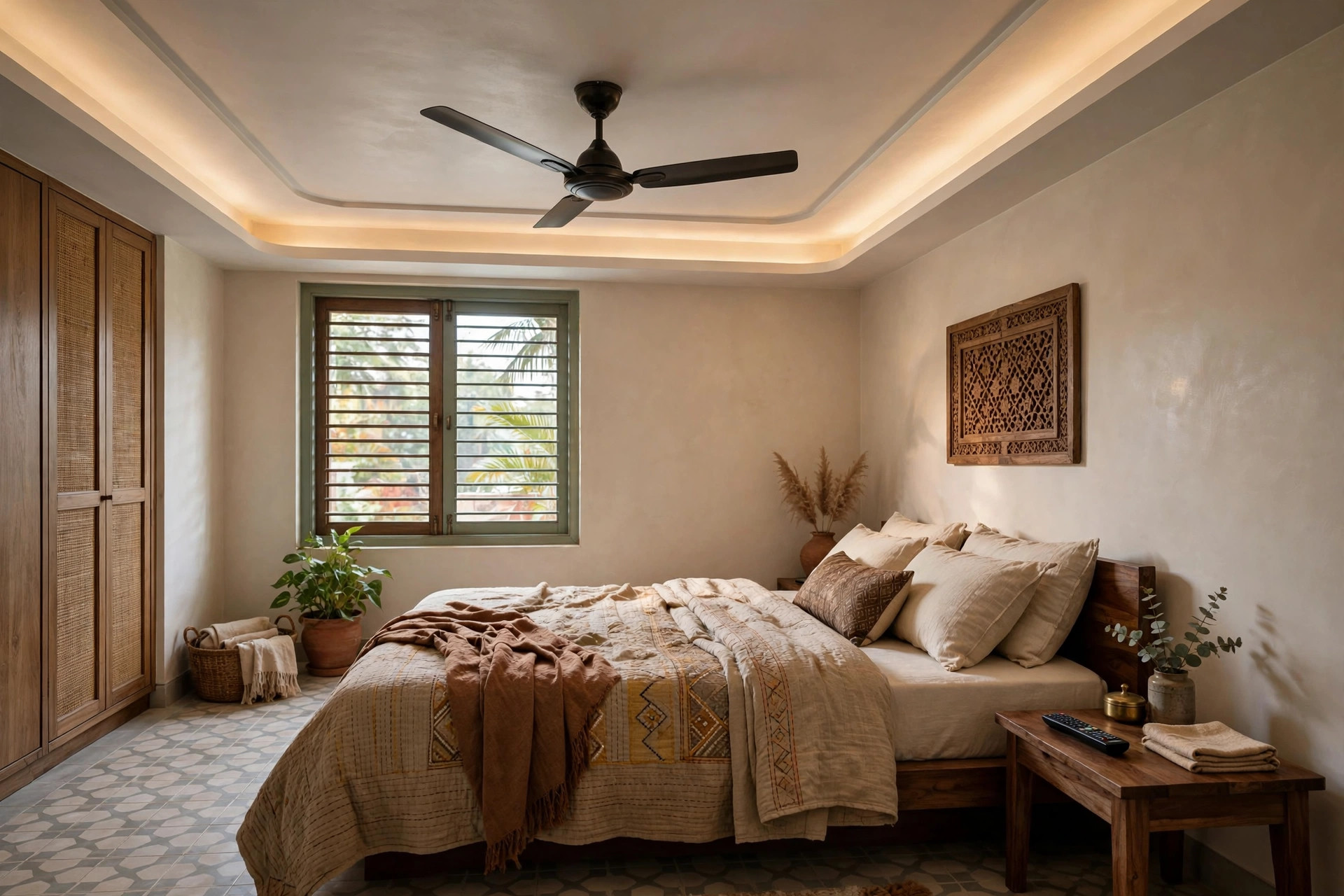
Safety: how a fan must hang from a false ceiling
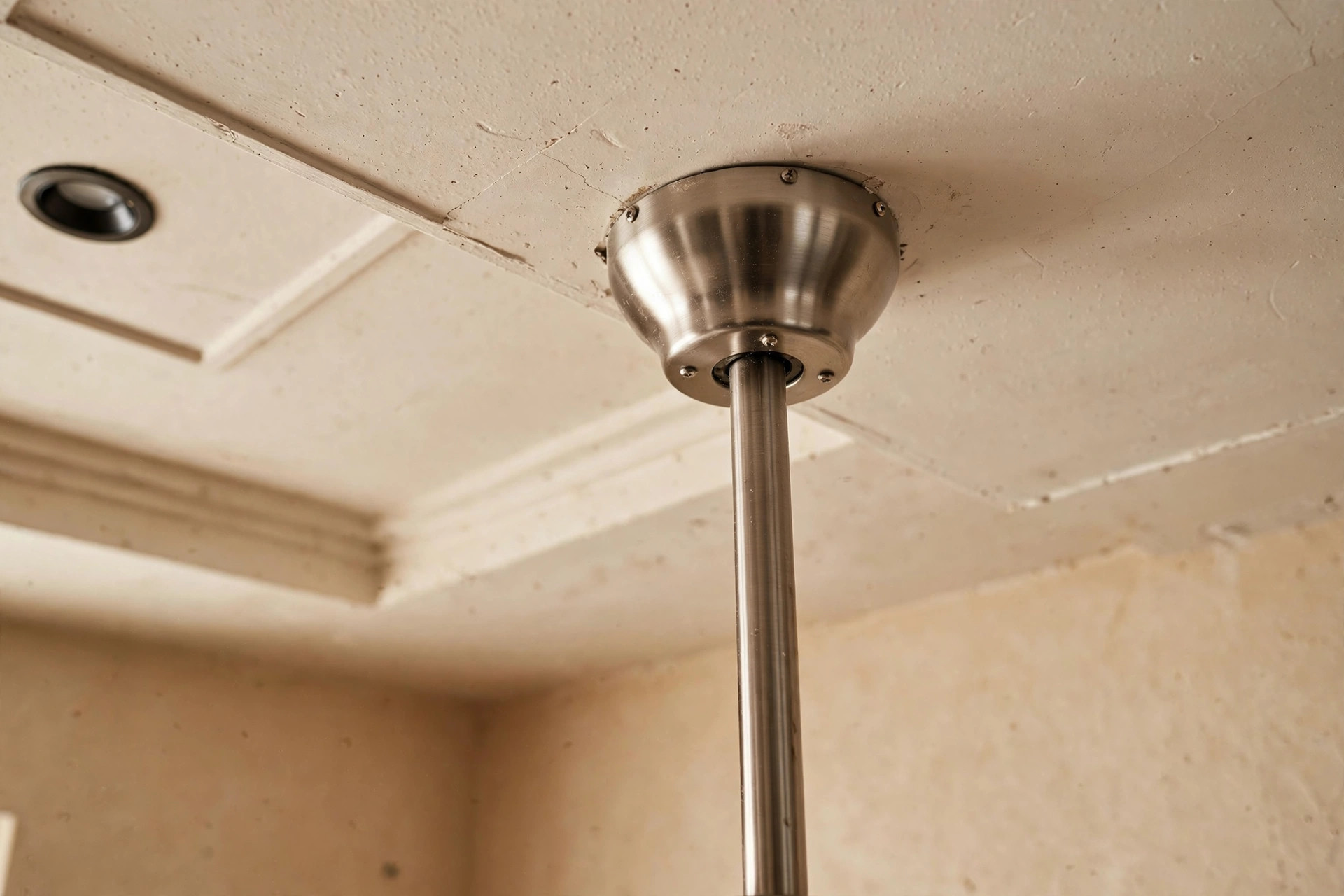
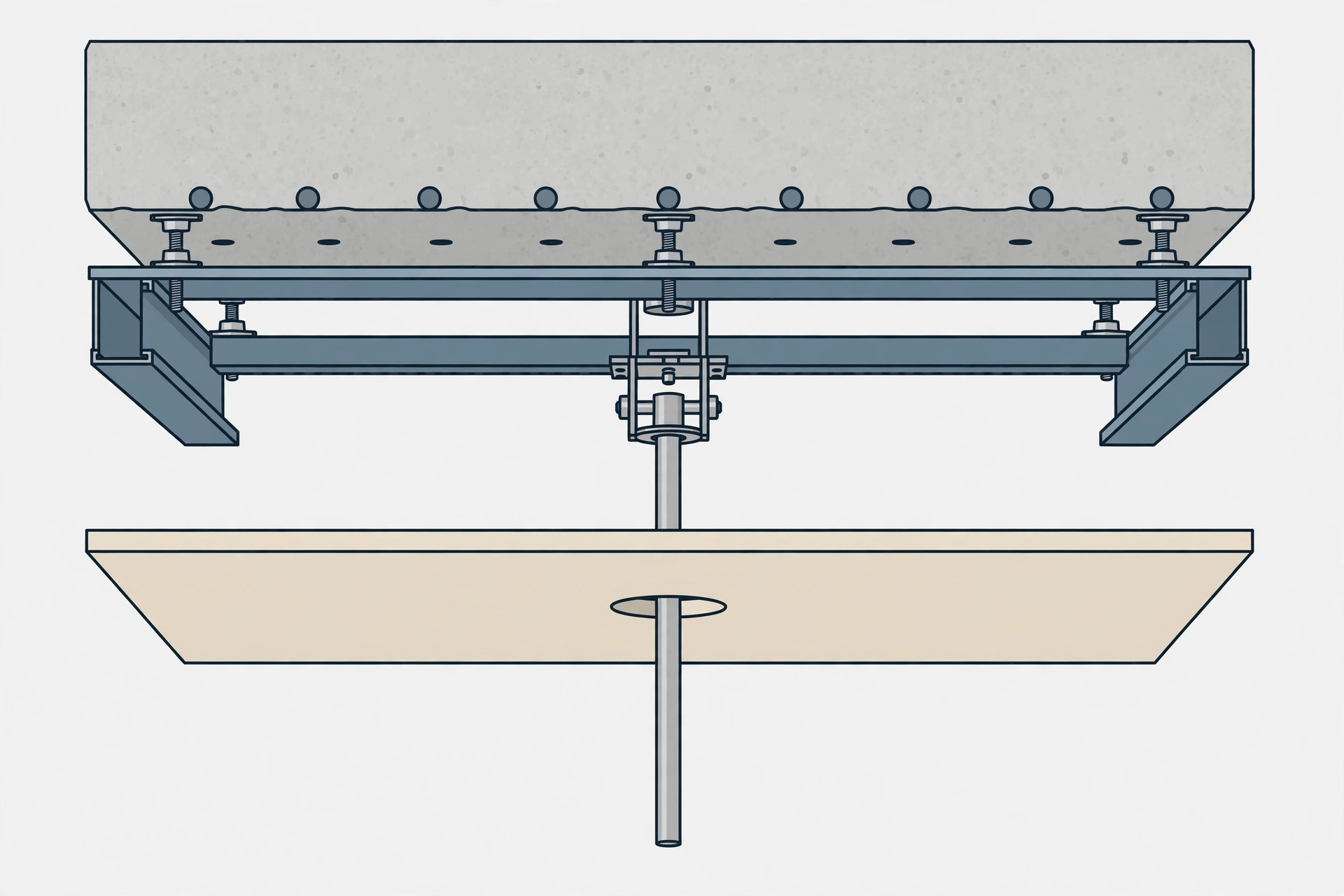
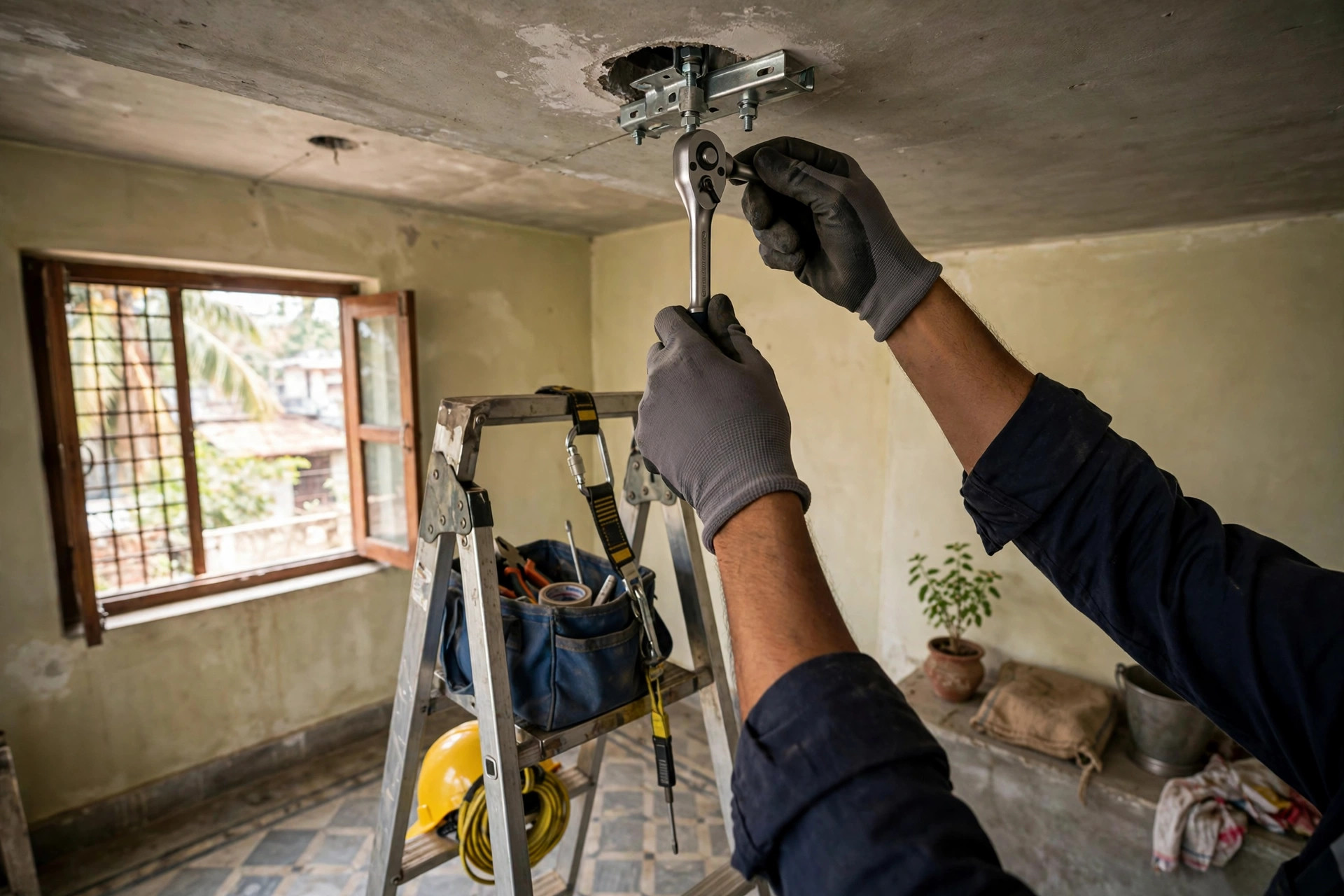
This is the section most design guides skip, and it is the most important one on this page. A ceiling fan is a heavy, vibrating machine. It must hang from the structural slab above — never from the false ceiling board alone. The standard method is a rod or hook fixed into the concrete slab that passes through a neat cutout in the false ceiling, with the fan’s canopy covering the opening. As one Indian ceiling-solutions FAQ puts it: the fan needs drop-down anchors and a threaded rod so it is suspended off the real ceiling, bridging the gap the false ceiling creates.
What this means in practice:
- Plan fan positions before the ceiling is built. The anchor points go into the slab first; the false ceiling is cut around them later. Adding a fan after the ceiling is finished is possible but messier.
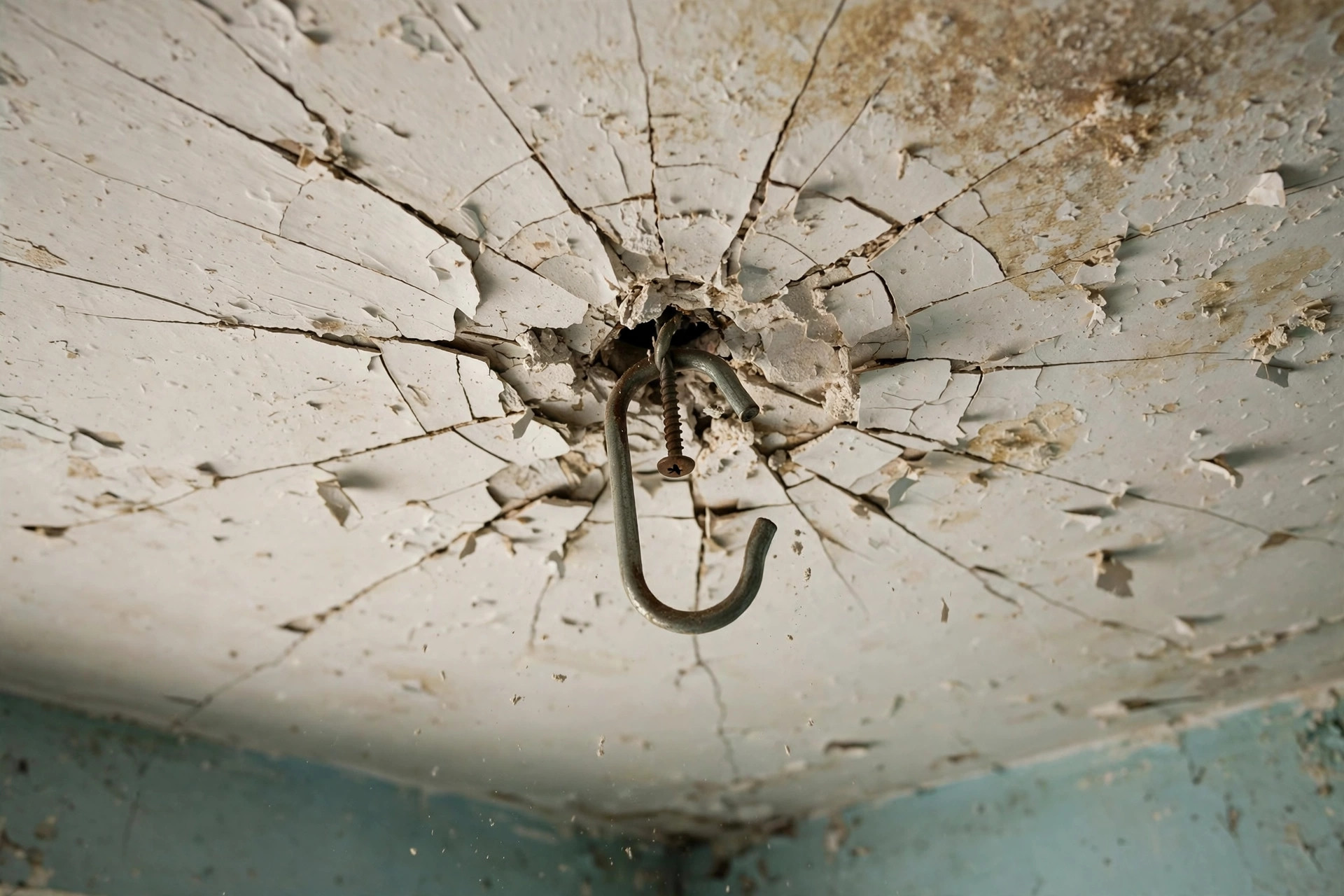
- Never screw a fan mount into gypsum or POP board alone. The board carries the ceiling’s own weight and light fittings — not a spinning fan. Cracked board around a fan mount is a warning sign, not a cosmetic issue.
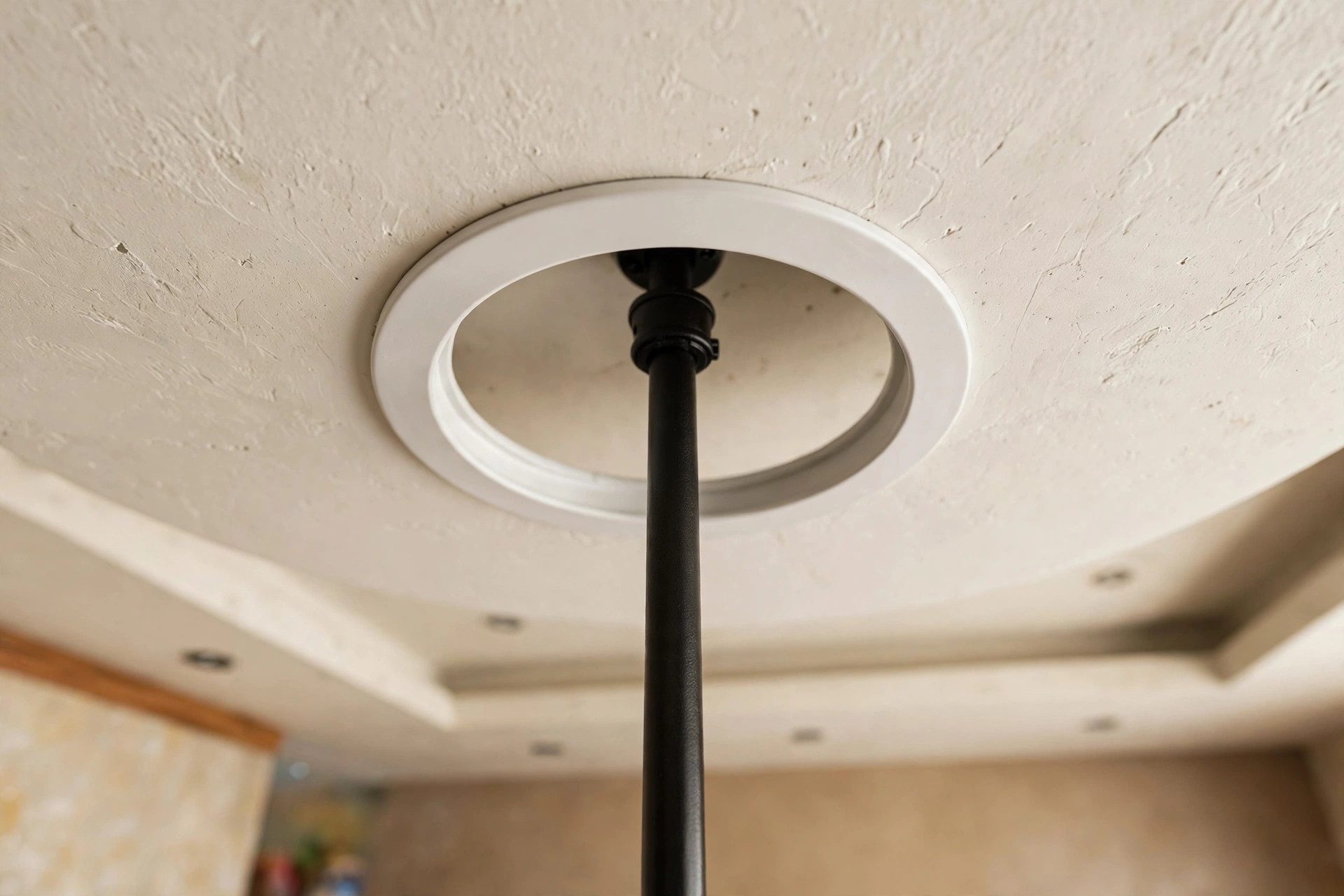
- Keep the cutout neat. A clean circular cutout with a finishing ring looks intentional and keeps dust out of the ceiling void.
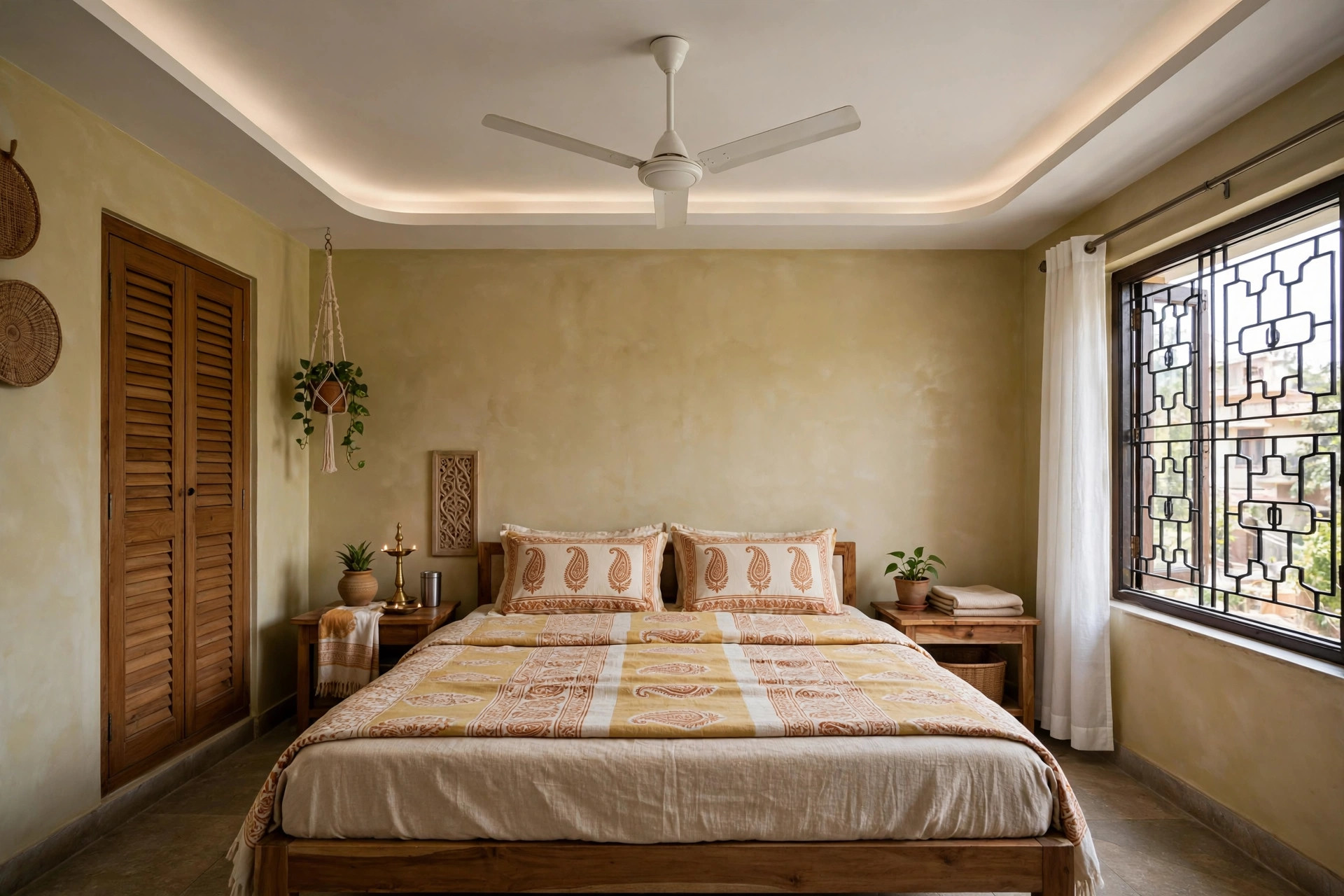
- Wobble is a signal. A fan that wobbles was either badly balanced or badly mounted. Get it checked rather than living with it — and never fit a fan through a patterned jali or CNC-cut panel, where the blades fight the cutwork.
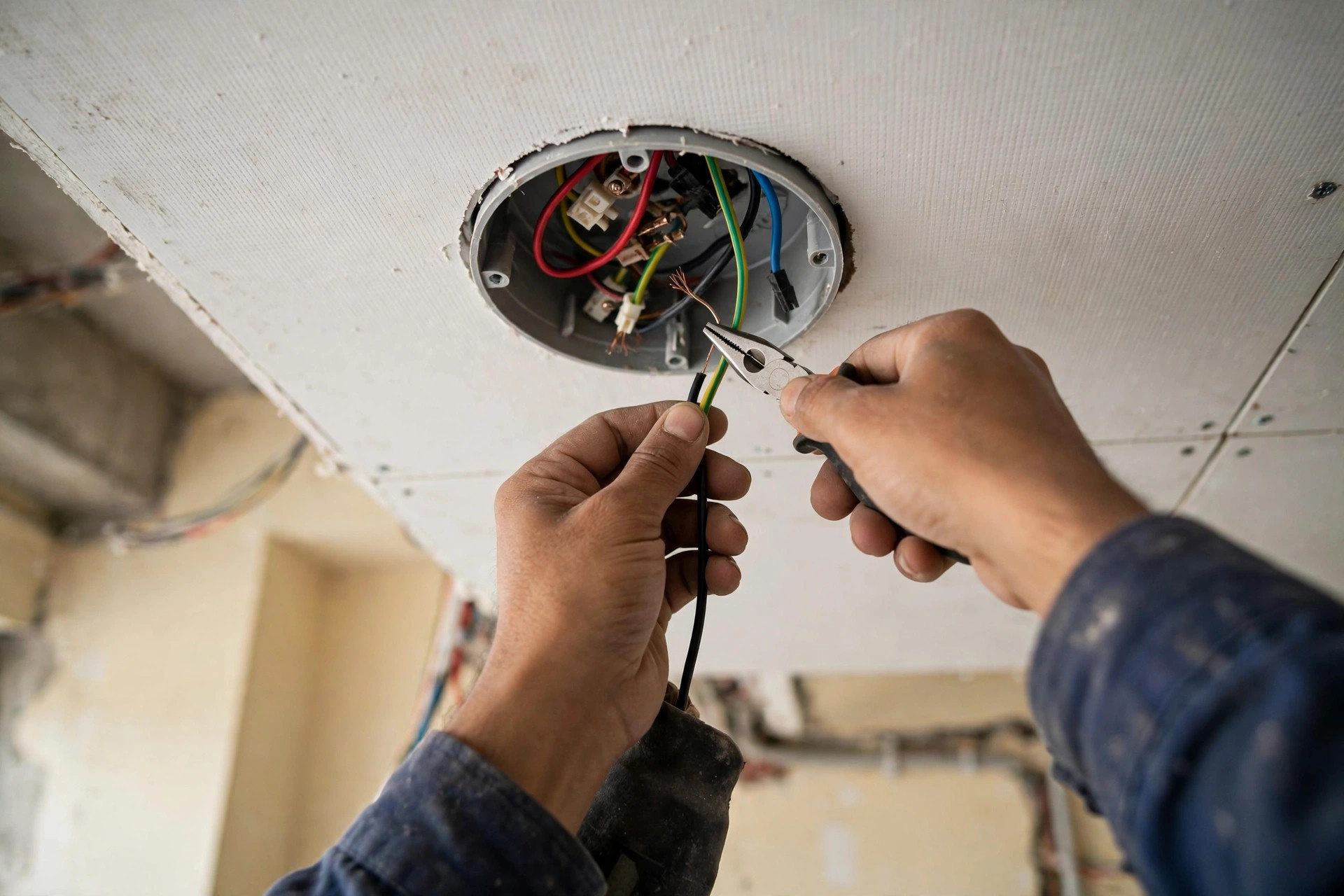
- All electrical work belongs to a qualified electrician. Wiring, regulators, and junction boxes above a false ceiling are not DIY territory. This guide does not give electrical instructions.
These are general principles, not engineering specifications. For the actual mounting hardware and method in your home, your contractor and electrician decide — ask them to show you the slab anchor before the ceiling boards go up.
Special cases
Kids’ rooms
Bunk beds put children closer to the blades. A protective wire guard cage over the fan is the cautious option, and hugger mounts keep blades tight to the ceiling. The kids’ room ceiling guide covers the room side of this.

High ceilings
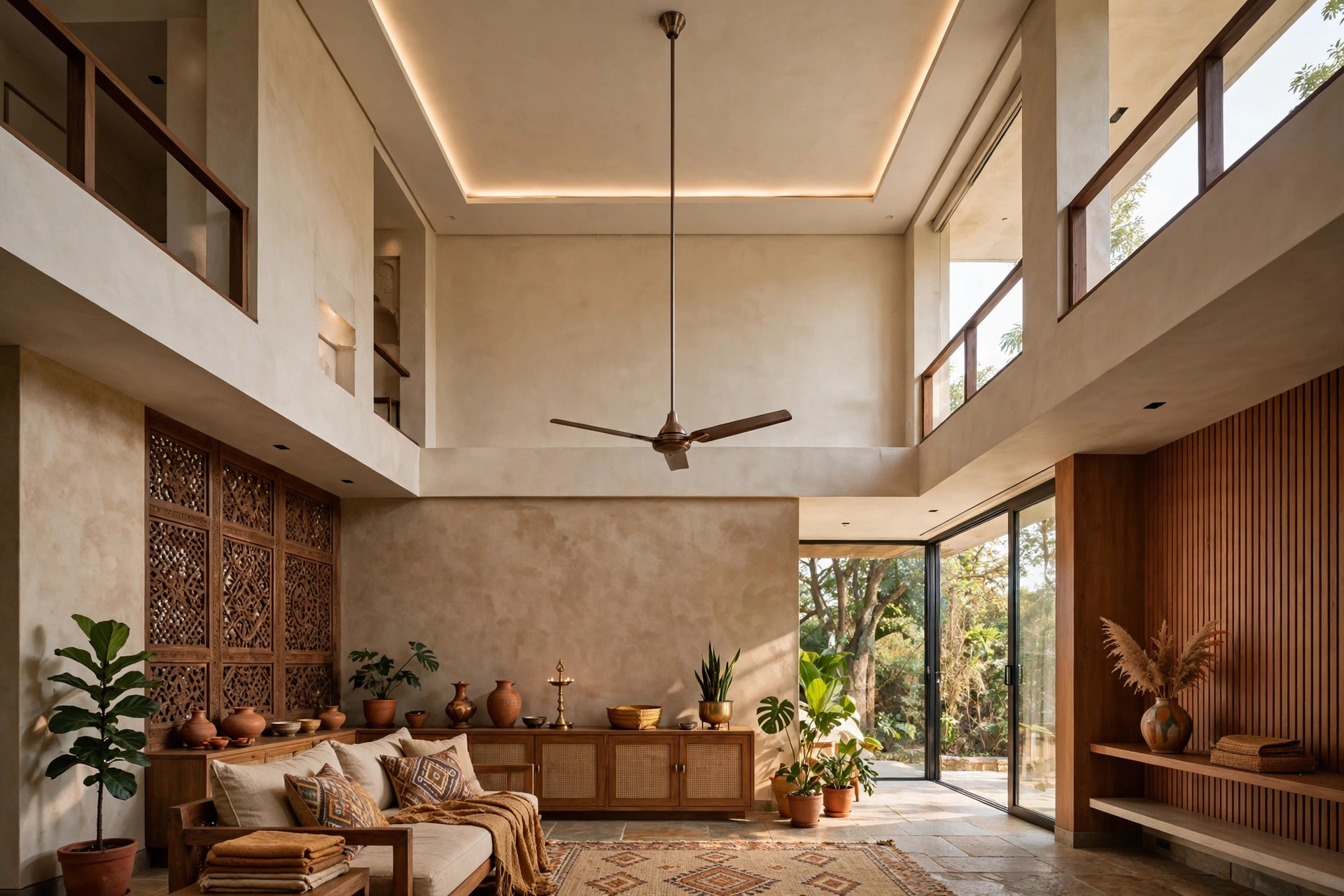
In double-height halls, a standard rod leaves the fan stranded near the slab. Longer downrods bring the blades into the occupied air. This is a normal, off-the-shelf part — not a custom job.
Balconies and outdoor areas
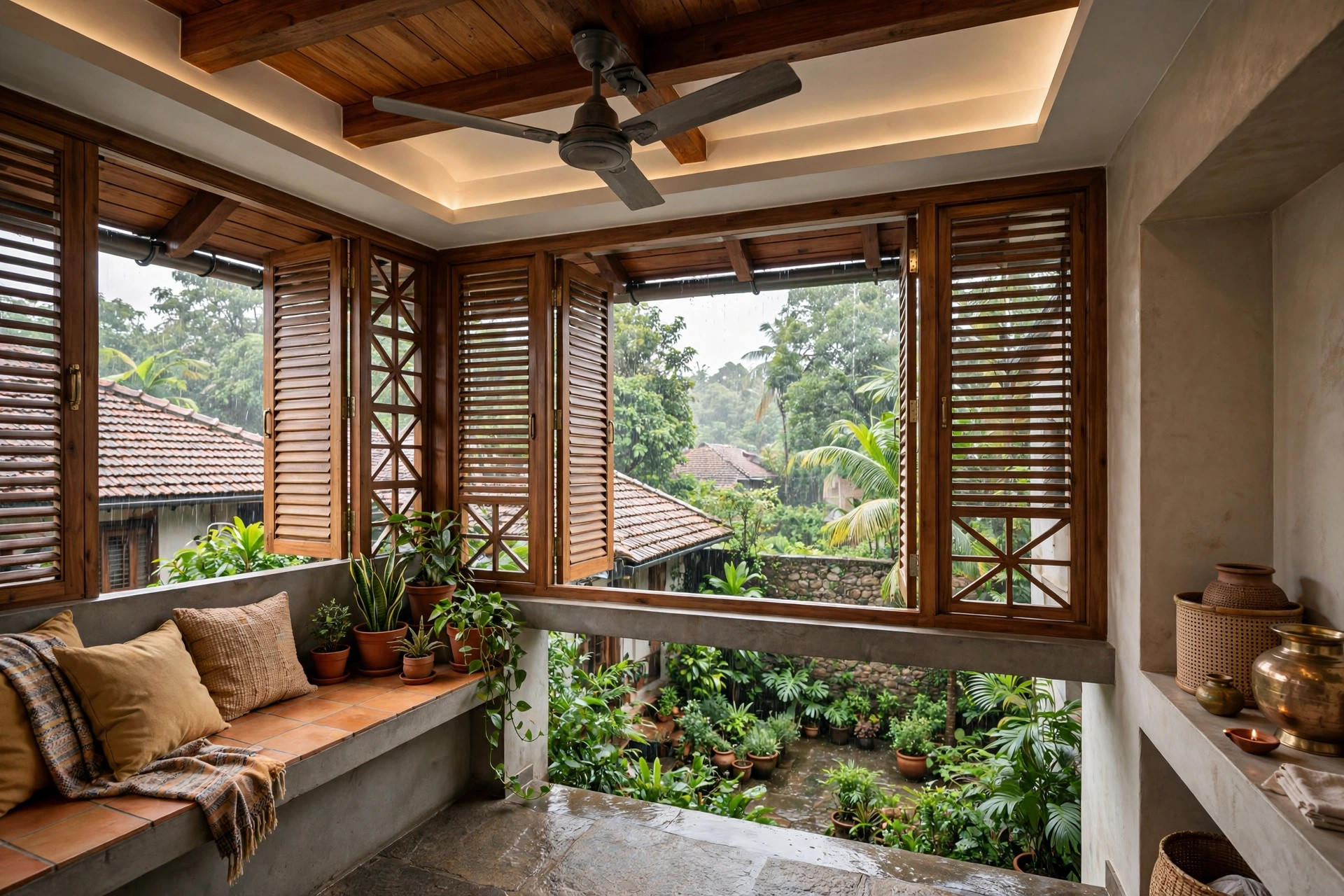
Covered balconies can take a fan, but it should be a weather-rated outdoor fan — standard indoor fans corrode. Pair with a moisture-tolerant ceiling; the balcony ceiling guide covers the options.
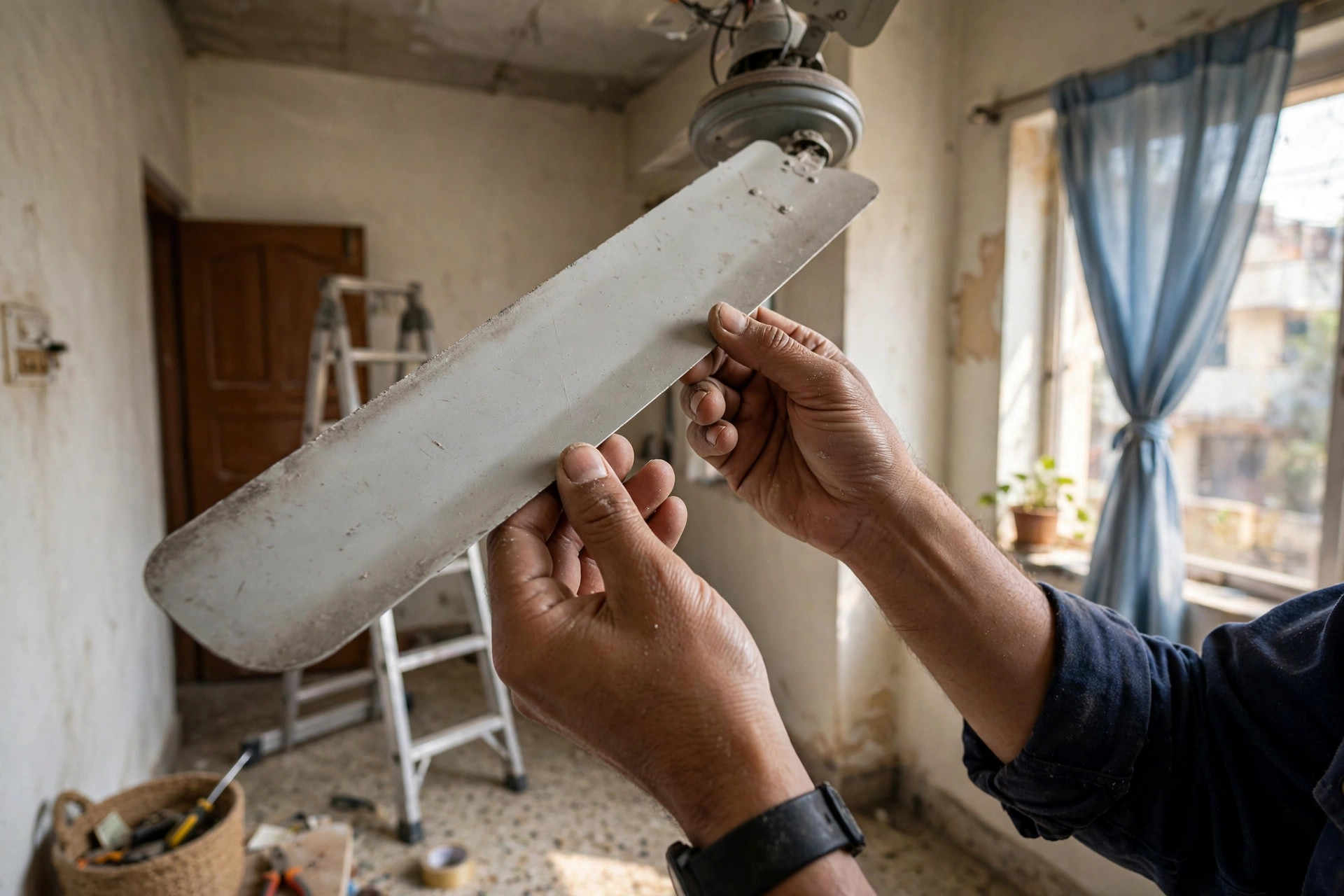
Choosing the fans: a quick buyer’s note
NoBroker’s 2026 guide organises hall fans into three tiers that are useful for budgeting (prices per fan, 2025–26):
- Budget (₹1,200–₹2,500): standard 3-blade, 1,200 mm sweep. Moves air; nothing more.
- Mid-range (₹2,500–₹6,000): decorative or BLDC fans with remote. Quieter, and NoBroker’s guide describes BLDC models as 30–40% more efficient.
- Premium (₹6,000–₹15,000): designer BLDC, smart, silent models.
Two fans double the fan budget: ₹2,400–₹5,000 at the budget end, up to ₹12,000–₹30,000 premium. Match the fan finish to the ceiling — white fans on white POP, dark fans on dark panels — and keep both fans identical. Mismatched fans are the fastest way to make a two-fan ceiling look accidental.
What the whole project costs
For a 300 sq ft hall, NoBroker’s 2025–26 planning bands (POP work only, excluding 18% GST, labour typically included; metros run 10–15% higher):
- Simple flat POP: ₹22,500–₹28,500
- Cove / two-level POP: ₹28,500–₹34,500
- Geometric / tray / step: ₹30,000–₹37,500
- Coffered / carved motif: ₹33,000–₹39,000
Add the fans (above) and lighting. All-in project bands: roughly ₹25,000–₹35,000 basic, ₹38,000–₹55,000 mid-range, ₹55,000–₹80,000+ premium. For the complete budget picture, see the false ceiling cost guide for India.
FAQs
Can a ceiling fan be mounted on a false ceiling?
Yes — but the fan must hang from the structural slab above via a rod or hook through the false ceiling, not from the POP or gypsum board. Plan the anchor points before the ceiling is built.
How far apart should two fans be in a hall?
The standard guidance: divide the hall length into thirds, place fans at the one-third and two-thirds marks, keep them 6–8 feet apart and 2–3 feet from walls.
Is it safe to hang a fan from a POP ceiling?
Only if the mount goes through the POP into a slab anchor. The POP board itself cannot carry a fan. If someone offers to screw the mount into the board alone, that is the moment to stop and get a second opinion.
Should the fan be directly above the sofa?
Guidance says no — circulate air over the seating zone rather than directly above seated heads for hours.
Do I need an electrician or can the POP contractor do the wiring?
Get a qualified electrician for all wiring, regulators and junction boxes. The ceiling contractor builds the ceiling; the electrician owns everything electrical.
All 22 images in this article are original concept renders and illustrations created for falseceiling.in — they show design ideas, not completed client projects. Cost bands are planning figures from the sources cited, not quotations. Fan mounting and electrical work should be done or verified by qualified professionals.